

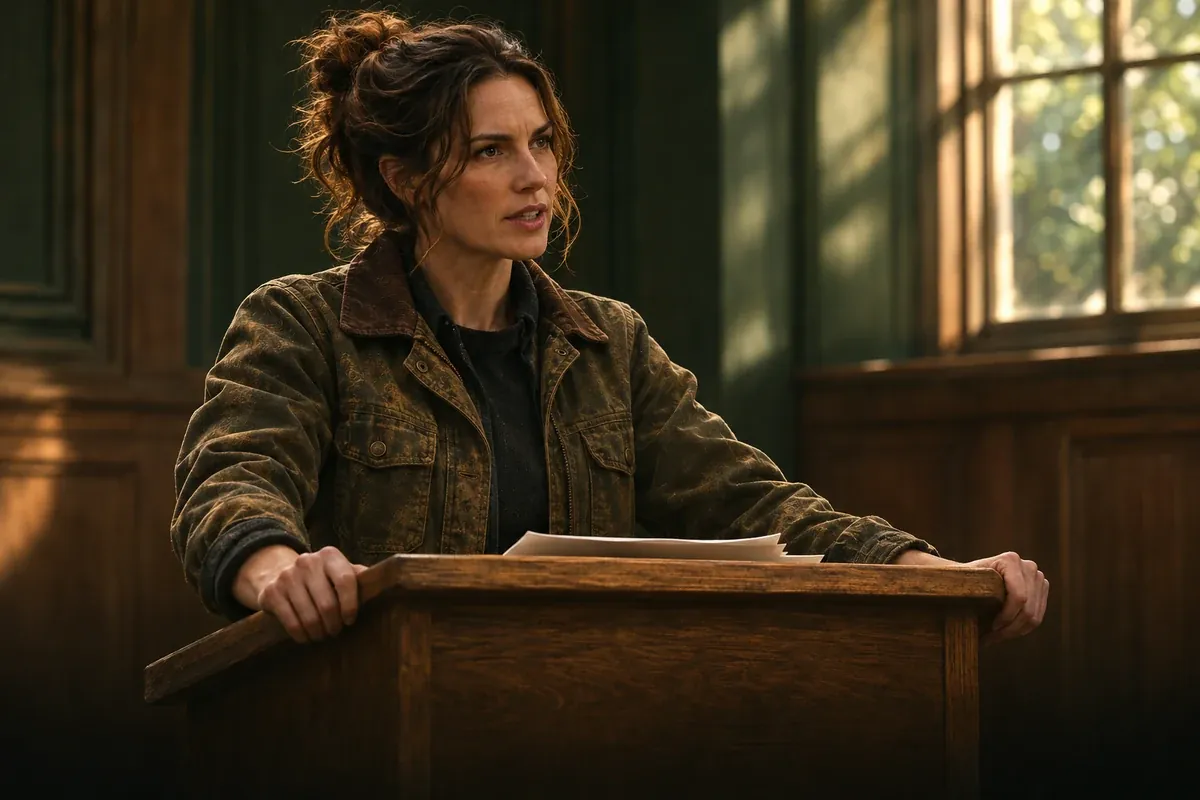
The Lark County commissioners meet in a room built for forty people, which on an ordinary Tuesday holds six. That morning there were two hundred, and the fire marshal, who is also the man who sells propane, stood at the back door with his arms crossed and counted heads like a farmer counting steers through a gate.
I had never seen the chamber so full. Ranchers in clean hats. Women from the Caddisfly in their aprons. A row of loggers from Hollis Timber in matching blue shirts, shoulder to shoulder, with Von at the end of it in a clean shirt and a very straight spine. Harl sat beside her, hatchet-faced, hands folded on his knees. Even Ansel Tolliver had come, in his green vest, glaring at the ceiling as if it had insulted him.
Behind them sat Garrett Voss, in the indoor jacket, relaxed, one ankle crossed over his knee.
The three commissioners came in at ten sharp and took their seats behind a long oak table that had probably seen the county’s founding. Chair Marjorie Tull was a compact woman in her sixties with reading glasses on a chain, a retired schoolteacher who ran meetings the way she’d run a fourth grade.
To her left was Dennis Aldous, a rancher with a sunburned neck who had signed the Lysark contract on Monday and was looking, now, as if he’d like to explain it. To her right, Bud Haskell, large and rumpled and gray, who ran the feed store across from mine and had once refused to sell me a bag of salt because he said I’d rather have the good kind.
“We’ll take the emergency order first,” said Marjorie Tull. “Dr. Marchand has the floor for fifteen minutes. Public comment follows. Please keep it civil. I taught half of you to read and I’m not afraid to say so.”
A ripple of tired laughter. Marchand rose and walked to the lectern with an easy, unhurried step, carrying nothing but a remote.
I have to say she was good. She was better than I’d feared. She spoke in a clear, warm, unforced voice, without notes, in sentences that sounded like they belonged to the room. She showed a map of the upper drainage in soft greens with a red boundary around it.
She showed photographs of a dead elk, of a coyote with patchy fur, of a graph with a shaded area and a line going up. She said “emerging” four times and never raised her voice. She said “out of an abundance of caution.” She said “we are neighbors.” She said “this is not an accusation, it is a protection.”
“The disease we have observed,” she said, “is a hemoproteopathy affecting wild canids. It is serious. It is spreading. We believe it is transmitted through shared water sources and we believe it can cross to domestic dogs. Several domestic dogs in this county have already shown early markers.” She let that hang. A murmur went through the room, anxious and low.
Half the people in the front rows had brought dogs in their trucks that morning. “We can contain this. We can contain it quietly, and cheaply, and with no harm to anyone’s livelihood. All we need is for the county to close a limited portion of the upper watershed for thirty days while we sample and map.”
She sat. Applause, scattered and uncertain.
“Thank you, Dr. Marchand,” said Chair Tull. “Public comment. Please state your name and, if you’re speaking as a professional, your license.”
I stood up. My knees held. The room went quiet around me in a way I felt in the back of my teeth.
“Rowan Mercer,” I said. “Doctor of veterinary medicine. Montana license number” and I gave it, the numbers ringing flat in the chamber like dropped coins. “I own Mercer Veterinary on Route 11. I’m the only veterinarian in this county practicing large and small animal medicine, and as far as I can tell, the only one the statute Dr. Marchand cited would recognize.”
“Go ahead, Doctor,” said Haskell, leaning forward, and for the first time since Teddy’s office I felt a thread of something that might have been hope.
I walked to the lectern. I laid my pages out on it, in order, with the blue graph on top. My hands didn’t shake. I told myself that was a good sign and tried not to look at what it meant.
“I’ll be brief,” I said, “because Dr. Marchand has set the terms, and she’s right about one thing. Something is wrong in the upper drainage.” I heard a stir behind me. “In the last week I have examined a number of animals in the Carrow Creek area. I have drawn blood. I have submitted samples, anonymized, to a state diagnostic laboratory under a research request. I am not here to tell you what that laboratory found in the animals.” I breathed. “I’m here to tell you what it found in the water.”
I put the blue graph on the document camera and it came up on the wall-sized screen behind the dais. Three bars, each three times taller than the last. TAP. INTAKE. LANDING.
“A protein is present in the surface water of upper Carrow Creek that is not native to any organism in the reference database,” I said.
“It carries a six-histidine purification tag, which is a feature of laboratory production. I’d describe it as recombinant. Its concentration rises as you move upstream. It enters the water in pulses, roughly eight weeks apart. It is present at the tap in the town of the Landing at a very low level, and at the old logging landing four hundred times higher.” I paused. “That is not a wildlife disease. A disease does not keep a calendar. Something is being added to the creek.”
The room had gone so quiet that I heard the old radiator knock under the window.
“That’s speculation,” said a voice from the back. It was a man in a suit I didn’t know, who’d stood up with a leather folder. “Madam Chair, I represent Lysark Bio. Dr. Mercer has made serious claims about a regulated protein with no supporting documentation.”
“I have the documentation,” I said. “Chain-of-custody forms for each sample, photographs of the collection sites, GPS coordinates, and the laboratory’s preliminary report. I will submit them to the clerk today. I will also submit a formal request that the county sheriff and the state Department of Environmental Quality inspect the upper creek for a source.”
“Madam Chair—“
“Sit down, counselor,” said Marjorie Tull, without looking up. “You’ll have your turn. Dr. Mercer, continue.”
I lifted my chin. “Dr. Marchand says the order closes the upper watershed for thirty days so her team can sample and map. I’d like to ask the commission one question. If the thing in that creek was put there by someone, who gets to decide who is allowed to look for it?”
Nobody answered.
“The statute requires a licensed veterinary diagnosis before a closure of this size. Dr. Marchand has not made one. She has not examined a single patient in this county in a clinical setting. I have. I have not found a disease. I’ve found a contaminant.” I gathered my pages.
“I am the veterinarian of record in this county. My professional opinion is that a quarantine is the wrong response. A water investigation is the right one. And I would ask that the order, if it’s signed, be amended so that any independent investigator is permitted access.”
I stepped back. For three seconds there was nothing. Then the front row of Hollis Timber men began to clap. It was slow and heavy and rhythmic, like a log being set down, and it spread. It didn’t turn into a roar. It was too grim for that. But it filled the room, and when I looked at Marchand, she was smiling with her hands folded, patient as a cat at a mousehole.
Public comment went on for forty minutes. I’d never heard so many people say so much they’d never said before. Dale Whitcomb stood in his EMT jacket, hip creaking, and said that he had worked the harvest festival and had seen a young woman with a nosebleed, and that he had seen what Dr. Mercer did, and that if anyone wanted to call that malpractice they could call him first. Mrs.
Dabrowski rose with her pug in her arms and said, trembling, that she had taken him for the free screening, and the letter had come back saying he was a carrier of “markers,” and she did not know what that meant and nobody would tell her. Old Teague said he had a filly three days old who would not be alive but for Dr. Mercer, and he did not like the idea of a stranger deciding which roads his neighbors could drive.
Then the Lysark lawyer was given his rebuttal, and he used it the way I’d expected. He was a tall, smooth man in a charcoal suit, and he did not look at me when he spoke. He looked at the commissioners, with an expression of grave, almost pained fairness.
“The commission should be aware,” he said, “that Dr. Mercer is currently the subject of a formal complaint before the Board of Veterinary Medicine, for administering a prescription medication to a human being at a public event. I raise this not to impugn her character, but because her professional judgment is the entire foundation of her testimony.”
A murmur went through the chamber. It had a different quality than the others, a small, cold, curious ripple. People who had been on my side a minute earlier were glancing at each other.
I could have sat down. I could have let Haskell or Tull answer for me, or let Teddy stand up and say something sheriff-shaped about due process. Instead I walked back to the lectern and put my hands on its edges. “May I respond?”
“Briefly,” said Chair Tull.
“The complaint is true,” I said. “There is a complaint, and I gave the drug. A woman I’d known for a week was bleeding from her nose and mouth in front of two hundred people and I had one bottle of tranexamic acid in my bag. I told her what it was, I told her what it did, and I asked her. She said yes. The EMT on scene, Dale Whitcomb, who is in this room, can tell you what happened next.”
I turned my head toward the lawyer, finally, and held his eyes. “I’ll answer the board for that. I’m not afraid of the board. I’m only asking this commission to notice who filed the complaint, and when.”
The lawyer’s mouth tightened. “Madam Chair, that is irrelevant.”
“It was filed Sunday morning,” I said, “by the same organization that is asking you to close the creek on Tuesday. It was written, I assume, before the festival ended.”
Silence. Then, from the third row, someone coughed, a short barking sound that was probably a laugh. Haskell leaned forward on his elbows and said, to nobody in particular, “Huh.”
“Thank you, Dr. Mercer,” said Marjorie Tull. She said it very evenly, with her glasses in her hand. “That will be all.”
I went back to my seat. My knees were water. Dane’s fingers brushed the back of my hand, once, so lightly that I could have imagined it.
Two other voices stood out. A young woman I didn’t know, with a baby on her hip, said that her father worked up Carrow Creek, and that three men on his crew had been tired since June and hadn’t seen a doctor because the nearest one was an hour away.
And Harl, who rose without being asked and without giving his name, because everyone in the room knew it, said in a voice like gravel in a bucket: “I’ve drunk that creek for seventy-one years. If somebody’s been putting something in it, I want to know who. And I want to know why she’s the one asking them to close the road.”
He sat down. Chair Tull took off her glasses and let them hang.
“We’ll vote,” she said. “Commissioner Haskell, you have questions.”
Bud Haskell laid his big hands on the oak. He looked first at Marchand, then at me, and then, for a long moment, at the blue graph still glowing on the wall.
“Dr. Marchand,” he said slowly. “The statute says the county needs a licensed vet’s diagnosis. Where is it?”
“My own team’s veterinary pathologist has examined—“
“Licensed in Montana?”
A pause. “She holds a license in Colorado and has applied here.”
“So not yet.” Haskell nodded. “And you’ve examined animals in this county, personally?”
“Our field team has collected—“
“I asked you, ma’am.” He wasn’t unkind about it. He sounded tired and a little sad. “Have you examined a sick animal in Lark County?”
For the first time in my experience of her, Celeste Marchand didn’t answer at once. Her face did not change, but something behind it tightened, a small cold click like a latch. “Not in the clinical sense.”
“All right.” Haskell turned. “Dr. Mercer. In your opinion, as the vet of record. Is the thing in that creek a disease?”
“No, sir.”
“Is it dangerous?”
“I don’t know yet. I know it shouldn’t be there. I know someone should find out where it comes from.”
“Thank you.” He folded his hands. “Madam Chair, I move that we table the emergency order and refer the matter to the sheriff and the state for a water investigation.”
“Second,” said Marjorie Tull at once, and the speed of it made Dennis Aldous start.
“Dennis?” said the chair.
Aldous looked at the Lysark lawyer. He looked at the paperwork. He looked at the room full of people who had been his neighbors for sixty years. His neck went a darker red. “I signed that contract on Monday,” he said. “I’ve read it three times since. I don’t like it.” He swallowed. “Third. Aye.”
The motion carried three to nothing.
The hall let out a noise I can’t describe. It wasn’t a cheer. It was the sound of two hundred people letting go of a breath they’d held since Friday. Von put her face in her hands. Harl sat unmoving with a look on his face like a man who had just seen a wolf cross a road that wasn’t supposed to have any. And Teddy Ibarra, at the side wall, put on his hat and looked at the ceiling with a very small, private smile.
I stood there with my papers, unsteady, and when I turned I found Marchand beside me.
She had come down the aisle without a sound. She stopped a polite two feet away with her portfolio under one arm, and her face had not so much as flickered. “That was well done,” she said. “I mean it. I’d hoped for a clinician with some spine, and you’ve surprised me.”
“Thank you.”
“I wish you’d chosen differently. The county would have been spared a great deal.” She said it with real, mild regret. “The board will hear your complaint on the fourth of October. I’ll be there, naturally. I’d be happy to speak to your character.” A pause, fine as a hair. “I’ll be careful with the Denver file. I don’t believe in circulating a person’s old mistakes, as a rule. But your friends are very loyal, Dr. Mercer, and loyalty so often depends on what a person doesn’t know.”
“What are you saying?”
“Nothing at all.” She smiled and touched my arm, lightly, with two fingers. “Good morning, Doctor. I’ll see you in the creek.”
She walked out of the chamber. She did not hurry. The doors swung shut behind her, and I stood alone in the aisle with my pulse hammering, and Dane’s hand closed gently around my elbow from behind.
“What did she say?” he asked, very low.
“She said she’d be careful with a file.” I laughed, and it came out wrong. “She’s going to take Denver to your council, Dane. She’s going to hand it to Ansel Tolliver in a nice folder.”
“Then we tell them first.”
“Yes.” The word surprised me. It came up out of me like a stone out of a field. “That’s the right order, isn’t it. We say it first, and ugly.”
“Yes,” said Dane. And he did not say it was going to be fine, and I loved him very slightly for that, in a way I would have to think about later.