

I texted him at four in the morning, because I’d lain on the cot until the springs started to sound like an accusation. The text said: Carrow Creek bridge, 5:30. Bring nothing. It did not say please, and it did not say I’m sorry, and I put the phone in my pocket before I could add either.
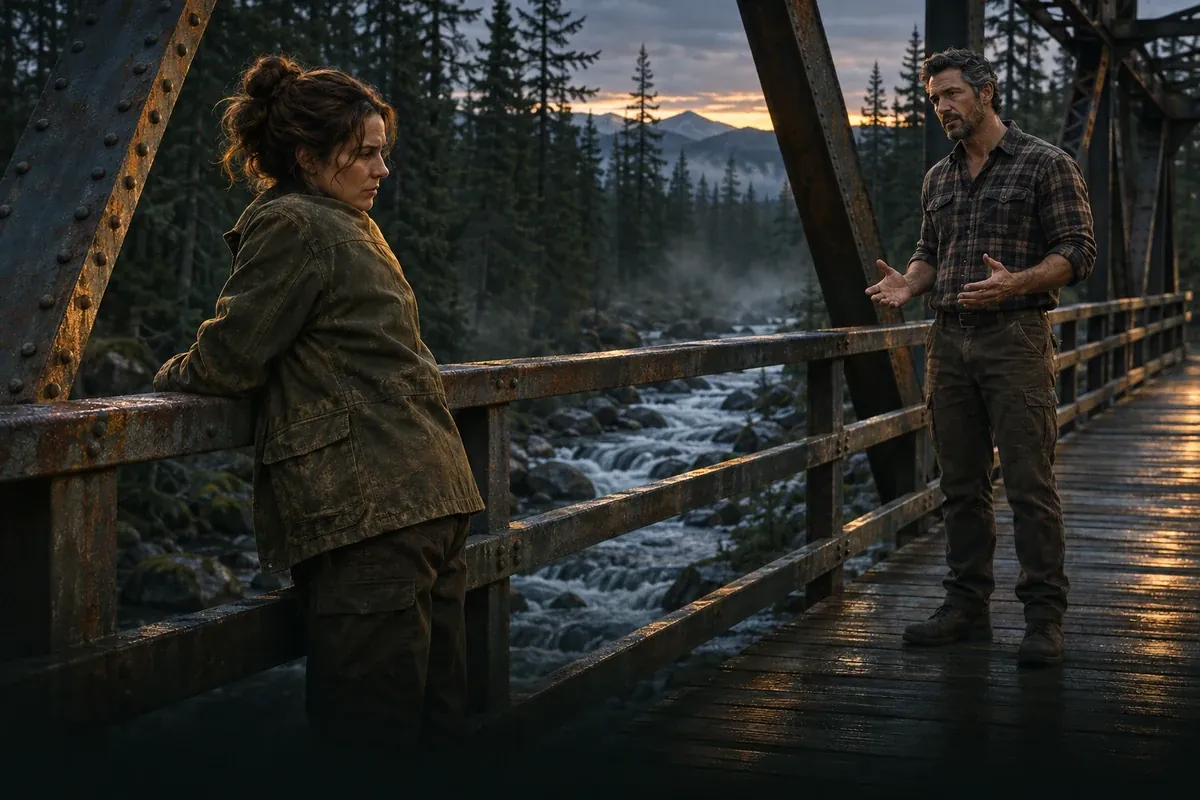
The bridge is a plank-and-steel crossing a quarter mile below the mill, wide enough for one truck and a nervous pedestrian. At 5:20 the sky over the divide was the color of dishwater and the creek was loud with snowmelt that had no business being there in September. I stood at the rail with my hands in my jacket and watched it run. I had spent the night rehearsing speeches. Every one of them had sounded like a woman reading her own verdict.
He was already there when I looked up. He’d walked down without his truck, without a coat, in a flannel shirt with the sleeves pushed to his elbows. He stopped ten feet away, exactly ten feet, and I understood that he’d measured it.
“You’re early,” I said.
“I’ve been here since three.” He tried a smile and it didn’t take. “I wanted to be somewhere you couldn’t say I’d cornered you.”
“It’s a bridge. I could be cornered by a goat.”
“I’ll keep my distance from goats too.”
It nearly worked. Something in my chest loosened a notch and then tightened again, because I’d come to say a thing that would hurt him, and the kindest thing I could do was say it plainly and fast.
“I’ve decided,” I said. “I’m going to tell you what, and then I’m going to tell you why, and then you can say whatever you need to say. Okay?”
“Okay.”
“My answer is no.”
He didn’t move. The creek went on talking to itself. A small gray bird landed on the rail between us, looked at both of us with the contempt of a creature that did not have a mortgage, and flew off.
“No,” Dane said. It wasn’t a question. He was just saying the word to hear what it weighed.
“No to the bond. Not no to you. I want to be very clear about the difference, because I think you’ll hear it as the same thing, and it isn’t.” I made myself keep my eyes on his face.
“You are a good man. You are stubborn and careful and you are terrible at telling people things, and you held a boy’s foot at three in the morning in a surgery you’d been told to leave. I like you. That’s what’s so hard. I like you more than I have liked anyone in a very long time, and I didn’t expect to, and I’d be lying if I stood here and said otherwise.”
His jaw moved. He said nothing.
“But I can’t say yes now. Look at what I owe, Dane. I owe a bank two hundred eighty-four thousand dollars I don’t have. I owe a mortgage to the people who are poisoning your creek. I owe a board a hearing, and I owe a boy a leg that’s still knitting and a woman a recheck and an entire valley an answer I don’t have. Everything I have is wrapped up in your pack. If I said yes today, there’s no way on earth either of us would know whether it was me or the debt. You’d always wonder. And I would too.”
“I wouldn’t.”
“You would. You told me yourself last night. You said you didn’t think I could say no to you freely.” I nearly smiled. “Well, I’m saying it. And it’s free. It’s the first thing I’ve done in a week that’s entirely mine, and I wanted you to be the first to know that it works.”
He looked at the water. He was breathing slowly, in careful measures, the way I’d breathe through a hard surgery. When he spoke his voice was low and absolutely steady, and I knew exactly what that steadiness cost.
“Thank you,” he said.
I had been braced for anger, or pleading, or the dignified silence of a man holding his wounds out of sight. I had not been braced for thanks. “For what?”
“For giving me a real answer. Not a kind one.” He turned his hands over and looked at them, as he had in the coffee room. “I’ve been told yes by a lot of people in my life because they were afraid of what no would cost. I’ve been told no by a few because they were angry. I think this is the first time anyone has said no because they thought I deserved the truth.”
“You do.”
“I know.” A breath. “I felt it when you said it. You may want to know that. It went quiet, like Essa said. A bell wrapped in cloth.” His mouth twitched. “It doesn’t hurt the way I thought it would. It hurts like something that was asked a question and got an honest answer.”
My eyes stung. I looked at the creek until the feeling passed. “I’m sorry.”
“Don’t be. Please. That would be a decision about my feelings.” And there it was, the tiniest crooked flash of the man who had held a wolf’s hind foot in both hands at three in the morning. “You said there was a second part.”
“There is.” I pulled my hands out of my pockets because I didn’t trust them.
“I don’t want to stop. Not working with you, not showing up, not being the vet who takes the call. The bond and the retainer are two different things, and I’d like to keep one. I want a real partnership. Not a patient and a doctor. Not a pack and a hired hand. Two people with equal say, who each get to tell the other no, and who tell each other the truth first, in the right order, even when it’s ugly.”
He was quiet a long time. The sun was beginning to push a thin gold line over the divide, and it picked out the gray in his hair at the temples that I hadn’t noticed.
“Equal say,” he said.
“Equal. If you want to close a road, you ask me. If I want to take blood from your people, I ask you. If either of us finds out something terrible, we say so that day. No waiting until it’s safe. Safe is a word people use when they’ve already decided.”
“I’ve decided a lot of things in that word.”
“I know. I’m asking you to stop.”
He put out his hand. I looked at it. It was large and scarred along the knuckles, with a callus across the base of the thumb that I’d seen on timber crews and no one else. “Dr. Mercer,” he said. “Partner. Is that the word?”
“It’ll do.”
I took it. His hand closed around mine, warm and dry and steady, and I waited for the flinch, and it didn’t come. He held on for a heartbeat and a half, then let go before it became anything else. I noticed that, and I noticed that he noticed me noticing, and for one second we were just two people on a bridge in the dawn who had agreed to something enormous and ordinary.
“Terms,” he said. “In writing. I’ll draft them. You’ll cross things out.”
“I will absolutely cross things out.”
“Good.” And then his face changed, a quick small reshuffle from private to practical. “Teddy Ibarra called me last night. Same time he called you, I’d guess. He said he wants us in his office at six-thirty.”
“He said to bring people I trust.”
“I’m one of them?”
“You’re on the list,” I said. “At the bottom, in pencil. Don’t let it go to your head.” I started toward the road, and after a moment he fell into step beside me, ten feet away, then eight, then close enough that our shoulders almost brushed and neither of us acknowledged it.
Sheriff Ibarra’s office is a brick box behind the courthouse with a flagpole out front and a plastic owl on the roof that nobody has ever explained. Teddy was waiting at the door with a pot of coffee and a face I had never seen on him, serious as a stone. He looked at Dane. He looked at me. He looked at the two of us standing close together and not touching, and a gleam of something wry went through his eyes and was buried at once.
“Come in,” he said. “Shut the door.”
His desk was cluttered and orderly in the way of a man who knows where every page is. On it lay a single manila folder, open, with three documents arranged in a neat fan. “The request came in at seven yesterday morning,” he said.
“Emergency order under section 50-2 of the county code. It invokes the disease-control statute. It cites, and I’m quoting, ‘an emerging hemoproteopathy in wild canid populations posing an imminent threat to public and animal health.’” He tapped the page. “The signature is Dr. Celeste Marchand, with an endorsement from a state veterinarian I’ve never met who works, as it turns out, as a consultant to Lysark.”
“That’s a conflict,” I said.
“It’s a conflict the commissioners don’t know about, because nobody told them. I did a little looking.” He turned a second page toward me. “The statute requires two things before a closure of this size. A finding of imminent threat, and a licensed veterinary diagnosis from the county. Marchand’s finding is hers. The diagnosis is supposed to come from a vet licensed in Montana and practicing here.” He looked at me. “That would be you, Doc. Or Doc Pettibone, who’s retired and in Arizona.”
“She doesn’t have a diagnosis.”
“She has a theory, and a lot of money, and a lawyer who writes very nice paragraphs.” Teddy leaned back. “The commissioners meet at ten. Three of them. Two are going to sign because they’re afraid of the word emerging. One is going to ask questions because he’s stubborn. I’d like to give him better questions.”
I sat forward. Dane, beside me, went very still.
“Public comment is open,” said the sheriff. “Any citizen can speak. A licensed veterinarian in the county speaking on the actual health of the animals up the drainage, with data, would be a thing Marchand didn’t plan for.” He rubbed his mustache.
“I’m not telling you what to say. I want to be clear. I don’t know what’s up that creek and I’d rather not until I do. But I know the statute wants a vet’s diagnosis, and I know what Marchand’s got, and I know what I’d like to see in that room at ten.”
“If I speak,” I said slowly, “I put my license on the table, and Marchand already has a complaint on file.”
“Yes.”
“And if I stay silent, the order passes, and we lose access to the creek, and the thing going into it keeps going in.”
“That’s how I read it,” said Teddy. He didn’t look away. “It’s a bad choice. I wish I had a better one.”
I looked at the manila folder. I thought about Denver, about the empty frame, about how very nearly I had learned to stay quiet. Then I looked at Dane, who was watching me with an expression so open that I had to look away from it, and who didn’t say a word. He didn’t say don’t, and he didn’t say please. He sat with his hands loose and let me have my own silence.
“I’ll need two hours,” I said. “And a printer.”
We took over the back office of the clinic like an occupying army. Jo commandeered the front desk printer and fed it paper in a steady rhythm, the way she does when she’s terrified and wants something useful for her hands.
Priya came in on speakerphone at seven, sleepless and furious, with a voice that sounded like it had been scrubbed with a wire brush. “You are going to stand up in front of three commissioners in a county courthouse,” she said, “and tell them about a protein you can’t legally say you found. I want that on the record. I’m going to be sick.”
“You don’t have to be anywhere near it.”
“I’m on the phone, aren’t I? That’s near.” Papers flew on her end.
“Fine. Rule one. Don’t say ‘engineered.’ You can say ‘non-native’ and ‘recombinant,’ and you can say ‘a purification tag consistent with laboratory production,’ but the minute you say ‘engineered’ somebody’s lawyer stands up and says ‘speculation.’ Rule two. Everything you say, you can show. Photographs, chain of custody, the three dilution numbers. Rule three, and I mean this one with my whole soul, do not name the animal. Say ‘canid.’ Say ‘ranch dog.’ Say whatever Marchand said. Do not tell them what you saw on that table.”
“I know.”
“I know you know. I’m saying it so I can sleep tonight.”
Dane sat at the corner of the desk with a legal pad and a pen he held like a chisel. He had been writing for twenty minutes. When I leaned over he turned it toward me, a little red around the ears, and I read the first line of the partnership terms. It said, in blocky print: ONE. EITHER PARTY MAY SAY NO. IT IS NOT A BETRAYAL. THE OTHER PARTY WILL NOT TAKE IT AS ONE.
“That’s good,” I said.
“There’s a two.”
TWO. NEITHER PARTY DECIDES FOR THE OTHER WHAT THEY CAN BEAR. I WILL ASK. SHE WILL SAY.
I took the pen out of his hand. I crossed out SHE and wrote THE OTHER, because it should cut both ways, and I handed it back. He looked at the change for a very long moment and then, with great ceremony, wrote a small initial in the margin beside it. DH.
“We have a deal,” I said, “and we haven’t even got to the part where I charge you for the lab time.”
“I would be disappointed if you didn’t.”
“Invoice’s in the mail.” Jo, from the doorway, didn’t look up from the printer. “She’s already put the pack on a retainer in her head, and I’ve got the spreadsheet.”
“Rate card,” I said. “Alpha, nights, weekends, holidays, and the ones where he doesn’t answer a text.”
“I always answer.”
“You answer eleven hours later with a haiku about timber.” I took the stack of pages from Jo. They were still warm. The top sheet was a graph I’d drawn at six that morning in blue pen, three bars labeled TAP, INTAKE, LANDING, each three times the height of the last. I looked at it and felt the ground go very slightly soft under me. I had not given testimony in front of a government body in my entire life. I had given an affidavit once about a bull.
“You’re going to be fine,” said Dane.
“You can’t know that.”
“No.” He got up. “But I know what it looks like when you decide to be useful. You get quiet and your jaw does a thing. It’s happening now.” He stood close, not touching. “I’ve seen you do it over a wolf with a broken leg and a boy having a seizure and a woman bleeding in the sawdust. Whatever’s in that room at ten, it isn’t going to be harder than any of those.”
“That’s not what I’m afraid of.”
“What are you afraid of?”
I thought about it honestly. Behind him through the window the Route 11 trucks were going by in the early light, and the sale barn flag was lifting in the wind. “That I’ll say the true thing in a room full of people who’ve already decided what’s true,” I said. “And that it won’t matter.”
“It’ll matter to the one who’s stubborn.”
“Teddy said there’s one.”
“Then you only have to be right for one man.” He put his hand briefly on my shoulder, gone before I could register it. “That’s smaller than a calf.”
At 9:50 we walked up the courthouse steps, the four of us in a ragged line: Jo with the folders, Dane with the printouts held against his chest like something sacred, Teddy with his hat in his hand, and me. The hall smelled of floor wax and old paper.
A bulletin board listed fence-line disputes and a bake sale. At the door of the commissioners’ chamber a deputy nodded us through, and the room opened out in front of us, a long hall with a dais at the far end and rows of folding chairs, already half full.
In the front row on the aisle, in a fitted field jacket with a leaf over the heart, sat Dr. Celeste Marchand with her hands folded on a leather portfolio.
She turned her head as I came in. She smiled, small and civil and without any surprise at all.