

The side door opened onto the mill’s coffee room, which is a long, low space with a steel sink, two vending machines that haven’t taken a dollar since the nineties, and a table scarred by sixty years of loggers’ elbows. Dane stood at one end with his back against the wall. Essa sat at the other, small and upright, the green ledger closed on her knees.
Both of them looked at me. Neither said anything.
I have walked into a lot of rooms where people stopped talking. Barns where a rancher and his son had been arguing over a dying cow. Kitchens where a family had just decided to put a dog down and wanted to be done before the vet arrived. You learn to read what the silence is made of. This one was made of a man who had been caught carrying something and a woman who had made him put it down.
“I heard,” I said.
“Rowan.” Dane came off the wall. “I would have told you.”
“When?”
He opened his mouth and shut it again. That told me more than an answer would have.
“I’m going to put something on the table first,” I said, “because I walked up here to do it and I’m not going to let this conversation eat it.” I took the flash drive out of my fist. It had a crease in the plastic from my grip. I set it between us, on the scarred wood.
“Priya Nair ran my samples. The protein is recombinant. It carries a purification tag that no animal makes, so somebody built it in a lab. It’s in your tap water, at a tiny dose. It’s in the creek above the intake, forty times higher. And it’s at the old logging landing, where the trap was, four hundred times higher. It comes down in pulses about eight weeks apart. Somebody is putting it in the water on a schedule.”
Dane stared at the drive. Essa did not move, but her hands tightened on the green cloth until the knuckles stood out like knots in a rope.
“The water,” Essa said finally.
“The water. That’s the delivery. I don’t know yet where it goes in. That’s the next thing.” I made myself breathe. “I also found out this morning that First Bench sold my mortgage to Bright Basin on Friday and called it due. Ninety days. The bank sold it the day before Dr. Marchand told me she would pay me better to document you. That is the whole news. I’m going to need you to take it in, because I’m about to be a lot less useful for the next twenty minutes.”
“Rowan,” Dane said.
“Now tell me about the bond.”
He flinched. It was small, just a tightening at the corner of the eyes, but I saw it. I’d seen Micah do the same thing when I asked him about the ridge.
Essa answered. She didn’t ask permission. She put the ledger on the table, folded her hands on it, and said it the way she’d say a dosage.
“When two of us touch for the first time, skin to skin, there is a chance the bond rings. Not every touch. Not most. Perhaps one in a lifetime for a wolf, and some never. It is a recognition. The body says: here is the one. It happens in the chest, and you cannot mistake it. Dane felt it when you took his pulse. You felt nothing because you are still-minded and the bond has no hook in you. That is the first thing.”
“The second thing?”
“For one of us, the ring pulls. The attention goes toward the other. You think of them, you want to be near, you feel it when they are hurt. It does not command. We are not puppets, whatever you have read. But it is a strong current and it takes a strong will to swim against it.”
She turned her palm up. “For a human with a still mind, there is no current. None. She hears the ring and then decides, with nothing pushing her, whether she wants it. It is the one clean choice in all of our law. A wolf cannot make it. A still-minded human can.”
I sat down. I hadn’t meant to. The chair was cold and hard and I was grateful for both.
“And if the human says no?”
“Then the bond closes. For her, it never opened. For him, it goes quiet, like a bell wrapped in cloth. He may feel it for a long time. That is his to carry.” Essa’s old eyes did not leave my face. “The law is plain. A no from the human is final. It can only be undone if the human herself reaches back and offers. No one else may ask twice.”
“And a yes?”
“A yes is free to anyone who means it.” She said it so simply that it made the room feel enormous.
“That is why we do not tell. That is why we are all of us afraid to tell. The ones who come to us from outside, who fall in love with a wolf, who carry a debt of thanks or a debt of fear, how can their yes be free? The law says the bond must be offered to a person who owes us nothing.” She let that sit. “You owe us nothing, Doctor. And we owe you a great deal. That is the trouble.”
I looked at Dane. He had not moved from where he stood, but he had gone gray around the mouth, and he held his hands very carefully in front of him as if they might do something he hadn’t approved.
“You felt it in my clinic,” I said. “Four days ago.”
“Yes.”
“You shook my hand at the council. You flinched. I thought you had a cramp.”
“I had a cramp,” he said. “It happens to be the same cramp.”
I almost laughed. It was a dreadful, cracked, useless impulse and I buried it. “Why didn’t you tell me?”
“Because you had a license and a bank note and a pack of strangers asking you for everything.” He said it fast, as if he’d rehearsed it in the dark and was afraid it would leave him. “Because I didn’t think you could say no to me freely. You had nowhere else to stand. You were doing the hardest thing you had ever done, and I thought, if I tell her this now, I put one more hand on her back.”
“So you decided.”
“I decided to wait until it was safe.”
“Safe for whom?”
The question hung in the air. I watched it reach him. I watched him look at it, turn it over, and find nothing on the bottom.
“For me,” he said quietly. “I think. I think I told myself it was for you.”
Essa made a small sound that wasn’t quite a laugh. “At last.”
I stood up. My legs held. “Let me tell you something about decisions,” I said.
“Three years ago I sat in a room in Denver while a board of men in suits explained to me that they had decided what I could understand. I had signed charts for a mentor I trusted. I didn’t know what was in them. They decided that not knowing was the same as knowing. They decided I was a person things should be done to. It took me eleven months and every dollar I had to get back in front of a patient.”
I was careful to keep my voice level. It cost me. “And I’m not accusing you of being them. You’re not. You kept me in the dark out of tenderness, and that’s much harder to be angry at, which is the problem. It’s still a decision about me made without me. I’d rather have your fear than your protection.”
“I understand.”
“I don’t think you do yet. I think you will.” I picked up the flash drive and held it.
“Here is what’s going to happen. I’m going to leave this room. You’re going to stay here and not follow me. Tomorrow I’m going to think about what Essa told me, and I’m going to decide without anyone helping, and I’m going to tell you what I decided. Until then, we are two professionals who have an outbreak to solve. If you want to talk about the bond, you can ask me whether I want to talk about the bond. You can’t tell me what I can take.”
“That’s fair,” Dane said. His voice scraped. “That’s more than fair.”
“Good.” I turned to go, and the old woman said my name.
“Doctor Mercer.”
“Yes.”
“I told him to tell you tonight, not because the law demands it, but because I have watched him deliver every hard thing to this valley in the dark, alone, in a soft voice, so no one would have to hold it with him. I wanted him to find out what happens when it isn’t soft.” She looked at the ledger. “I did not do it to hurt you.”
“I know,” I said. “Thank you for the vocabulary.” And I left through the door I’d come in by, and the afternoon sun hit me full in the face like a slap of clean water.
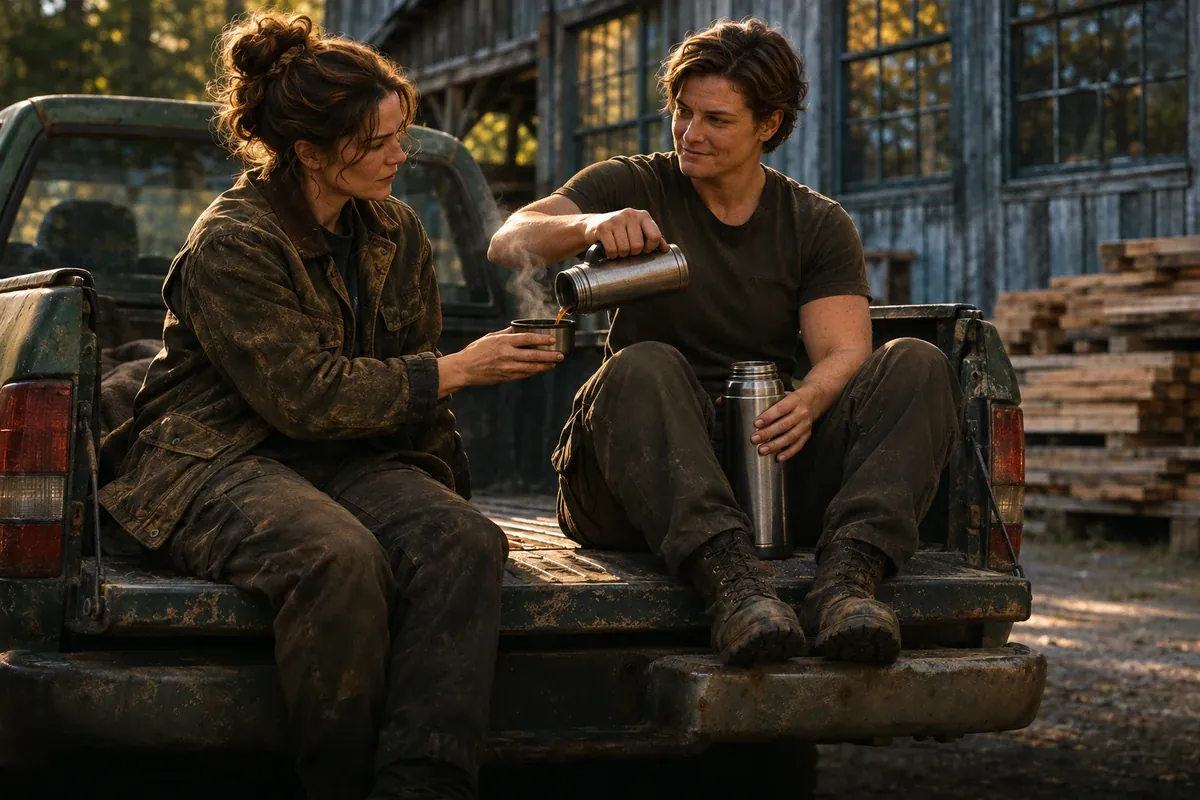
Von was sitting on the tailgate of my truck. She had her boots hooked on the bumper and a thermos between her knees, and she didn’t get up when I came across the yard, which I appreciated. She poured coffee into the lid and held it out.
“I’m sorry,” she said. “In the truck, Saturday night. I shouldn’t have asked you like that. I thought you knew and were being polite. Then I thought you didn’t know and I was an idiot. Then I was both.”
“It’s fine.”
“It’s not fine. It’s a very quiet kind of not fine, and you’re doing the Dane thing where you say it’s fine until it comes out of your ears.” She pushed the lid at me. I took it. The coffee was terrible and scalding, and I could have wept over it. “Drink. Then yell at me if you want. I like being yelled at. It means somebody thinks I’m worth the lungs.”
I drank. I sat down beside her on the tailgate, and we looked at the mill, at the long dark windows, at the stack of cedar planks drying in the yard.
“Did you know?” I asked. “That first morning at the clinic?”
“Essa told me that night. She told the whole kitchen. My brother stood outside with his forehead on the door for an hour.” Von turned the thermos in her hands. “He’s not good at this. I want you to know that I know he’s not good at it. He’s been the alpha since he was twenty-two. Everybody tells him what he can’t do and what he has to carry. Nobody ever hands him a thing and says, here, this one’s yours, and it’s soft.”
“You make him sound lovable.”
“He’s an idiot,” Von said. “He’s my idiot. It’s a different category.” She glanced sideways at me. “I’m not going to tell you what to pick. I’ll just say, whatever you pick, I’m still going to ask you to do my next physical. You’re the only person in this valley who ever listened to my lungs and then told me the truth about them.”
“Your lungs are fine.”
“See? Honesty. It’s attractive.” She bumped my shoulder with hers, then slid off the tailgate and stood. “Go. Do your thing. Come back when you’ve decided. And Rowan?” She waited until I looked up. “Thanks for not yelling at him in front of everybody.”
“I haven’t started yet,” I said, and she laughed, a short bright sound, and walked back toward the mill with her hands in her pockets, and I understood that I had made a friend and a complication on the same afternoon and that I could not tell, from where I sat, which was which.
I made it to Horse and sat in the cab with my hands on the wheel for what felt like ten minutes and was probably two. My heart was behaving itself, which was strange. I’d expected it to riot. Instead it moved in slow, deliberate strokes, a heavy bell instead of a snare drum, and it took me a moment to understand why that sounded familiar.
Dane’s pulse. The first morning. A big bell, slow and enormous.
I pressed two fingers to my own wrist, out of old habit, and counted. Sixty. Perfectly ordinary. A human heart doing human work. I laughed, and it came out wet, and I wiped my face with my sleeve and started the truck.
The call came as I was coming down the ridge road, where the cell signal flickers on at the second switchback. Jo, flat and fast. “Where are you?”
“Leaving the Landing.”
“Sheriff Ibarra’s been trying to reach you for an hour. He says it’s urgent and that he doesn’t want to say it on the phone. And Rowan.” She stopped. I heard her swallow. “There’s a certified letter. I signed for it. It’s from the Montana Board of Veterinary Medicine.”
My foot came off the gas. Horse coasted. The trees went by in long green flashes.
“Don’t open it,” I said. “I’ll be there in forty minutes.”
“I already know what it says,” said Jo. “I can read the return address and the little checkbox. It says complaint.”
I took a long breath and let it out. The creek flashed silver below the road, clean and cold and quietly murdering people, and the sun lay on it like a hand.
“Okay,” I said. “Then we have a bad day and a worse week. Put the kettle on.”
“We don’t have a kettle.”
“Put the idea of a kettle on,” I said, and hung up, and drove the rest of the way down with the window open and my whole body singing a note I did not have a name for.
Jo met me at the door of the clinic with the envelope held flat against her chest, like a girl bringing home a report card she hadn’t earned. She’d locked the front. The sign said BACK IN 15 in her square block capitals, and under it, in pencil, she’d added: EMERGENCIES CALL THIS NUMBER. I loved her for that more than I could say.
“You can open it,” she said. “I just wanted to be standing next to you when you did.”
I opened it. It was two pages on stiff cream letterhead, the kind the state uses to make bad news feel respectable. A formal complaint had been received on Sunday by the Montana Board of Veterinary Medicine, it said, alleging that Dr.
Rowan Mercer had administered a prescription drug to a human being at a public event on September 13, in violation of the Veterinary Practice Act. A hearing officer had been assigned. I was invited to submit a written response within twenty days. A paragraph at the bottom noted, with bureaucratic delicacy, that the board “may take into consideration any prior disciplinary history in any jurisdiction.”
The complainant was listed as the County Wildlife Health Initiative. Principal contact: C. Marchand, Ph.D.
“She filed it Sunday,” I said. “Which means she wrote it before the festival was over. She had the paperwork ready.”
“Because she knew you’d do it,” said Jo. “She watched you. She was standing right there. She didn’t try to stop Von bleeding, she waited to see if you’d cross a line.” She said it in her flattest voice, which I’d come to recognize as the sound of Jo being so angry she’d run out of adjectives. “She let a woman almost die to get you on a form.”
“You can’t prove that.”
“I don’t have to prove it. I’m just saying it out loud so it exists.”
I put the pages on the counter and squared them against the edge with both hands, the way you straighten a stack of anything when your mind needs a task. Twenty days. A hearing officer. A phrase about prior history that would bring Denver rolling back across my life like weather.
My phone rang. SHERIFF IBARRA. I let it ring twice, and thought about everything it might be, and answered on the third.
“Rowan.” His voice was quiet and level and entirely without the mule. “I need you to come by the office. Not tonight. Tomorrow, early. Before the commissioners meet.” A pause. “And I need you not to tell anybody you’re coming.”
“What’s happened, Teddy?”
“Marchand filed a request with the county this morning. Emergency authority, under the disease-control statute. She wants the whole upper Carrow Creek drainage closed. Roads, trails, access. Quarantine, she’s calling it, for wildlife-disease surveillance.” I heard him exhale. “Seven hundred acres, from the old landing to the divide. That includes the Hollis timber lease.”
I closed my eyes. Of course she had. It was so clean. A closure order would keep Priya’s samples out of our hands, keep us from walking the creek, keep our own people from checking on their own water. It would let Lysark do whatever it wanted up there, behind a county seal, with no one allowed to look.
“When does it take effect?” I asked.
“If the commissioners sign tomorrow? Midnight.”
“Teddy.”
“I know,” said the sheriff. “Come early. Bring whatever you’ve got. And bring the people you trust.”
He hung up. I stood in my lobby, with Jo watching me and the empty frame on the wall and the cream-colored letter lying flat on the counter like a dealt card, and I realized that my phone had another message waiting, and I knew who it would be from before I looked.
DANE: I won’t follow. I won’t ask. But I need you to know the tap in the mill is running clear tonight and I’ve turned it off. We’re hauling water from the town hydrant until you say otherwise. That’s a decision I made for me, not for you. Thought you’d want to know the difference.
I read it three times. Then I put the phone face down on the counter and laughed until I had to hold the edge of it, with Jo staring at me, because it was the most precisely correct thing a man had ever said to me in writing, and I didn’t know what to do with my hands.