

I kept my promise to Dale Whitcomb. I sat up all night on a kitchen chair beside Von’s bed at the Landing, with my back to the window and a bottle of tranexamic acid in one pocket, and I watched a woman I’d known for six days sleep with her mouth a little open and her fist curled against her chin like a child’s.
Every hour I checked her gums. Every two I took her pulse. Twice I pressed a thumbnail to the pink of her lip and counted, and twice the color came back in under three seconds, which in a person with a hemorrhagic disease is the sound of a door deciding not to slam.
Dane sat across from me for the first three hours, motionless. At 1 a.m. I told him to go outside and breathe. He went. He stood in the dark yard for forty minutes without moving, and I watched him through the window, his big shape against the stars, a man trying to hold up a sky with his shoulders.
By dawn Von was awake and hungry and furious that I’d let her miss the tractor pull finals. I decided to count that as a clinical sign.
Dale got his recheck at eight. He listened to her chest, pressed his fingers to her wrist, studied her nail beds, and looked at me with a long, flat, appraising face. “Vitals are fine,” he said. “Better than they should be. I’m not going to ask.” He wrote something on his clipboard and tore it off. “Dr. Mercer. Between you and me. If I see this twice in the same family, I’m going to have to ask.”
“I know.”
“And if the same woman in the jacket is around when I do—“ He didn’t finish. He handed me the paper. It was a signed refusal form with a margin note in blocky capitals: SHE WAS FINE. I FOLLOWED UP. D.W. “That’s for your file,” he said gruffly. “Keep it somewhere dry.”
I drove home Sunday with that slip of paper in my pocket like a medal.
Monday morning I called First Bench Bank at exactly 8:01, because Jo had said to, and because the idea of waiting any longer had begun to feel like negligence. A woman named Pam, whom I’d known for eleven years and who’d sent a fruit basket when I reopened, said the loan officer would call me back. Pam’s voice had a dead flat patience in it I’d never heard, like a person reading from behind glass.
At 8:14 the loan officer called. His name was Craig, a decent man in a bad spot, and I heard it in his first sentence. He said, “Rowan, I need to be straight with you.”
“Please.”
“The bank’s sold your note.” A beat. “Friday. It went in a package of twelve local commercial loans, to a holding company out of Delaware called Bright Basin. It happens, you know, small banks sell paper all the time, it doesn’t mean— Rowan, I’m so sorry. I fought it. I want you to know I fought it.”
I was standing in my lobby, holding the phone, and I watched the sun move across the floor tile where Jo mops every night. “What are the terms?”
“The note has an acceleration clause. They’ve invoked it. Effective Friday.” He took a breath. “You’ve got ninety days to pay in full.”
“In full.” My voice came out smooth, which is how it goes when the body sends the shock somewhere else. “Craig. That’s two hundred and eighty thousand dollars.”
“Two hundred and eighty-four thousand, six hundred. With the fees.” He sounded ill. “They’ll entertain a modification. A sale, at, uh, a fair number. Garrett Voss is the contact. He said you’d know him.”
He was right. I knew him.
I thanked Craig, because manners are a reflex, and hung up, and stood in my lobby with my hand on the phone and the empty picture frame at my shoulder. Marchand had said she’d be in town through the end of the month.
Four days earlier she’d offered me a way out of the exact corner I was now standing in, and she’d done it in the same tone, with the same warm gray eyes, and the bank had been sold Friday. A whole day before the pie auction. A whole day before I put my hands in Von’s blood and my name in Dale Whitcomb’s mouth.
They’d known. They’d known before I did what kind of vet I’d turn out to be.
I told Jo at nine, in the back room, with the radio off. She listened without moving, the clipboard against her chest. When I finished she said, in the flat clear voice of the girl who’d watched her family lose a ranch the slow way, “You’re not going to sign anything.”
“I’m not going to sign anything.”
“Say it like you mean it.”
“I mean it. I just don’t know how I’m going to keep meaning it.” I rubbed my eyes. “Ninety days, Jo. I can’t raise two hundred eighty-four thousand dollars. I couldn’t raise it if I sold the practice, the truck, and my organs.”
“Then we find out why they want it so badly.” She put the clipboard down. “They don’t want a vet clinic, Rowan. Nobody wants a feed store with a mortgage. They want you to take the offer so they can have the pen, the building, the license, and the one person in seventy miles who looks at blood for a living.” She said it flatly, as arithmetic. “Whoever’s behind this isn’t buying property. They’re buying silence. And what they’re paying with is the thing you’re afraid of.”
“The bank.”
“The bank. And you can’t pay it, so they’ll offer you a way out in exchange for a favor.” She picked the clipboard up again. “My dad took the way out. It cost him the ranch and also everything else. Don’t.”
“I’m not going to.”
“Good,” said Jo. “Then let’s go find the thing that makes them nervous.”
We did the books anyway, because the alternative was staring at the wall. Jo pulled the ledger program up on the front-desk computer and I sat beside her on a rolling stool, and for forty minutes we added up my life in a spreadsheet. Checking account: eleven thousand, two hundred and six dollars, minus payroll due Friday.
Receivables: nineteen thousand, most of it from the sale barn, which pays on the ninety-day plan and on the honor system. The practice’s insurance policy. The truck, Horse, worth maybe six thousand to someone who loved him. The building itself, appraised two years ago for three hundred and ten thousand, which meant that on paper I owned twenty-five thousand dollars of feed store and owed everyone else the rest.
“If you sold the building at appraisal,” Jo said, “paid the note, you’d clear nothing. You’d still own a stethoscope.”
“And a truck.”
“And Horse,” she agreed gravely, and typed it into the sheet with a straight face: ASSETS, Horse, sentimental. “If Voss offers you a number, it’s going to be a nice one. That’s how they’ll do it. They’re not going to make it feel like a loss. They’re going to make it feel like a rescue.”
“That’s the part that scares me.”
“Me too.” She leaned back, rubbing her eyes with the heels of her hands. “Rowan, my family took the nice number. You sign the paper, they send you a check for a little more than you expected, and you drive away feeling like you got away with something. And six months later you drive past and there’s a parking lot where your barn was and you can’t remember why you thought it was a good idea.” She dropped her hands. “I’d rather lose it fighting.”
“Then we fight,” I said. “We don’t have a plan. We have a notebook and a mass spectrometer in a different time zone.”
“That’s more than my dad had.” She closed the spreadsheet. “That’s a lot more.”
Priya’s second set of results arrived at noon, by email, an encrypted attachment with no message other than a single line: CALL ME WHEN YOU CAN BREATHE. I called from the truck in the clinic lot.
“The tap sample,” Priya said, before hello. “SAWDUST-TAP, your label, I laughed for ten minutes. It has the protein. It’s tiny, about a nanogram per liter, three orders of magnitude below what’s in your patients’ blood. But it’s there, and it’s the same hexamer. The same tag.” She exhaled. “Rowan, it’s in the water.”
I closed my eyes. “I took the other samples Sunday morning. The creek above the intake, a hundred yards up, and a second at the old logging landing, a mile higher, where the trap was.”
“I got those too. The upstream creek sample has about forty times more than your tap. The one from the old landing has four hundred.” Papers shifted. “Whatever it is, it’s coming down the creek in pulses. A slug of it every few weeks, diluting as it goes, and by the time it hits your people’s tap it’s tiny. But it adds up, because it’s the same stuff every time, and because—“ She broke off. “I did the kinetics. Do you want the number?”
“Give me the number.”
“Eight weeks.” Her voice had gone very thin. “If I back-calculate from the tap concentration at the dilution you described, the peak pulses come about eight weeks apart. Your ledger isn’t a coincidence. It’s a release schedule.”
“Where’s the source?”
“Upstream from your landing, wherever the old landing sits. Upstream of that. I can’t tell from here, but you can, with a stream survey and a few more samples.” Another pause. “Someone is dosing a creek, Rowan. Deliberately. Every eight weeks. Over a valley where, if I understand correctly, a group of people, humans — people — are drinking the water.”
“People,” I said. “Yes.”
“Then I’m going to say something and I want you to hear it. Whatever you’re involved in, whoever you’re protecting, call the federal people. I’ll do it for you. I’ll do it tonight. If I’m wrong and it’s a crank, I’m embarrassed. If I’m right—“
“If you’re right,” I said slowly, “the first thing Lysark does is move the schedule, destroy the evidence, and call the whole thing a rumor, and my people lose the only window they have. Priya. Give me three days. Let me get a proper survey. Let me find the source with my own eyes. I’ll call the minute I have it. I swear.”
She was quiet a long time. When she spoke again her voice was ragged with something that wasn’t anger. “Three days,” she said. “And then I call. And Rowan? I’m not asking who they are. But you drive carefully.”
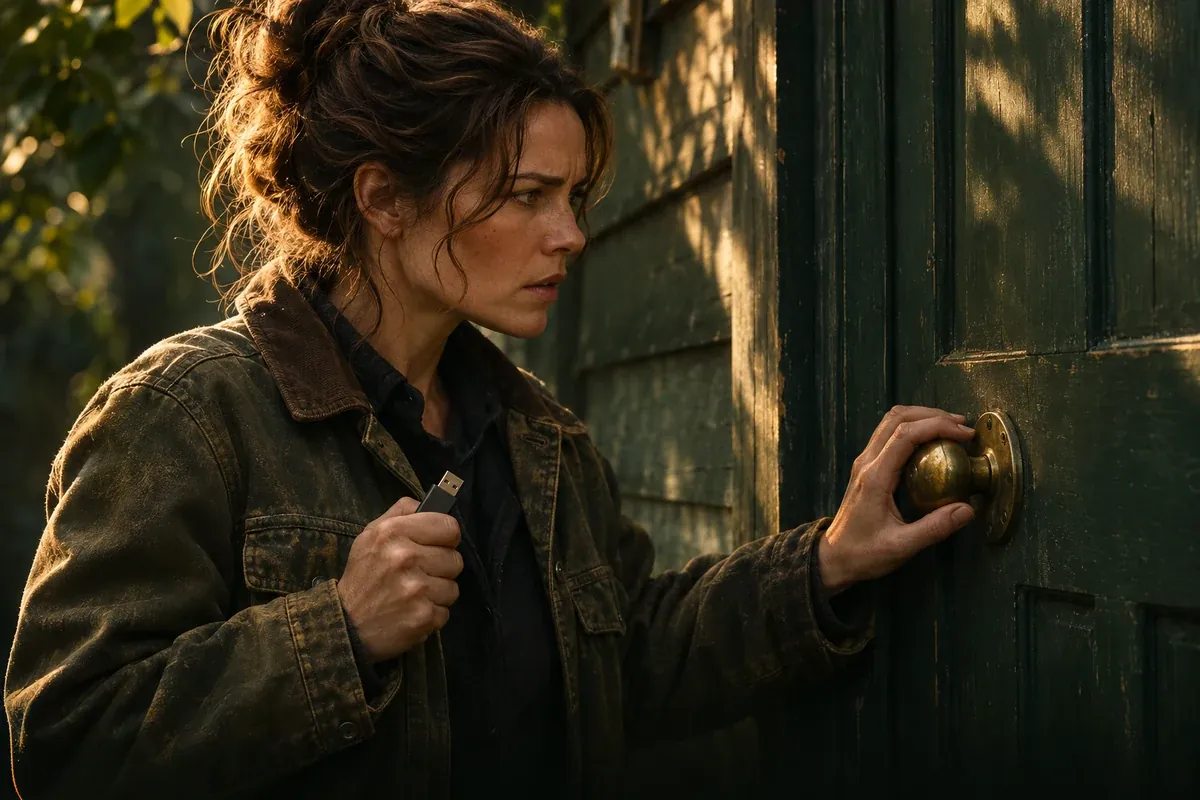
I drove carefully. I drove to the Landing at two in the afternoon on a Monday with the creek results on a flash drive in my shirt pocket and my own two-hundred-eighty-four-thousand-dollar problem riding on the seat beside me, and I intended to tell Dane everything in order: the bank, the water, the schedule, the pulses. And above all, the plan I’d built out of Priya’s kinetics on the drive up: where the source had to be, how to find it, and the first honest piece of evidence we could use.
The Landing was too quiet. No saw in the mill yard, no laundry on the lines. A scatter of trucks parked in front of the big doors, all of them idle, and the doors themselves pulled mostly shut. I parked and walked across the packed dirt with the drive in my fist and my boots loud in the hush, and I was ten feet from the side door, the little one the loggers used for coffee, when I heard Essa’s voice through the gap.
She wasn’t using the Hush voice. She wasn’t using the council voice either. This was the old, dry, ordinary voice of a woman who has been trying to say the same sentence for a very long time and has run out of patience with delivery.
“—and you will listen to me, Dane Hollis, because I was old before your grandfather was born. You’ve known since the morning in her clinic. Since she took your pulse. You felt it ring, and you stood there like a post and let her walk out the door with it still ringing.”
“Essa.” Dane’s voice, low and rough. “It’s not that simple.”
“It’s the simplest thing in the world. It’s the oldest law we have. She is your mate.”
My hand stopped on the doorknob.
I want to be accurate about what came next, because accuracy is all I have. For one long second, nothing happened. The words simply stood in the air like a smell. Then, from deep in my chest, something went off, a small silent flare, as if a pilot light I’d never known I carried had been lit by the sentence. I felt blood in my ears. I felt my fingers on the cold brass, the grain of the door. I felt, absurdly, the flash drive crumpling in my other fist.
“She’s human,” Dane said. “She’s still-minded. She walked in blind, Essa. She has no idea what a bond is. If I tell her, I put it on her, the whole weight of it, and she hasn’t had a choice about a single thing since that night—“
“She walked in blind,” Essa snapped, “and she’s the only one in this valley who’s kept her eyes open. You think you’re protecting her. You’re deciding for her. It’s the same thing you did to Marian, and to Alma, and to every person in this pack who ever asked you a hard question and got a soft answer.” A long pause, thick as gauze. “Tell her. Tonight. Or I will.”
“You wouldn’t.”
“Try me, boy.”
And in the long, awful silence that followed, I understood two things at once. The first was that my whole body had gone cold and then hot and was no longer entirely mine. The second was that I could still walk away. I could set down the flash drive on the step. I could climb back into my truck and drive home to my mortgage and my clinic and my careful, stubborn life, and the door would stay shut, and nobody would know I’d stood on this step.
I thought about Colorado. About the pages I’d let someone talk me into leaving off. About how it feels, to be the last one told.
I turned the knob and stepped through the door.