

Ferran’s Bend holds its Harvest Days on the second weekend of September, which is the only time of year the town’s one stoplight gets turned off, on purpose, so Main Street can hold a pie auction, a tractor pull, three food trucks that have never visited any other county, and a beer tent so large that I once watched a man get lost in it for forty minutes.
I go every year, in the vet’s capacity: a folding table by the kids’ petting zoo, a cooler of water for the dogs, and a stack of flyers about rabies boosters that nobody takes. The town expects me. Missing it would be noticed.
So at noon on Saturday I was standing next to a Nubian goat named Reverend, who had eaten a corn dog stick and was taking it personally, when I saw the banner two booths down.
COUNTY WILDLIFE HEALTH INITIATIVE, it read, in the clean sans-serif of people who spend money on fonts. FREE PET WELLNESS SCREENING. And below it, smaller, a leaf logo I’d last seen laser-etched into a steel cage frame. A white tent. Two folding tables with sky-blue cloths. A crisp line of ranch dogs and their owners, waiting with the easy trust of a town that has never been lied to in a pleasant voice.
A woman in a fitted field jacket was drawing blood from a border collie with the kind of unhurried competence that I’d have admired in a colleague.
“Don’t,” said Jo, at my elbow, with a plate of funnel cake held in front of her like a shield. “You’ve got a face on. I can see you doing the thing with your mouth.”
“I don’t do a thing with my mouth.”
“You do a very small thing, and it’s terrifying.” She ate a bite of funnel cake. “Everybody’s lining up for the free bloodwork. Mr. Teague’s already got Delilah’s cousin in there. The Dabrowskis. Half the sale barn. They’re giving out tote bags.”
“Tote bags.”
“With a leaf on them.”
I looked at the line, forty people, some of them my clients, some of them folks who’d trusted me with a sick animal in the middle of the night for eleven years, and watched them hand their dogs, cheerfully, to a woman whose institution had a trap in the woods with a status light. I’d have given a year of my life to stop them. I didn’t have an argument that wouldn’t sound like a stranger’s tinfoil. I had a notebook, a tag, and a sheriff who’d told me, over a peppermint, to be careful.
“We watch,” I said. “That’s all. Chain of custody. We write down what she does.”
Jo’s eyes were already on the tent. “I’m counting tubes,” she said.
The first sign that the afternoon would go wrong was Von’s laugh. It carried across the street from the beer tent, a big joyful bark with a crack in the middle, and I knew the crack. I’d heard it in the lab in September, in a boy who’d said he was fine.
I turned, and there she was, in the mouth of the tent in a Hollis Timber T-shirt, a plastic cup in her hand, tall and bright and mid-sentence, and she put the back of her wrist to her nose like a woman checking for a sneeze.
It came away red.
I was moving before I thought about it. I will not say I ran. A vet doesn’t run through a crowd; running makes animals panic and people panic worse. I walked through a tractor-pull crowd at a speed I’d call determined, past a face-painting stand and a lady selling candles, and by the time I reached the tent Von had a napkin to her nose and a smile on her face, the grin of somebody handling a thing she’d decided not to mention.
“Hey,” she said. “Doc. Nosebleed. Dry air.”
“Sit.” I said it in the tone I use on Reverend. “Pinch below the bridge, lean forward, not back. Von, look at me. How long?”
“Few minutes. It’s fine. Happens.” Her eyes slid away from mine, and I saw her gums, in the flash of her grin: a shade too pale. Winter sky. “Rowan, I’m fine.”
“You’re not. You’re lying, which means you know you’re not.” I took the napkin. It was soaked through. She’d been bleeding for more than a few minutes. “Come with me. Now. Quietly.”
She stood. Took one step. And coughed — a wet, tearing sound, a cough with no business in a healthy chest — and her knees went, and I got my arm around her before she hit the sawdust, and what came up on my shoulder, warm, bright, and not stopping, was blood.
People noticed after that. There’s a hush a crowd makes that’s different from silence; it’s the sound of two hundred people deciding not to look and looking. Someone said “Oh my God.” Someone said “Is there a doctor?” and I heard myself answer in a voice I didn’t know I owned.
“I’m a doctor. I’ve got her. Everybody back. Give her air.”
I’m a doctor. That’s a sentence I’ve said ten thousand times and never once felt it bend.
Jo was beside me suddenly, with the trauma bag I’d left at the table, and Dane was beside her — I hadn’t known he was in town; I hadn’t known he was within thirty miles; he must have come the instant he felt something. He was white. He had Von’s head in his lap, one hand under her skull, and his face was the face of a man about to commit crimes.
“Don’t,” I said. “I need you calm. If you shift here, I lose this.”
“I’m calm.”
“You’re not. Breathe.” I was already working. Airway: clear. Breathing: labored, wet. Pulse: Von’s resting rate was forty-five and now it was a hundred and forty, thready. Blood loss, external, from the nose and mouth — her clot time was gone. Whatever LC-7 had been doing slowly, it had decided today to hurry.
I dug in the bag. There’s a bottle of tranexamic acid in every large-animal practice. It’s cheap and it’s old, and it makes clots hold. I’ve given it to colicky horses and dogs with bleeding tumors and one memorable steer. I’d never put it into a person, and I’d have lost my license, again, for doing it.
I drew up the dose by weight, a human weight guess, forty percent over what I’d give a dog her size. I flushed the line. Dane watched me do it with a face I didn’t have time to read. “Von,” I said, “I’m going to give you something that makes your blood stick together. It’s a drug I use on animals. It’s safe at this dose, I’ve checked the math three times, and I’d never give it to you without asking. I’m asking. Yes or no.”
Her eyes found mine over the napkin, big and dark, a little glassy. She said, thickly, “Do it, Doc. Biscuit.”
I’d never seen so much trust in a face. I put the needle in and pushed.
The ambulance came in under six minutes, which for Lark County is a record the volunteer department will tell you about at weddings. Two EMTs jumped out, a man and a woman in navy, and I knew them both: Dale Whitcomb, who’d had a hip replaced and still did every call, and a woman named Lupe who delivered mail by day. Dale took one look at the tableau and went to his knees at Von’s side with the instinct of a man who’d done this at three in the morning for thirty years.
“Dr. Mercer? What’ve we got?”
“Epistaxis and hemoptysis, thirty-one-year-old female, onset about fifteen minutes ago. Tachycardic, hypotensive. I’ve given tranexamic acid.” I said it clean and level, the way I’d say it in a surgical report. “Prior history unknown. I’m a veterinarian, not an MD. Treat her as you’d treat anyone, I’ll give you whatever I can. But Dale, I want her stable before you move her.”
He gave me an odd look. “You gave TXA? To a human?”
“The patient consented. It’s the only thing I had.”
“Huh.” A long moment. He looked at me, and at Von, whose nosebleed was slowing, whose color was coming back into her face a notch at a time. Dale Whitcomb rubbed the white stubble on his jaw. “Well, I’d have done it. Hospital’s an hour. We’ll transport her, get a CBC and a coag panel—“
“No.” Von’s voice came out rough, but clear. She’d pushed herself up on one elbow, supported by her brother. “No ambulance. No hospital. I’m an adult. I refuse transport.” She looked at Dane. “I’m fine.”
“You are not fine,” Dale said gently.
“I’m fine enough. Doc’s got me. I trust her, not the— not the lab.” Her eyes slid, a thin silver glint, to me. “Rowan. Tell him.”
I had the whole picture then, with a sickening clarity. If Von went to the hospital, her blood went to a lab. Labs have instruments. Instruments have databases. A smear under a pathologist’s scope would show frost on a windshield, in rows. Somebody would look up the tag. Somebody would learn exactly what we had been trying to keep inside a valley, and there was somebody in a leaf-logo tent forty yards away who already knew what to look for.
“Dale,” I said. “She’s right, legally, and she’s competent, and I’ll stay with her all night.” I put my hand on his sleeve. “Please. I’ll sign whatever you need.”
Dale looked at the two of us for a long time. Then he looked down at his own hands, at thirty years of Lark County, and sighed through his nose. “Against medical advice,” he said, to Lupe, who was already uncapping a pen. “Witnessed. Dr. Mercer, I’ll hold you to the all-night part. And I want her at my station for a recheck at eight, or I’ll come looking.”
“Deal.”
He stood, creaking, and held out a clipboard for Von to sign, and she did, one-handed, in a shaky scrawl. Dale glanced once, shrewdly, at the tent where the wellness screening was running its efficient line of dogs, and I saw him not say something. Then he took his clipboard and went back to the ambulance, and the crowd, released, rolled back into a Saturday of corn dogs and tractor pulls, whispering about it already.
I knelt in the sawdust with my hands shaking at last, and Dane’s hand closed hard around my wrist, not to hurt, to hold. He said nothing. His eyes were wet. “Thank you,” he said, finally, very low, a sentence made of gravel.
“Don’t. Not yet. I haven’t done anything but buy time.” I stood, unsteady, and wiped Von’s blood from my cheek with the back of my wrist. “We take her home. We watch her all night. If the bleed comes back, I’ll need more than a bottle of TXA, and I’ll need it faster than an ambulance. And Dane—“
“A woman in a field jacket,” said a voice behind me, level and pleasant, “would like a word, if you can spare it, Doctor.”
I turned.
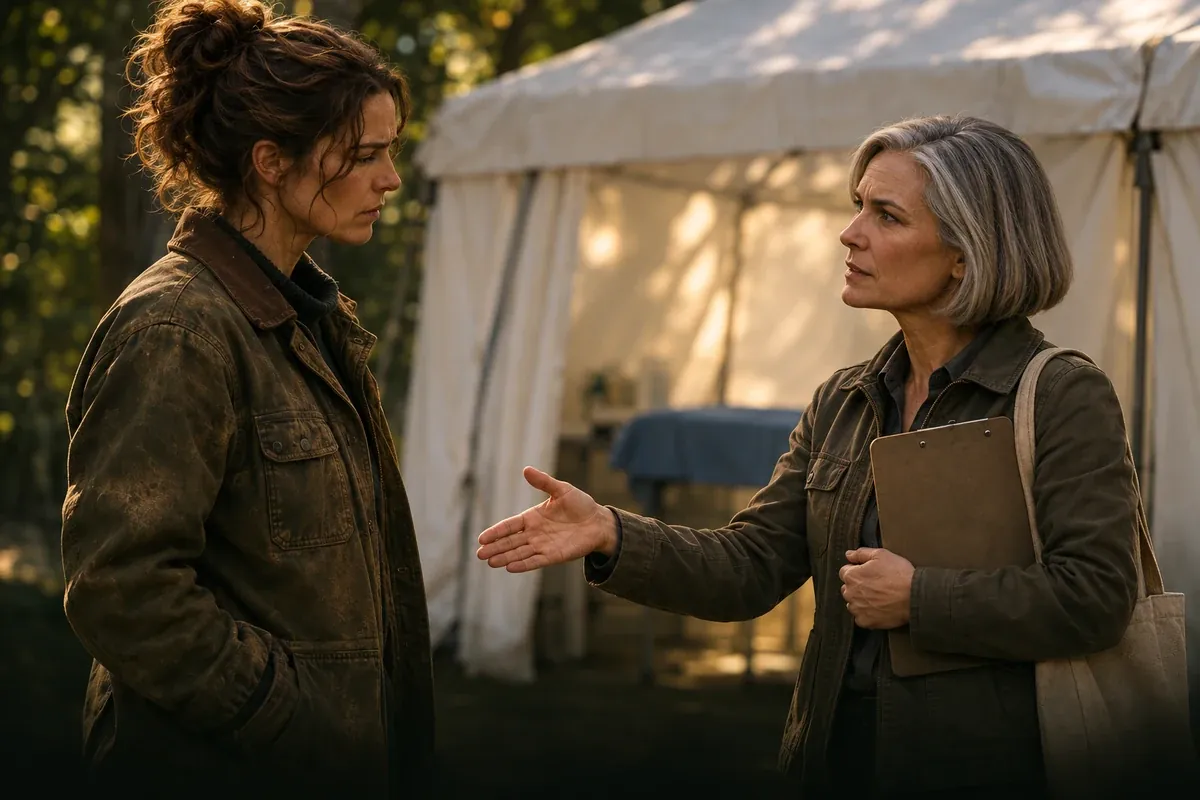
She was shorter than I’d expected, which is how it always goes. Early fifties, silver hair cut in a precise bob, a field jacket with the leaf stitched small over the heart, and a face that looked like it had never been surprised in its life. She held a clipboard, and a tote bag with a leaf on it, and she smiled with the exact amount of warmth a good insurance adjuster brings to a kitchen fire.
“Celeste Marchand,” she said, and offered a hand. “Lysark Bio. I run the county’s wildlife health initiative. I was watching from the tent. I thought that was extraordinary work.”
I didn’t take the hand. I’m not proud of it. I looked at it, soft and dry and well kept, and then at her eyes, which were gray and kind and measuring, and I let the silence do what I couldn’t.
“Dr. Mercer, isn’t it? I’ve read your file.” She withdrew the hand without offense. “Bold, to give tranexamic acid to a person. A less sentimental clinician might call that a license issue. But you chose compassion over procedure, and I respect it. We all make that choice.” She nodded at Von, still propped against Dane’s chest, pale and breathing. “Hemorrhagic presentation in a young adult female, acute onset, no trauma. Interesting.”
“She had a nosebleed,” I said.
“Of course.” Dr. Marchand tipped her head, a small bird’s gesture. “My initiative is concerned with an emerging disease in wild canids in this region. A hemoproteopathy, we’re calling it. Very rare, very localized, very interesting. We’ve been trying to find clinicians in the area who’ve seen unusual presentations. You treat the Hollis family’s animals, I understand. Ranch dogs.”
“I treat a lot of ranch dogs.”
“Do you.” She smiled, small and flat and perfectly civil. Her eyes didn’t leave my face, but I felt them rest, for a quarter-second, on Dane, who had gone stone-still, and on Von, and I knew with a cold clarity that she had added us up before I walked into the tent.
“I’ll be direct, since you strike me as a direct person. We’d welcome your cooperation. Our researchers could use a clinician’s eyes on the ground. We’d compensate you well. Your practice is, I understand, under some financial strain.” She said it so kindly it took me a moment to hear the hook. “The county has a budget for exactly this kind of consultation.”
“I’m not for sale, Dr. Marchand.”
“Everyone is for sale, Doctor. It’s only ever a question of the unit.” She tucked the clipboard under her arm. “Please think about it. I’ll be in Ferran’s Bend through the end of the month. And Dr. Mercer?” She lowered her voice, and the warmth went out of it as cleanly as a light going off, and what remained was reasonable, patient, and terribly sure. “A word to the wise. You’re a gifted veterinarian. You’re treating an invasive species. We’d pay you better to document it.”
She walked away across the crowded street toward her white tent, and the crowd parted for her without knowing why.