

Priya called at 7:40 the next morning, which meant she’d been awake all night, which meant I had slept two hours on the cot in the clinic office with a wolf’s worth of adrenaline still draining out of me through my ears.
“I need you to sit down,” she said.
“I’m lying down. It’s better.”
“Then stay there.” Paper rattled. Priya takes notes by hand when she’s afraid, an old habit from residency that I’d have recognized across a continent. “I ran your smears on a standard hematology scope and then I put the frozen aliquots on the big instrument. Intact-protein run, top-down, because I didn’t trust my own screen. Rowan. There’s a protein bound to the red-cell membrane in your samples that isn’t a canine protein, isn’t a human protein, isn’t a protein from any organism in the reference database.”
“Okay.” I sat up. “What is it?”
“It’s about forty kilodaltons. Highly regular. Self-assembles into hexamers on the cell surface — that’s your frost rosettes — and then it cross-links to a variant of hemoglobin that, as far as I can tell, only your patients have. Their hemoglobin has a shifted binding pocket. Don’t ask me why, I’m going to be thinking about that for a month.” She breathed. “But the protein is the thing. It’s recombinant. It has a tag.”
“A tag.”
“A six-histidine tag at the C-terminus. Six histidines in a row. Rowan, nobody’s body makes that. You put a six-histidine tag on a protein so you can pull it off a column when you purify it in a lab. It’s a handle. It’s the thing you bolt on so you can wash everything else away.”
She was quiet for a second. “Somebody made this protein in a bioreactor and purified it and put it into your animals. Or in their water or their food. And whoever did it forgot, or didn’t care, to cut the handle off.”
I sat with the phone against my ear and the cot springs ticking under me. Outside the window, the Route 11 trucks were going by on schedule, headed for the sale barn, for the lumber mill, for ordinary Wednesday. “You’re sure.”
“I’m sure about the tag. I’m sure about the structure, I ran it three times. The rest — the intent, the dosing, who — that’s your end.” Another pause.
“I’m going to put my neck out and say what you didn’t ask. If I saw this in a human cluster, I’d call the federal health people. I’d call the state epidemiologist. I’d call the investigators. I’m not calling any of them, because you told me not to, and because I know your face when you’re not saying something. But Rowan—“ and her voice cracked, just once, “—please tell me whoever’s in the middle of this is safe.”
“They’re safe enough,” I said. “They’re better than safe. They’re stubborn.”
“Good. Send me more samples when you have them. And Rowan? Whatever this is, you’ll want that tag in your pocket like a business card. Anybody who made this has the same tag in a database somewhere. It’s a fingerprint with a serial number.”
I wrote down six histidines. Then I wrote LC? next to it, because I needed a name, and the first thing I thought was Lysark Constructed, and it stuck, and I would call it LC-7 for the rest of my life.
I spent the afternoon in the clinic with my patient and a sleep deficit I’d stopped counting. Micah woke at two, thirsty and apologetic and under strict orders to say neither word to me again, and I rechecked the splint and the screw line and the neuro status while he narrated, with the humiliated precision of a boy who had been caught, everything he remembered of the cage.
He remembered the smell first, clean metal and water, and then the hush of the foam under his paws, and a very soft click when the door dropped. He remembered the green light. “It watched me,” he said. “Not like a person. Like a thing that was patient.”
Essa came at four and sat with him in the recovery room, and I let them have it, staying visible through the door without hovering. The old woman peeled an orange with her thumbs, the whole peel in one coil, and fed him the sections one at a time as if he were a child, and the two of them talked quietly in a tongue I only caught pieces of. When Micah slept again she stayed in the chair, small and upright, hands folded over the green cloth book in her lap.
“You’ll want to say it,” she said to me, without turning. “That I should’ve asked for help in March.”
“I wasn’t going to say it.”
“You were going to think it very loudly.” She smoothed the cover. “In the old country, gray gum killed whole parishes. My grandmother’s grandmother wrote down every name, because the priest wouldn’t. I started this book on my wedding day, the way my mother told me to. I’ve never been without it. When Alma sickened, I wrote the date and told myself the Hush would hold the grief, and the herbs the fever, and that was all a healer could do.”
She looked at the sleeping boy. “I was wrong for a lot of months. I’m eighty-one years old and I’ve never been wrong that long about anything.”
“You weren’t wrong. You had one tool and it was a good one. It’s just not a microscope.”
“Humph,” said Essa. But her thumb moved on the cover, once, the way you’d rub a worry stone. “That man,” she said. “My nephew’s son. He didn’t tell you why he fights the council on everything, I expect.”
“Dane?”
“He thinks he’s a lock,” she said. “He thinks his whole job is to keep things out. It never occurs to him that a lock can also be a door.” She said it too plainly to be an accident, and I looked at her quickly, and she gave me nothing but her profile, old and level, aimed at the boy asleep in the heat-lamp glow. “Go see if the girl wants coffee,” she said. “I’ll sit with this one.”
I went. I did not ask what she meant. I’m good at not asking things; it’s half of how I’ve survived. But the sentence went into my pocket anyway, next to the word Feel and the tag with six histidines, a growing collection of things that didn’t add up, and I could feel the sum, somewhere, waiting to be done.
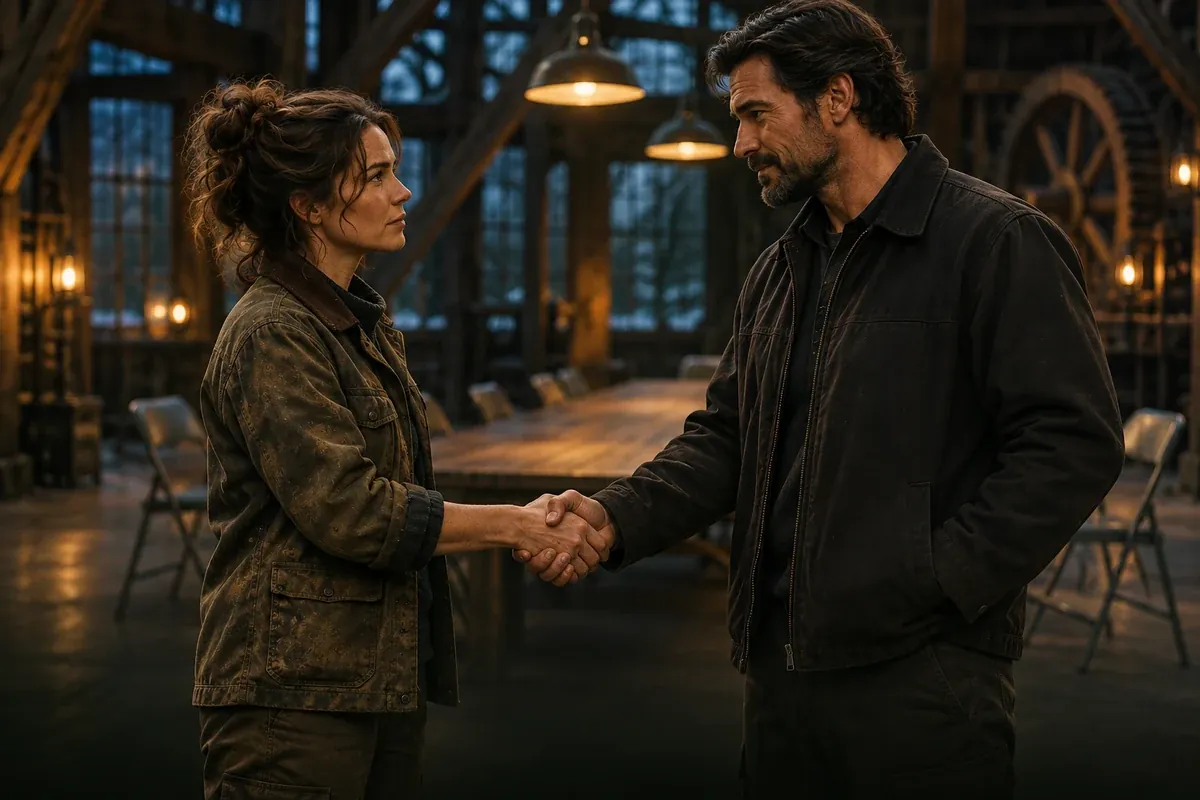
The council met at dusk. Not in the mill office this time but on the mill floor itself, thirty-odd people in a rough half-ring around the wide concrete where, a hundred years earlier, men had stacked planks. Folding chairs, workbenches turned sideways, a long table at the head with three seats. Dane in the middle. Essa on his right, her wooden box open before her like a tool chest. On his left, a vacant chair, and I understood slowly that it had been put there for me.
Von caught my elbow on the way in. “Don’t look at the four,” she muttered. “The four are the ones in the second row with their arms crossed. Harl’s kind of a teddy bear, for the record. The guy in the green vest is Ansel Tolliver and he doesn’t like anything. The last thing he liked was a TV show that got cancelled before he was born.”
“Is that a warning?”
“It’s a data point.”
I sat. The room went quiet the way a barn goes quiet when the farrier walks in, thirty heads turned and every one of them a different weather. Dane stood. He didn’t use notes. He told them, plainly, the way a man reads out a lab result, what I’d found: the strange cells, the ledger pattern, the trap with its logo, the tag.
He told them the word engineered, and watched it land. A hum of a different kind went through the half-ring — not the Hush, nothing so tidy. Fear, and under it something harder. Anger with nowhere to put its hands.
Then he sat, and Essa stood, and I saw I was about to be examined in public.
“The vet,” Essa said, “has asked for things.” She read them off her fingers. “The blood of every living member of this pack. The right to put her instruments in our creek and our taps. The records, mine, the green book, the births and the dead. The run of the Landing, any house, any hour. And the final word on who’s sick and who isn’t and who sleeps where, when she says.”
“That last one,” said Ansel Tolliver, rising, “is a whole bloody coup.”
“That’s the one I’m going to need to explain,” I said.
I stood, because I didn’t trust my knees sitting down, and walked to the center of the half-ring. Thirty faces. I was aware of my boots on the concrete, of the slant of window light, of Dane very still behind me. I had not prepared a speech. I never do; I prepare data and let the words follow, a habit that has gotten me through some bad rooms.
“Mr. Tolliver’s right,” I said. “It’s a lot. I’d say no to it too. So let me tell you what I’d be saying no to.” I held up one hand and counted. “One. Blood. Without it I’m guessing, and guessing is how I lost three patients in Colorado. I won’t write names on any tube. Your people become dogs. I’ve got a whole kennel. Nobody outside this room will ever be able to match a sample to a person. If somebody gets to the tubes, they get Biscuit, and Pepper, and a very confused hamster.”
A rustle that was almost a laugh.
“Two. The water. Eight weeks. The pattern isn’t a germ, it’s a schedule, and something with a schedule has to arrive somewhere on one. What do all of you do once every eight weeks, or once a day, or once a week, that nobody outside this valley does? You drink water that comes from one place.”
Ansel Tolliver snorted. “That intake’s older than the county. If it were the water we’d all be dead.”
“Not necessarily. We don’t know the dose. Or the schedule. Or who’s gotten more.” I met his eyes. “I’m not saying it’s the water. I’m saying it’s the next question, and I won’t know the answer unless someone lets me take a sample.”
“Three.” I raised a third finger. My hand wasn’t shaking. That made it a good day. “The records. Essa’s ledger isn’t the pack’s secret; it’s a dataset. Four deaths on a clock isn’t a tragedy, it’s a signal, and I’m not going to publish it and I’m not going to share it and I’m not going to tell a single soul without this council’s say. But I can’t read a pattern I’m not allowed to see.”
The room was quiet. Even Ansel had gone quiet, which in his case was a kind of attention.
“And four. The word.” I let it sit.
“Authority. Yes, Mr. Tolliver, I’m asking for a say over who sleeps where, and I’ll tell you why. Because if this is contagious — and I don’t think it is, but I can’t rule it out — then the difference between a good decision and a bad one is about eighteen hours. That’s not enough time to call a council. It’s not enough time for a vote. It’s enough time for one person to say, ‘You, stay in; you, stay out,’ and be right. I’m not asking to run your lives. I’m asking for the right to make the call in an emergency, and be accountable to you after for every one.”
A long silence. Then, from the second row, Harl, who hadn’t spoken: “And if you’re wrong?”
“Then I’m wrong, publicly, and you can replace me.” I took a breath. “But I’m warning you now, I’m not usually wrong about the next eighteen hours. I’m wrong about the long run all the time. That’s why I want the council.”
Someone laughed. Someone else said, quietly, “Honest, anyway.”
“That’s the trouble with her,” said Essa, from the table, with a tone I couldn’t read and wouldn’t have wanted to. She had her arms crossed and her chin up and her old eyes on the floor, as if the concrete were a ledger. “The trouble is she means it.”
“Council,” Dane said. He didn’t raise his voice. He didn’t have to. “The question is whether the retainer stands as written, with the changes she’s named. Hands.”
I didn’t look at the hands. I looked at the floor, at a long crack in the concrete that ran from my left boot to the wall, and I counted it. I count things when I’m afraid. When I got to nineteen, a woman near the back said, “Count’s in,” and I made myself look up.
Eighteen hands, out of thirty-one. A majority, narrow as a surgical margin. Ansel Tolliver’s was down. Harl’s was up. Essa’s, I saw — I’m not sure why this undid me — was up first.
“Stands,” said Dane. He rose and came around the long table toward me, and put out his hand, the way he’d done at the clinic. “On the terms you’ve named. Dr. Mercer.”
I took it. And the same current went through my fingers that went through them the first time — warm, dry, large, a flicker of static like a fuse blowing three counties away — and Dane Hollis drew a sharp, short breath, and let go as if the contact had burned him, and put his hand in his pocket.
“Sorry,” he said, to the floor. “Cramp.”
“You’ve got a lot of those,” I said. “I’ll write you a prescription.”
He didn’t laugh, this time. He looked at me for a half-second longer than the sentence needed, with the look of a man holding an enormous object very carefully behind his back. Then he said, “Meeting adjourned,” and the half-ring dissolved into thirty conversations, and I stood in the middle of the old mill floor, with its smell of cedar and cold concrete, feeling inexplicably like I’d won something and been handed the bill.
The ride down the mountain was Von’s, in her own battered truck with the dash light out and a country station she didn’t turn up. She drove with one wrist and sang half of every song, off-key. The night folded around us, black and enormous. We’d gone about three miles before she said anything at all.
“That was good,” she said. “Back there. That was really, really good.”
“Thanks.”
“I mean it. My brother’s been holding that roof up by himself for eight months and you walked in and gave him a chair.” She wound the wheel through a switchback, eyes on the road. “Can I ask a weird question?”
“You can ask.”
“When you shook his hand.” She wasn’t looking at me. “Just now. And at the clinic, Essa told me. And the first morning, when you took his pulse.” Her voice had a funny carefulness, like a woman stepping on ice she knew was thin. “You really don’t feel it?”
“Feel what?” I said.
Von was quiet for a full quarter mile. The headlights swept over a deer standing at the roadside, eyes like coins, that watched us pass with the placid contempt of its kind. When Von spoke again, her whole voice had changed — gentler, older, as if somebody had opened a window onto a different room.
“Nothing,” she said. “Forget I asked.”
I didn’t forget. I never forget. It went into the second notebook that night, under the dog names, in the margin next to the one word I couldn’t have explained to anyone: Feel what?