

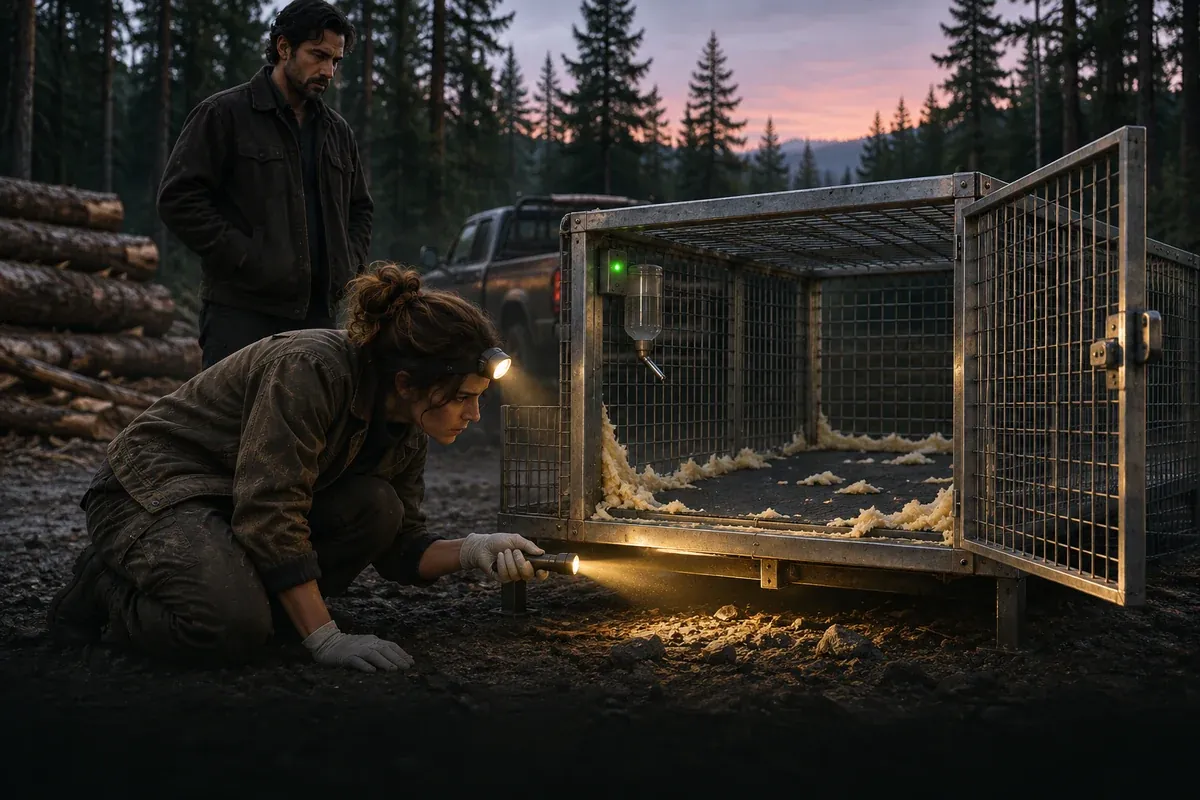
The ridge road is not a road. It’s a rumor of one, two ruts and a spine of loose shale that climbs out of the Landing through lodgepole so dense the headlights turned the trunks into bars.
Dane drove it with the window down and his head half out of it, nose into the wind like a dog on a highway, and every time I opened my mouth to ask what he was tracking he said, “Wait,” and I waited, because I had learned in four days that Dane’s waits were never evasions. They were him listening to something that I couldn’t hear and he couldn’t explain.
I had the field kit between my knees, the trauma bag open on my lap, and a list running in my head the way it does when I drive to a calving: sedation, fluids, splint, light. Two headlamps, one of them mine. A rope. A quarter-gram of thiopental I’d never have dared stock in an ordinary practice and had bought at an old supplier’s liquidation sale, because a rural vet owns exactly three miracles and keeps them under a false-bottom drawer.
“Von’s already up here,” Dane said, at a switchback. “Three of the others too. They’re spread along the firebreak.” He said it flat, but his knuckles on the wheel were the color of old bone. “She’ll find him first. Then she’ll call, and I’ll decide whether to be angry.”
“Be angry later,” I said. “It keeps.”
“Does it?”
“No. But the idea of it is a comfort.” He gave me one quick sideways glance that on any other man I’d have called a smile, and I looked away, out the window, at the black shapes of the trees going by.
For a while there was only the engine and the tires’ dry argument with the shale. Then Dane said, to the windshield, “You’re not afraid of me.”
“I’m afraid of a lot of things. Heifers on ice. The bank.” I watched the trees go by. “You, no. It’s a little insulting, honestly. I keep waiting to be afraid of you and you keep handing me equipment.”
“I’ve never known how to be frightening to someone who’s useful.”
“That’s the nicest thing a man has ever said to me with a dead teenager’s worth of stakes on the line.”
He laughed. It startled both of us, a short rough sound, like a starter motor on a cold morning, and it stayed in the cab a long moment after it was gone. “He’s not dead,” he said.
“He’s not dead. I don’t let them be dead on my watch unless I’ve asked first.” I hadn’t meant to say anything more, but it was four in the morning on a ridge, and the dark makes confessors of us.
“I lost three patients in Colorado the same week the board came. One was a retriever named Marigold whose owner bought me a card. I don’t think about her, ever, in the daytime. I think about her about once a night. So when I say I don’t let them die, understand it’s because I know what the other thing costs.”
Dane didn’t turn his head. His hands tightened and loosened on the wheel. “My father used to say the pack was a promise you make to the dead, and every day you keep it, you owe them another.” A pause. “I used to think that was a comfort.”
“And now?”
“Now I think he was describing the debt.” He took a corner too slowly, the way a man does when he doesn’t want the trip to end and can’t say so. “I’m glad it was you at the clinic. I’d like to say it plain, now, in case there’s no plain time later.”
My throat did something. I said, with enormous professionalism, “Your gratitude is noted in the chart.”
“Good.” And the corner of his mouth moved, and I looked out the window again, with both hands clamped around the trauma bag as if it might fly off the seat.
Von’s call came forty minutes into the climb, on the radio taped to the dash. Her voice was thin and fast, stripped of its jokes. “Dane. East side, past the second creek crossing, the old logging landing. He’s in something. A box. A trap, a cage, I don’t know. It’s got him. He’s not shifting and I can’t— he’s awake, he’s looking at me, he’s not making any sound.”
“Don’t touch it.”
“I wasn’t going to, I’m not stupid—“
“Don’t touch it,” Dane said again, quieter, and I understood that the order was less for her than for the wolf in him, the part that would want to rip a cage apart with bare hands and wasn’t permitted to.
We found them on the old landing, a flat bench of ground where loggers once decked their timber and where the lodgepole had since come back in a green rash, and the first thing I saw was Von, crouched twelve feet from a cage with her fists jammed under her armpits like a child told not to touch the stove. The second thing was the cage.
I’ve seen a thousand traps. Bear snares, coyote cables, leghold jaws on fence rails, the gnarled homemade nonsense ranchers build out of tire chains and bad temper. I know what poachers make. They are made for killing, or for holding what they’ll kill later, and the metal has the dull rust of things built by people who didn’t want to spend money.
This was the cleanest trap I’ve ever seen.
A box of stainless mesh, five feet by three, with a spring-loaded door and an interior padded in food-grade foam. A water nipple fixed to one wall, like a rabbit’s hutch. A small battery pack and a status light — green, steady. A trail camera strapped to a tree two yards away at exactly the angle you’d choose to record what came in. No blood. No chain. No teeth. The kind of trap you build if you want a living animal for study and can afford to treat it kindly.
Inside it, a wolf with a freshly healed foreleg lay on his side with his chest hammering and his eyes on me.
“Micah,” I said. “Good. Good boy. I’m here.”
He couldn’t answer. He looked at me with amber eyes full of the whole confusion of a nineteen-year-old who’d been told to rest and had gone to find something he thought was his to fix. The surgical leg was tucked under him, and I saw, even at that distance, that he was favoring it.
The splint was gone; the carpus had a new twist in it. In the cage, his breath came in short heaves, and the whites of his eyes rolled once toward the corner of the cage, where the foam padding had been shredded in a spiral around the latch.
“Eight hours post the pull,” I said, to nobody. “He climbed a ridge on a plated leg and tore a cage up from the inside and the plate held. God, Essa’s broth.” I was talking to keep my hands busy. “Dane. Don’t get any closer. Everyone back.”
“Rowan—“
“He’s panicking, he’s got a titanium plate and a cage latch, and the last thing I need is a hundred-and-forty-pound wolf thrashing into a man who can’t stop himself from helping. Back. All of you.”
Dane went back. I watched the strain of it travel across his shoulders — the rage and the ache of obeying somebody else’s order about his own — and then I knelt at the mesh and began the part of the night that I am, God help me, best at.
You don’t cage-sedate a wolf like a dog. You talk first. I talked the way I talk to everything, low and level and with no hurry in it: what I was going to do, the pinch he’d feel, the cold that would follow. I narrated the syringe.
I told him that when he woke up there’d be a lot of fuss and a lot of food and Essa would be insufferable about it. I told him I would not let go. And I reached through the feeding slot with my left hand, flat, palm up, fingers slow, and he put his chin in it.
I will remember that for the rest of my life. A wolf that large, afraid, injured, in a trap, with six of his own people within a hundred feet, and he put his heavy head in my hand and shut his eyes like a child settling for a story.
The thiopental went in at 3:52. By 3:56 he was out, and I was in the cage with a headlamp in my teeth and both arms around a hundred and forty pounds of unconscious predator, feeling the foreleg, checking the plate.
“He’s got a fracture at the screw line,” I said. “Not new, a stress failure, from the cage. It’s not displaced yet.” I laid the leg across my knee and wrapped it with whatever I had — a malleable aluminum splint, vet wrap, a rolled foam splint from the trauma bag — and my hands worked while my mouth ran: “I need him out of here, flat, supported, no jostling. Von, take his head. Dane, take his hips — keep the foreleg level. On three. One, two—“
We lifted him together. The wolf’s weight went through us like a rope through a pulley, and Dane’s hands under the hips were where mine told them to be and not an inch from it, warm through his jacket sleeves, braced, steady. When we shifted position at the cage door, in the flat white of the headlamps, we ended up close enough that I could see the sweat at his hairline, the pulse in his neck going slow and heavy and not quite slow enough.
“Okay,” I said. “Down the slope. Slowly. A stretcher—“
“We don’t have a stretcher,” Von said.
“We have a tarp,” said Dane, and I looked at him. “We’ve carried worse.”
I’d learn that was the pack’s creed, a thing they said without noticing, the way a family says grace. We laid Micah on the tarp and bore him down the hill in a procession of headlamps, five people and one hundred and forty pounds of sleeping boy-wolf, with me walking beside the tarp holding the splint with both hands and an IV bag between my teeth, counting his breaths aloud so I could stop counting my own.
It was past five when we got to the truck. I’d given fluids, checked his pupils twice, re-wrapped the splint, and tucked a coat under his head with the pretense that it was for the bruising. Dane had stood over us through every minute, two feet away, hands in his pockets, face carved out of something that doesn’t weather.
“He’s stable,” I said, at last, sitting back on my heels in the truck bed, suddenly very tired. “The plate held. The fracture’s a hairline. He’ll need three weeks of rest and I will personally tie him to the bed. Where did he get the idea that going back up there was a good idea?”
“He said he smelled it again,” Von said, from the tailgate, her voice flat and small. “On the ridge. The clean metal. He texted me — before he went. I didn’t read it until— I was asleep, Dane, I’m sorry.”
“It’s not yours to be sorry for.”
“It’s a little bit mine.”
“No.” Dane crouched in front of her and took her face in both his hands, the way I imagine a man does with someone who’s been his sister since before either could talk. “It’s mine. I told the pack to stay off the ridge and then I didn’t ask why it needed telling.” He breathed. “That’s the last time I give an order without asking what’s behind it.”
I did not look at them. Some things, you let a family have. I walked to the far side of the truck and busied myself with the IV line, and found, to my irritation, that I was being watched. Harl, the hatchet-faced elder from the casserole lunch, had come up the slope with the rear guard and was standing at the tailgate with his arms folded and his cap pushed back, studying me with the impassive attention of a man pricing a horse.
“You went in the cage,” he said.
“The cage wasn’t going anywhere.”
“The wolf could’ve bitten you.”
“He could have. Wolves with plated legs and no sedation usually do. I used the thiopental, which is a very good idea and wasn’t mine; it’s just how this works.” I checked the drip rate. “I know what you’re going to say.”
“I’m going to say,” said Harl, “that I voted against you, and I want it known I’d vote that way again for any outsider, and I also want it known that was the bravest thing I’ve watched anybody do in this valley in twenty years.” He settled his cap.
“That’s all. Don’t let it go to your head.” And he went back down the slope, a stiff old man in the gray light, and I stood there with an IV bag in my hands and tried to remember when anyone had last handed me a compliment I couldn’t invoice.
Von, passing, bumped my shoulder with hers without looking up. “That’s a standing ovation,” she murmured. “Frame it.”
I thought about the empty frame in my lobby, and decided, privately, that I might.
I looked at the trap instead, still sitting on the bench of the old landing in the thin dawn, because the dawn had come up while we’d been busy, a cold gray going pink.
The mesh door stood open and the foam was shredded and the little green light was still blinking, patient and indifferent, a machine that had done its job and was waiting for the next. I walked back to it, and Dane, behind me, said, “Rowan,” in the tone of a man who knows what I’m about to do and has decided not to forbid it.
I knelt. I put the beam of my headlamp on the underside of the trap, along the frame where a manufacturer stamps the thing it wants known. And there it was, laser-etched into brushed steel, clean as the trap itself, a short string of characters and a tiny logo I had seen two days before without seeing it, in the corner of the glossy one-pager a salesman had dealt onto my counter, the one with the drone photograph of my town.
LY-4471-C.
A little stylized leaf. And under it, in letters small enough to need the lamp: LYSARK BIO · FIELD UNIT.