

Priya Nair answers her phone the way she answered it in vet school, which is to say on the fourth ring, mid-chew, with the voice of a woman who has been awake since a different decade. “If this is about the horse that ate the drywall,” she said, “the answer is still no.”
“It’s about something worse.”
“Rowan Mercer.” The chewing stopped. “You haven’t called me since the Colorado thing. I assumed you’d joined a convent.”
“I opened a clinic.”
“That’s the same thing with more manure.” But the voice had gone warm and careful, the way a friend’s voice goes when she suspects the favor is the real call. Priya runs the pathology service at the state diagnostic lab, three hundred miles from my feed store and a universe away in equipment.
She is the only person from my old life who sent a card when the board suspended me, and the card said, in her terrible handwriting, YOU DID NOTHING WRONG EXCEPT TRUST A MAN WITH A FANCY CAR. I still have it. It’s in the drawer under the second notebook.
I told her what I could, which was less than I wanted and more than I should. A canine patient, a cluster of unexplained cases, abnormal red cells with a crystalline surface pattern I’d never seen. Samples I wanted to ship anonymized, no names, no source, labeled with whatever she wanted.
“A cluster of how many?”
“Four dead. Possibly more sick. Eight weeks apart. Almost to the day.”
Silence. A long one. When she came back her voice had dropped out of friend and into pathologist. “Eight weeks apart. That’s not an infectious pattern, Rowan. That’s a dosing interval.”
“I know.”
“Do you know what you’re telling me?”
“I’m telling you I’m not sure yet, and I’d like someone smarter than me to be unsure alongside me.”
“You are such a pain in my ass,” Priya said, fondly, and rattled off an overnight address and the packing protocol I’d forgotten: frozen aliquots on dry ice, double-bagged, fixed smears in a slide mailer, paperwork reading research submission, species: undetermined canid, no diagnostic request. “I’ll run it on the big mass spectrometer myself after hours. I’m not putting it through intake. If your cluster is what your voice says it is, somebody upstream is going to want to know who’s looking.”
I hung up with my hands cold and Jo watching me from the doorway with a cardboard shipping cooler in her arms. She’d already pulled the dry ice order. She’d also already, I noticed, labeled the box with my home address instead of the clinic’s.
“Just in case,” Jo said.
“Just in case of what?”
“You told me yourself. It’s not paranoia if the man leaves his engine running.”
It took the afternoon to prepare. You do not ship a frozen secret across three hundred miles without ceremony: aliquot, label, log, photograph, seal, photograph again. When I handed the box to the driver in the lot he asked what was in it and I said, “Research,” and he said, “Looks heavy,” and I said, “It’s mostly ice,” which was true in at least two ways.
Dane arrived after closing, as he’d arrived every night that week. He came in through the lobby and stopped, as he had before, in front of the wall where my license hangs in its cheap black frame, and beside it the second frame, the empty one.
“Dr. Albee did that,” he said, nodding at the license. “Mentor. You mentioned him to Essa at the mill, when she asked about your training.”
“I did?” I didn’t remember saying it.
“You said he taught you to suture. In the same breath you said you’d never use his technique again.” He turned from the wall. “I’m not asking. I notice things, it’s a bad habit. The empty frame.”
“The empty frame is a joke with one reader.”
“Then I’ll be a polite audience.” He said it with such grave seriousness that I laughed, and the laugh sprang a leak somewhere I’d been bailing for three years. I told him. Not all of it.
Four sentences, flat: that I’d co-signed charts for a boss who was diverting the anesthetics, that I hadn’t known until the day a state investigator did, that the board had decided ignorance was a kind of negligence and had suspended me for eleven months, and that when I got the license back I’d hung a second frame beside it for whatever the board owed me in the way of an apology. “I’m still waiting for the document,” I said. “It’s a long wait. I like to keep the nail warm.”
He didn’t say he was sorry, which I had braced for and would have hated. He said, after a moment, “Eleven months is a long time to be told you can’t do the one thing you’re good at.”
“Yes.”
“And you came here anyway, and put it back on a wall.”
“I put it on a wall in a feed store in a county with one stoplight, Dane. It’s not a victory lap.”
“No,” he said. “It’s a stubborn woman who doesn’t know when to quit.” And he said it with so much respect that I had to go check a thermometer I didn’t need to check.
When I came back he was standing on the threshold of my lab again, pointedly, the way he always did. I’d stopped pretending the threshold was a coincidence. It had been an offer, the whole time: a man holding the door open for me by never walking through it uninvited.
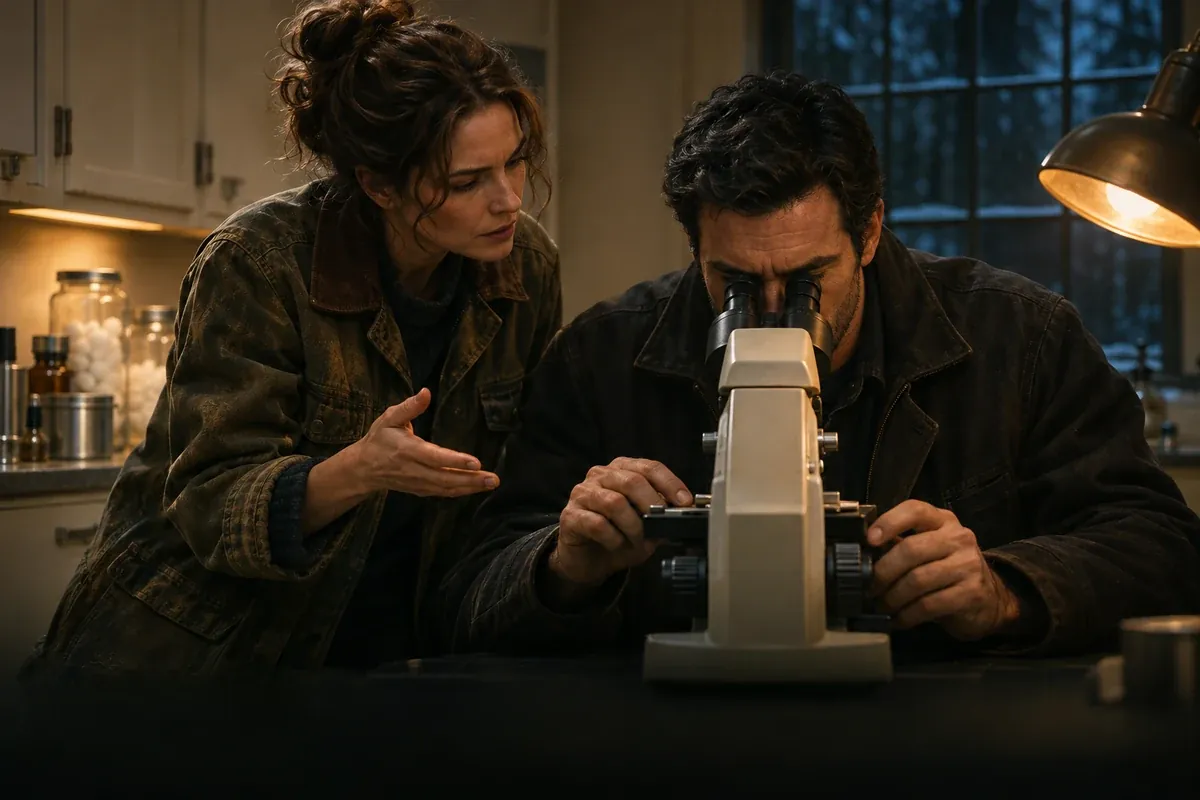
“Come in,” I said, without turning from the microscope. “I’m about to show you something and I don’t want to do it in a hallway.”
He came in. The lab is eight feet by ten; he filled a third of it. I’d taken the stool off the bench to give him my chair, and he looked at the chair as if it were a diplomatic gesture, and sat.
“These are Micah’s red cells,” I said. “Look.”
I got him to the eyepieces and talked him through the focus and watched his big hands settle on the stage, careful as a man defusing something. He looked for a long time. “I see dots,” he said finally.
“Those are not dots. Those are rosettes. Frost on a windshield. Each one the same size, the same six-sided shape, laid out in rows on the cell surface. In nature, things like this are rare, and when they happen they’re messy: crowded here, missing there. This is typeset. This is a machine making a thing it knows how to make.”
He sat back. The chair creaked. “You said that to Essa.”
“I said something like it. Essa said a word in old Gaelic that I’m told translates, roughly, to ‘bad.’ And then we looked at her ledger, and it said March, May, July, September, and I stopped being able to pretend this was weather.”
I made myself say the next part gently, because I’d begun to see how each piece of data landed on him like a physical blow he refused to flinch from. “Dane, I think someone is dosing your pack. Not poisoning, the way a poacher would. Dosing. Measured. On a schedule. A clinical trial with no consent form.”
The lab was very quiet. He sat looking at his hands, and then he said, in a voice I would not have known for his, “Four people.”
“Four that I know of.”
“Alma taught me to fish. I told you that. She stood in the creek with me when I was nine years old and held my hand on the rod.” He looked up, and I saw the rage in him, the real one, the one he spent every waking hour compressing into manners. “If you’re right, Rowan, I’ve been burying my people for eight months and I never once asked who was handing out the shovels.”
“You didn’t know.”
“It was my job to know.”
“It was your job to protect them. Nobody’s job description includes divination.” I heard my voice sharpen. “I’ve had patients die of things nobody could have caught. I’ve also had patients die of things I should have caught, and I can tell you precisely how much the second kind weighs. Don’t compare the weights until you’ve got the facts.”
I put my hand, briefly, flat on the bench between us, not on him, and the gesture sat there anyway, a bridge of eight inches of laminate. “We find who. Then we decide what’s yours to carry.”
He looked at my hand, and at his, and the eight inches between them seemed to take on dimension. “You’re very hard to argue with.”
“It’s a trained skill. Mostly useful on cattle.”
The corner of his mouth moved. The first real expression in thirty hours. It rearranged everything. His whole face, which had been a closed door, opened a quarter inch, and I could see the man behind it — younger, not structurally tired but ordinarily tired, the way a person is tired from caring about things — and my stupid, disloyal, expert pulse answered it before I could stop it.
“Rowan,” he said.
“Mm.”
“I want to say something and I don’t have the order right.”
“Then say it in the wrong order.”
He opened his mouth. The phone on the front desk rang, the emergency line, the dedicated one, the one that rings at the end of every good moment. Then rang again, insistent.
“Mercer Veterinary,” I said, three strides later, a little breathless, and an old man’s voice said, “It’s Teague at the Shale Flats. She’s down. The mare. She’s down and she’s pushing and there’s one leg and I don’t know what I’m looking at.”
Of course the mare.
It was a malpresentation — a front leg back, a classic, the sort of problem you can solve in forty minutes with a clean sleeve and good lubricant or lose both animals to in two hours without them. I grabbed my kit and my chains and said, “Get in the truck,” to Dane without thinking, because I needed hands, and he did not ask what for.
The Shale Flats is a thin pasture on a thin wind, and Teague’s barn at one in the morning was a yellow box of light and the smell of straw and fear. The mare lay flat in the aisle, ribs heaving, eyes rolling white.
I got to my elbows in the mud of the birth canal in four minutes and found the foal’s head, one forelimb, and nothing else — the second leg folded back at the knee like a hinge. I told Teague to hold her head. I told Dane, who’d come in behind me with a face like granite and absolutely no clue, to put his hand here, under the mare’s tail, and push against the foal’s shoulder on my word.
“Push it back,” I said. “Away from me. I need room.”
He did. And I want to say something about Dane Hollis’s hands, for the record, since I’ve been so reluctant elsewhere: he had the gentlest pair of hands I’d ever watched do violence. He pushed the foal back, not like a man shoving a boulder but like one persuading a ship out of a harbor, with a patience that made the mare’s whole body ease around it. I got my fingers around the folded knee and cupped the hoof in my palm so it wouldn’t tear her, and drew it forward.
The foal came out in the long slide, wet and limp and then not limp, a filly, and sneezed. Teague, who is eighty-one and has delivered four hundred foals and loses it every single time, started to cry quietly into the mare’s neck.
I wiped my arms with towels. I was standing in a barn at three a.m. with mud to the shoulder, a trembling new filly, and a man beside me who smelled like cedar and cold air and lacked entirely any capacity for small talk, and he said, softly, “Is she all right?” — and for a second I did not know whether he meant the filly or me, and I answered both.
“She’s perfect. So am I.”
Teague tried to pay me in eggs. I told him I’d take the check, he told me he didn’t write checks, he wrote notes on the back of feed receipts, and we negotiated a settlement of two dozen eggs, a jar of chokecherry jelly, and his word that the next time a mare looked at him funny he’d call before midnight.
Dane stood by the barn door the whole time, holding the filly’s lead rope as if somebody’d handed him a newborn nation, watching the foal find the udder on her third attempt and her fourth, getting bumped by a nose that didn’t care who he was.
The corner of his mouth moved again, and then he looked down at the foal, and the whole face came open, straight on, defenseless as a child at a window. “Look at that,” he said, to nobody. “Look at her.”
And I looked. Not at the filly.
My phone buzzed in my pocket and I let it, for five seconds, ten, a luxury I don’t allow myself. When I finally took it out the screen said VON, 3:14 A.M., and under it, in her all-caps style, a text she’d sent twice, with the second copy arriving as I read the first:
MICAH’S GONE. HIS BED’S EMPTY AND THE WINDOW’S OPEN. HE TOOK THE RIDGE ROAD. ROWAN I THINK HE WENT BACK UP.
I handed Dane the phone. I watched his face close — the door sliding shut, bolt after bolt, every hard-won inch of the last hour sealed over — and he was already moving when I caught his sleeve.
“Wait. He’s post-op, he’s got a titanium plate, he’s not fully through the neurologic window. Whatever he’s doing, he’s not doing it clearly.” I said it fast, a medical order to a man who was no longer hearing orders. “Take me with you.”