

By the time Dub Teague reaches the part where a thirteen-year-old heeler inherits one point six billion dollars, I have done the math on my business loan three times, and Pickle has passed gas twice.
The first one earns a cough from the court reporter. The second one earns a look from Margit Voss that could frost a windshield.
I do not apologize. He is not my dog. Not yet. Right now he is an eleven-thousand-acre problem with one eye, lying across my left boot under a conference table that smells like sacked oats, because Teague & Teague, Attorneys, sits on the second floor of the Saddle Gap feed store and the whole building has smelled like oats since 1962.
“Per the instrument,” Dub says, and lowers his reading glasses to look at us over them. He is seventy and shaped like a fence post, and he reads a will the way other men read scripture, as if the words might be graded. “I will read that again for the benefit of the room.”
“Please don’t,” says Dennis Pell.
“It is a matter of record, Dennis.” Dub finds his place with a finger. “To my dog, Pickle, the thirteen-year-old heeler of Cold Spring Ranch, I leave my fifty-one percent voting interest in Brandt Cold Chain, to be held in trust for his natural life, directed by his guardian, Dr. Josephine Marrow, who must reside at Cold Spring Ranch for so long as he lives.”
Nobody breathes. Somewhere below us, a pallet jack rolls across the feed store floor, and a man yells that the layer pellets are on aisle four.
I am still wearing a disposable bootie on my right foot.
I came straight from a calving. A first-calf heifer on the Delaney place, backward calf, two hours with my arm in to the shoulder, and when the text came from Dub’s office saying the reading had been moved up to ten and my presence was “strongly advised,” I had a choice between showering and being late. I chose late.
So I am sitting at the table of the richest family in Montana in scrubs with something dried on the knee, a work coat with one cuff chewed off by a goat named Dolores, and a blue paper bootie that is slowly coming off in the heat.
Across from me, the Brandts sit in their funeral clothes like a row of expensive crows.
Margit, at the head, is sixty-six and wearing a silver bob, pearl studs and a scarf the color of a bruise. She laughs. It is a small, bright, lovely laugh, the sound a hostess makes when a guest has dropped a tray.
“Wendell,” she says. “Darling. My brother has been dead for thirty-two days, and you are asking this room to take seriously a gift of control of a three-billion-dollar company to an animal that eats his own vomit.”
“I’m not asking anyone to take it any way, Margit. I’m reading it.”
“As a practical matter,” says Dennis Pell, and I watch him do the thing I have already seen him do twice this morning, which is smile first and speak second, “no probate judge in the state is going to let this stand. I say this with the greatest respect for Gus. Pet trusts are meant for tuna and cashmere beds. Not for voting rights.”
Pell is fifty-five and beige. Beige suit, beige tie, beige hands that came across the table at me when I walked in, soft as dough, with a warm squeeze. He remembered my name before I said it. He told me he was sorry about my father. I have been thinking about that for an hour, because I do not remember telling anybody here that my father is dead, and my father has been dead for fourteen years.
“Dennis,” Dub says mildly. “I drafted this instrument at Gus’s direction. It has been tested in Pronghorn County court twice, once by a cousin and once by a disgruntled nephew. It was executed in front of three physicians, each of whom certified in writing that he was of sound mind, and one of whom is a neurologist from Salt Lake who, I gather, asked a great many questions about the dog.”
“It was a prank,” Margit says.
“It is a very expensive prank, then,” says Dub, “and legally airtight.”
I look at the table. I look at the grain of the wood, a knot like an eye, and I do not look at the man at the other end of it.
He has not said a word. He has not moved. Colton Brandt, thirty-four years old, chief operating officer of Brandt Cold Chain, the son, the heir, the obvious answer to every question in this room, is sitting with both hands flat on the table and his gaze fixed on a point somewhere around my collarbone.
I know exactly how long it has been. Ten years, two months and some days. The last time I saw that face it was twenty-four and sunburned and leaning out the window of a rental car in my father’s driveway, saying he’d write.
He grew into the jaw. He has a gray suit that fits like it was poured on, and a wristwatch with a cracked leather band, and shadows under his eyes like thumbprints. He looks like a man who has not slept since the funeral.
And he is looking at me. Not through me. At me. For the first time in a decade.
Okay, I think. Okay. Okay.
It is a habit. When I am scared I count. Forty-one pounds of dog on my foot. Heart rate, mine, a hundred and four, which is fine, which is a healthy mammal reacting to a stressor. Respiration fast. Pupils, probably blown. A woman in shock would be pale and cool and quiet. I am pale and cool and quiet.
“Dr. Marrow,” Dub says, “you will want to hear the rest.”
“I think I’ve heard plenty.”
“No, ma’am. I don’t believe you have.”
He turns the page. The paper is heavy, cream-colored, with a watermark, and I see that the next paragraph has been typed in a different font from the first. Dub reads it slow.
“The guardian shall be paid for each monthly examination of the dog at her usual rate, which I am told is too low. The guardian shall have the free run of the ranch, its larder and its library. The guardian shall make no decision about the dog’s care that is not hers alone to make.”
Margit stops smiling.
“And,” Dub says, and takes off his glasses entirely, “should the dog die in the guardian’s care, by neglect or otherwise, the shares pass in full to the Brandt Family Foundation, to be administered by its directors.”
There it is. The sound of a trap closing is not a snap. It is a small, polite click.
“By neglect,” I say, “or otherwise.”
“Those are the words.”
“What does ‘otherwise’ cover, Mr. Teague?”
“Anything, Dr. Marrow. That is rather the point of the word.”
Margit Voss is the Foundation’s chair. Dennis Pell is its treasurer. Neither one of them has looked at me for a full minute, which is how I know they are both thinking about it. A thirteen-year-old dog. A guardian with no money, no lawyer, a clinic she is about to lose. A very large prize at the end of a very short rope.
I think about the thirty seconds I spent in the ranch driveway this morning, checking Pickle’s gums, counting his respirations against my watch, and I think: that’s going to be the rest of my life. Counting.
“I want to decline,” I say.
Everyone looks at me.
“Is that permitted?” I ask. “Declining?”
Dub does not answer right away. He folds the page with great care and puts it down on the blotter, and I understand that he has been waiting for this question since he wrote the document, and that he does not like the answer.
“It is,” he says. “If the guardian declines, guardianship passes to the Foundation. The Foundation’s chair would take custody of the dog. The shares would be voted by the Foundation’s directors for the dog’s natural life, and the trust would continue.”
“So I walk away,” I say, “and Margit gets the dog.”
“I would give him such a lovely kennel,” says Margit.
Under the table, Pickle lifts his head.
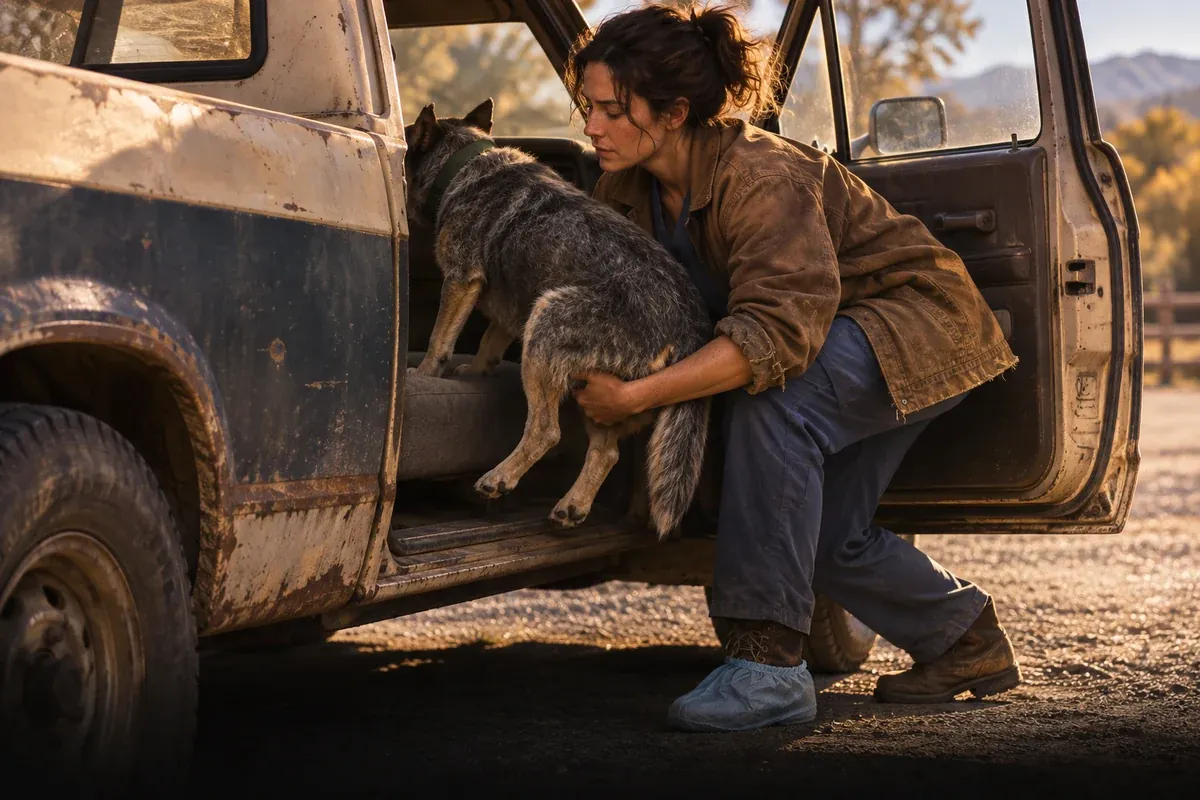
He is a blue heeler, mottled like a blue-gray river stone, with a muzzle gone white and a chewed ear tip and a left eye that was lost to barbed wire when he was nine. I know, because I was twenty-six and in my first year of practice and I stitched the socket shut on the Brandts’ kitchen table while Gus Brandt held the dog’s head and cursed me in a steady, gentle voice, like a man talking to a horse.
The right eye is brown and cloudy and full of opinions. He is deaf on that side too. When he wants to look at you, he turns his whole body, like a ship coming about.
He turns it toward Margit.
He looks at her for a long moment. Then he lays his chin back down across my boot and sighs, and I swear to God, the whole room hears it.
“Kennel,” I say.
“Climate controlled. We have a place in Billings.”
“Does the place in Billings let him eat first?”
Margit’s eyebrows rise a quarter inch. “I’m sorry?”
“It’s a thing he does. At meals. He gets fed before everyone else.” I can’t say why I’ve said it. It is the only fact I have that the room might not. “Gus used to say it. Feed the dog first.”
Something goes across Cole’s face, fast, a window shade snapping up and down. His hand moves a half inch on the table, toward the watch.
“Everyone in that house knows that rule,” Margit says. “Gus was a sentimental old man at the end.”
“Yes,” I say. “That’s what I thought, too.”
I look down at the bootie coming off my right foot. I look at the dog. I think of the Pronghorn Valley Savings foreclosure notice taped to the glass of my clinic door, dated this morning, a neat white rectangle with a number on it. Two hundred twelve thousand dollars. That is what I owe for buying out Dr. Halloran’s practice, for the X-ray machine and the barn, for the chairs in the waiting room that I picked out myself.
I have sixty days. I have one vet tech, one truck with a bad transmission, and a freezer full of other people’s horse semen I cannot afford to lose.
And a dog worth more than all of it, sleeping on my foot.
“I accept,” I say.
“Doctor—”
“I accept the guardianship, Mr. Teague. Where do I sign?”
He pushes the paper across. His hand shakes, a little, which I did not expect. “You understand the residence requirement.”
“Cold Spring Ranch.”
“For so long as the animal lives.”
“He’s thirteen,” I say. “How long can that be?”
Dub gives me a look I can’t read, and it occurs to me that I have never heard anybody in Saddle Gap say anything unkind about Dub Teague, and also that he has not answered my question.
I sign.
It takes four minutes. There are seven signatures, two witnesses, a notary, a separate form for the horse semen, which is not related, which I have been carrying in my coat pocket since the Delaney calving, and which I fish out and hand to Dub’s clerk with a mumbled apology. The clerk looks at it, looks at me, and tucks it under her stapler without a word. She has been in Saddle Gap her whole life.
When I lift my head, Cole is gone from the table.
He has left a mug of coffee, untouched, and a sheet of paper with a number written on it in a neat engineer’s hand. I don’t touch it. Pell collects it for him, folds it small, and says, to nobody, “Of course. Of course. As a practical matter.”
I do not wait to hear what the practical matter is.
I take the stairs down through the feed store, past the layer pellets and the sweet feed and a rack of baby chick waterers, and out into the lot, where the sun is bright and thin and the wind has teeth. Pickle trots beside me, left-leaning, his whole body tilting toward the side he cannot see, like a man walking into a crosswind. He has no leash. He has never had a leash.
He has a collar, a faded green nylon band with a rabies tag and a microchip and a small steel cylinder on a loop that looks like a bullet casing and is not.
My hand goes to my pocket. It is in the pocket of my work coat, the capsule, because I took it off his collar myself on the night Gus Brandt died and carried it ever since. It is cold. It is a steel tube no longer than my thumb. Nobody knows it exists. Not Dub, not Margit, not Pell, not the man in the black truck. I have held onto it for thirty-two days, with the particular carefulness of someone holding a live wire.
My truck is parked at the end of the lot, with its tailgate down and its transmission leaking onto the gravel. I am three steps from it when somebody says my name.
“Josie.”
It is not a shout. He has never had to shout.
I do not turn. I count to three. Then I turn.
Cole Brandt is standing between two feed trucks with his suit coat open and his hands in his pockets. The wind has gotten into his hair. He looks even more tired out here, in the daylight, like a house with the lights left on.
“Dr. Marrow,” I say.
“Josie.”
“You’re going to want to call me Dr. Marrow. We’ve got an audience.” I tilt my head toward the second-floor windows over the feed store. Pell’s beige silhouette stands in one of them, perfectly still.
He does not look. “I’m going to say this fast, and I need you to hear all of it before you answer.”
“All right.”
“Four million dollars.”
For a second I think I have misheard him. The wind rattles a bag of rock salt against a pallet.
“For what?”
“For the dog.” He says it evenly. “Cash, or wire, today. I have a lawyer in Billings who can have the paperwork drafted by noon. You hand over the guardianship, you walk away, you pay off your loan, and you never have to set foot on that ranch again.” His mouth tightens. “I know what you owe. I know the clinic is posted.”
“How do you know that?”
“Because I looked.”
“You looked.” I laugh, and it comes out wrong, flat and scraped. “Ten years, and the first thing you do is look up my debts.”
“That’s not—” He stops. His jaw works. “It’s a fair price, Josie. It’s more than fair. I’m trying to take something off you.”
“Four million dollars is a lot of money to pay for a dog that, if I’m reading the paperwork, you have no legal claim to.”
“I know what the paperwork says.”
“Do you? Because the part I keep getting stuck on is the penalty clause, the one where if the dog dies in my care, the shares go to your aunt’s foundation. That’s a funny thing to offer cash to a person to take on. It’s almost like you’d rather have the risk with somebody else.”
Cole says nothing.
He has a way of going still when he’s been hit that I remember. At twenty-four he did it when his father’s foreman told him, in front of a barn full of men, that he rode like a man selling something. He went perfectly quiet and perfectly polite and then got back on the horse, and rode better.
“Noted,” he says.
It was always his word. Noted, in that dry, level voice, a man closing a file drawer. I used to find it funny. A hay-dust summer, a loft, a boy who said noted to everything including, once, to my telling him I loved him.
“Then it’s no,” I say.
“Then I’ll have to live with you.”
I stare at him. “I’m sorry?”
“The residence clause. Cold Spring Ranch. The house.” He looks past me, at the road, a long gray ribbon running out across the sagebrush to a line of snow-dusted hills.
“It was my father’s. The will left it to me. Life estate. Nobody read that part out loud because it’s dull. The main house is mine until I die. The guardian has to live at the ranch.” He says the next words as if he were reading them off a card. “I’m not going to be able to stop you from living in the guest room.”
“The will says I live at the ranch,” I say. “It doesn’t say I live with you.”
“It’s a big house.”
“It’s eleven thousand acres.”
“Then I suppose you’ll have a great deal of privacy.”
The corner of his mouth moves. It is not a smile. It is what is left of one, after a very long drought. I am looking at it before I can stop myself, and I look away.
Pickle sits down on my foot.
That is how he settles a dispute. He doesn’t bark. He sits on whichever person he has chosen and leans, forty-one pounds of old herding dog, his one good eye aimed at nothing, his ear tip twitching, until the person gives in.
“He likes you,” Cole says, surprised.
“He likes everyone who owns boots.”
“He doesn’t.” He crouches before I can stop him, a long folding movement in a gray suit that will have to be dry-cleaned, and holds out his hand, and Pickle sniffs it, and then licks it, once, and goes back to leaning on me.
I watch that man, in a feed store parking lot with the wind in his hair, crouched in the gravel with a dog’s tongue on his knuckles, and I think very clearly: do not.
Do not do the thing where you remember the loft. Do not do the thing where you remember the smell of the hay. He did not write. In ten years he did not write one word, and that is a thing a body keeps, in the same place it keeps the weight of a calf and the sound of a heifer’s breathing.
“Four million,” I say. “And you’d have to live in the same house as a woman who hates you.”
“I’d put up with it.” He stands. He is not smiling. “I don’t think you hate me, Josie. I think you’re very tired.”
“Don’t tell me what I think.”
“Noted.”
“Cole.”
“Yes.”
“Whatever you’re trying to buy,” I say, and my voice is quieter than I mean it to be, “I’m not selling.”
He studies me. I do not know what he sees. The scrubs, the coat, the rim of blue paper still clinging to my boot. A woman with a clinic on the block and a dog on her foot and a hand in her pocket.
My hand is closed around the capsule so hard the edge cuts into the heel of my palm.
“All right,” he says, and he sounds, for the first time, like he means it. “Then I’ll see you at the ranch.”
He walks to a black truck the size of a small barn and gets in and sits there with the engine off, his hands on the wheel, not driving, watching me over the dash. I put Pickle in the cab. I lift him, because he can’t jump anymore, and he lets me, because in thirteen years he has never once complained about being helped. I climb in after him. The transmission groans like a cow in labor.
I have the key in the ignition when someone raps on the window.
It’s Dub. He is out of breath. He came down the stairs too fast, an old man in a bolo tie, one hand pressed to his side, and the other holding an envelope against his chest as if it were a baby.
I roll the window down.
“Doctor,” he says, and for a moment he just breathes. “I should have said this inside. I thought it better to say it out here.”
“Say what?”
“The will. Gus rewrote it fourteen months ago.” His eyes, very pale, find mine. “To the week. There’s a date on every page. He called me out to the ranch on a Tuesday in September, no warning, sat me down at the long table, and dictated the whole thing without once checking his notes. And he said, Wendell, from now on we feed the dog first.”
I do not move. I do not breathe.
“I thought it was an old man’s whim,” Dub says. “I thought so right up until this morning. Then I looked across that table, at your face, when you said it. Feed the dog first. And I thought, she knows something I don’t.”
“I don’t know what you’re talking about.”
“Of course not.” He lets go of the envelope. It lands in my lap, light, sealed. “That is not to be opened before Monday next, unless I tell you otherwise. The instrument allows for it. It is Clause Two.”
“There’s a Clause Two?”
“There are, Dr. Marrow,” says Dub Teague, almost kindly, “a great many.”
He pats the door of my truck twice and walks back toward the feed store, a small, bent figure in a bolo tie, and I sit with the engine rattling and the dog’s weight against my thigh and the capsule hot in my fist, because I am the only person in this lot, in that room, in the whole of Pronghorn County, who knows what else began fourteen months ago.
It was not the will.
It was the day the old man started making everyone feed the dog first, and I no longer believe it was because he loved him.