

“Did you eat?” says the woman at the kitchen door of Cold Spring Ranch, before I have set down my duffel, before I have said hello, before she has so much as looked at the dog.
Ines Abara is sixty-one and about five feet tall. She wears a gray cardigan fastened with a safety pin and a pair of reading glasses on a beaded chain, and she has been cooking in this house since I was born. When I was twenty and spent one summer wrangling Gus Brandt’s horses, she fed me every day at noon, and every day she asked me the same question.
“I had a granola bar,” I say.
“That’s not eating.” She takes the cooler out of my hand. It holds Pickle’s medications, a bottle of joint supplements and a bag of ice, and she carries it as if it were a casserole. “You’re in the room off the mudroom. I put towels out.”
“Ines. I know where it is.”
“It has a new mattress.”
It also has a different bedspread, and a lamp I do not remember, and a framed photograph of a Hereford bull on the dresser. It used to be the room where the summer help slept. It is a guest room now, which seems about right. I put the duffel on the bed. Pickle walks in, circles the rug twice, tilts left, and lies down across the doorway so that nobody can come in or out without stepping over him.
I think: there is the whole job. A dog who sleeps in doors.
Then I go and stand at the window for a minute, because from here I can see the cottonwoods in the last of the light, and the pond, and a long stone building behind them that I have never been inside. The old creamery. When I was twenty, I asked Cole what it was for. He said his father kept something cold in there, and that nobody asked what.
I did not ask.
Dinner is at seven. Of course it is.
The dining room at Cold Spring Ranch has a table that seats fourteen and was built from a single bur oak that fell across the creek in 1958. Gus Brandt used to sit at the head of it with a napkin tucked into his collar like a man afraid of ketchup. Tonight his chair is empty. A place has been laid at the far end, to its right. Mine.
On the floor beside the empty chair is a rubber mat and a steel bowl.
I stand at the doorway and watch Ines bring out the kibble. She measures it out with a metal cup, the same cup, I would swear, that she used when Pickle was a puppy. She sets the bowl on the mat and straightens up, one hand on her lower back.
And then she looks at the head of the table, at the empty chair, and says, very quietly, “Okay, mister.”
Pickle goes to his bowl. He eats the way he does everything, in a slow, deliberate, left-leaning way, crunching on one side because of a bad molar I have been meaning to pull. Nobody sits. Nobody speaks. The only sound in the room is a dog, chewing.
It goes on for about two minutes. I have never watched a rule enforced so completely.
I realize I am watching the people instead of the dog. Margit Voss stands behind a chair with her fingers resting on its back. She is smiling. Dennis Pell is next to her with his hands clasped at his belt buckle. He is smiling too, a little less. And Cole is at the sideboard with a glass of water in one hand and his eyes on the bowl.
Not on the dog. On the bowl.
Pickle licks the steel clean, sighs, and wanders back to me and sits on my foot. Margit exhales.
“There,” she says. “Now we may all eat. Doctor, you’ll sit by me.”
I sit by her. She has arranged this the way a hostess arranges a cat in a lap.
“I wanted to welcome you properly,” she says, as Ines sets down a platter of pot roast. “Not as an adversary. As family.”
“I’m not family.”
“Darling, you are the guardian of the single largest asset in the Brandt family’s possession. Spiritually, you are my niece.” She spreads her napkin. “I assume you have been told that everything at this table is for your use. The larder. The library. The horses.”
“I was told.”
“And the car,” says Pell. He has not touched his plate. He is watching Cole’s glass. “There is a car in the garage that Gus bought himself last year and never drove. As a practical matter, the Foundation would be happy to cover its insurance.”
“I have a truck.”
“I have seen your truck,” says Margit pleasantly. “I have heard it from a block away.”
Cole lifts his water glass.
I almost miss it. The glass is half full, and he raises it with his right hand, and halfway to his mouth the surface of the water shivers in a fine, fast ring. He sets it back down before he has drunk. He puts the hand under the table.
It is a tremor. A small one, the kind I see in old dogs with bad kidneys and in teenage boys who have drunk too much coffee. I file it under things I notice and do not understand, in the drawer I keep for the twenty-two cases a week that I will not have time to think about until two in the morning.
Okay. Okay. Okay.
“How is the clinic?” Pell asks me. He has a way of asking that sounds like a man tucking in a child. “I understand you’re on a tight schedule with the bank.”
“I understand that’s my business.”
“Of course. Of course it is. But the Foundation does have a duty of oversight, and as a practical matter, the guardian’s finances are the trust’s finances. If there were any, say, irregularities in how the practice handled controlled substances.” He lets it hang. “A routine audit would protect you.”
“I keep a clean log.”
“I’m sure.”
I set down my fork. “Mr. Pell, do you have a reason to think I don’t?”
“None at all.” He smiles. “I only know that people who have recently had a great deal of trouble sometimes find that small things get misplaced.”
Margit lays a hand on my wrist. It is cool and dry and light, and it stays one beat too long.
“Dennis. The girl has been here three hours.” She turns the smile on me. “Darling, I want to be honest with you, because I like you, and nobody has been honest with you today. The company is the finest thing my brother ever made. It feeds eleven states. Forty-eight hundred people depend on it. A dog cannot vote.”
“No, ma’am.”
“You can.”
“Through the trustee. Per the instrument.”
“I would so hate,” says Margit, “for you to discover how many ways there are of making a person unhappy in this county.”
It is said with such warmth that for a moment I think I have misheard. Then I look down the table and see Cole’s face, and I know I have not.
“Noted,” says Cole, from across the roast.
It is the first word he has said since we sat down. Margit’s eyes go to him, then away.
The rest of dinner is pot roast and small talk and my own pulse. I eat everything Ines puts in front of me, because she is watching me do it from the kitchen door with her arms folded. I do not taste any of it.
After the plates are cleared and Margit has been walked to her car by a man in a beige suit, I do what I came here to do.
I move the kitchen table lamp, clip my headlamp over my ponytail, and lay Pickle on his side on a folded quilt. He permits it. In thirteen years he has permitted me a great many things.
“Ines. Can you hold his head?”
She comes without a word and kneels on the tile in her cardigan. She puts one palm flat on the dog’s skull and one on his chest, and he goes soft under her hands the way a horse does for a person it trusts. I find the vein in his foreleg. He does not flinch.
Two tubes. Gray top, red top. Forty-one pounds, a slow steady pulse, a little over eighty, gums pink and moist. He licks my wrist when I am done.
Ines does not look at the tubes. She looks at my hands.
“This is for his monthly exam,” I say. “The will says he has to be seen.”
“Mm.”
“I’m going to run it tonight, at the clinic. I don’t have the full analyzer out here.”
“You want somebody to go with you?”
“No.” I peel the glove. “But I’d like to take him.”
She studies me over the glasses. “Mr. Cole’s in the library. Doesn’t sleep. If he asks where you’ve gone, I’ll say you went to see a sick horse.”
“How did you know I wasn’t going to tell him?”
“Did you eat?” says Ines. It is not, I realize, a change of subject.
I drive to town at a quarter to ten with Pickle upright in the passenger seat, one ear flat against the wind from the cracked window. The road from the ranch to Saddle Gap is eleven miles of blacktop through sagebrush, no streetlights, a ribbon of cat eyes down the center line. The truck complains the whole way. At the single stoplight, which is blinking yellow for the night, I sit for a long moment with my forehead on the steering wheel.
Cole’s hand. Pell’s face. Margit’s thumb on my wrist.
I do not know why I am so sure that the thing I am about to do is the reason the old man picked me. I just am.
The lights are on at Marrow Animal Clinic. They are always on. Tori Nakamura-Boyd is behind the front desk with her feet on a chair, her teal hair stuffed into a surgical cap, a textbook open against her knees, and a stuffed raccoon wearing a stethoscope perched on the monitor like a supervisor.
“Respectfully,” she says, without looking up, “I did not hear from you for eleven hours and I have been drafting your obituary.”
“I was at a will reading.”
“I know. It’s on every feed in the county.” She looks up. Her mouth falls open and then she is out from behind the desk and on her knees with her arms around a dog who has never in his life been hugged by a twenty-four-year-old in a surgical cap. Pickle lets it happen. He closes his one eye.
“Is it true?” Tori says into his neck. “Are you a billionaire?”
“Forty-one pounds of billionaire,” I say. “I’m a guardian. It’s different.”
“Are we rich?”
“We are in considerably more debt than yesterday.”
She grins. She is twenty-four, and she has been working for me for three years for a salary I am ashamed to name, and she once drove a calf into the waiting room in a laundry cart because the barn door was frozen shut. She has a big heart and no instinct for self-preservation whatsoever.
Then I see the basket.
It is sitting on the end of the front counter, a wicker thing the size of a bread box, wrapped in cellophane, with a gold bow. There are cookies in it, and a jar of honey, and a card in a cream-colored envelope. There is also a twenty-pound bag with a picture of a happy retriever on it, tucked in behind the cookies.
“Who’s that from?”
“Oh!” says Tori. “Mr. Pell. He dropped it by around four. He said it was a welcome-to-the-trust present for the doctor and the dog.” She makes a face. “He remembered my name. And he asked how my mom’s hip was doing. I didn’t even know he knew I had a mom.”
“What kind of food is that?”
“The premium stuff. Grain-free. He said it was what they feed at the ranch.” She shrugs. “It was a nice gesture, honestly.”
It was. It was a nice gesture. I stand there with my hand on the dog’s head, looking at a bag of kibble with a smiling retriever on it, and I do not know why my stomach has gone cold.
“Nobody feeds him anything from that,” I say. “He eats what Ines gives him.”
“Okay.”
“I mean it.”
“Okay, boss.” She tilts her head. “Are you all right?”
“I need the analyzer.”
“It’s in the back.”
“I know. I need the room. I need you to check the boarders, the mare in stall three, and then go home.”
“The mare’s fine. I checked her at nine.”
“Then check her again.”
Tori looks at me for a long time. She has the instincts of a bird dog about when I am lying, which is why I have never been able to keep a secret in this building.
“Respectfully,” she says, gently, “no. But I’ll do it anyway.” She picks up a flashlight from the desk and heads through the back door, toward the barn.
I wait until I hear it close.
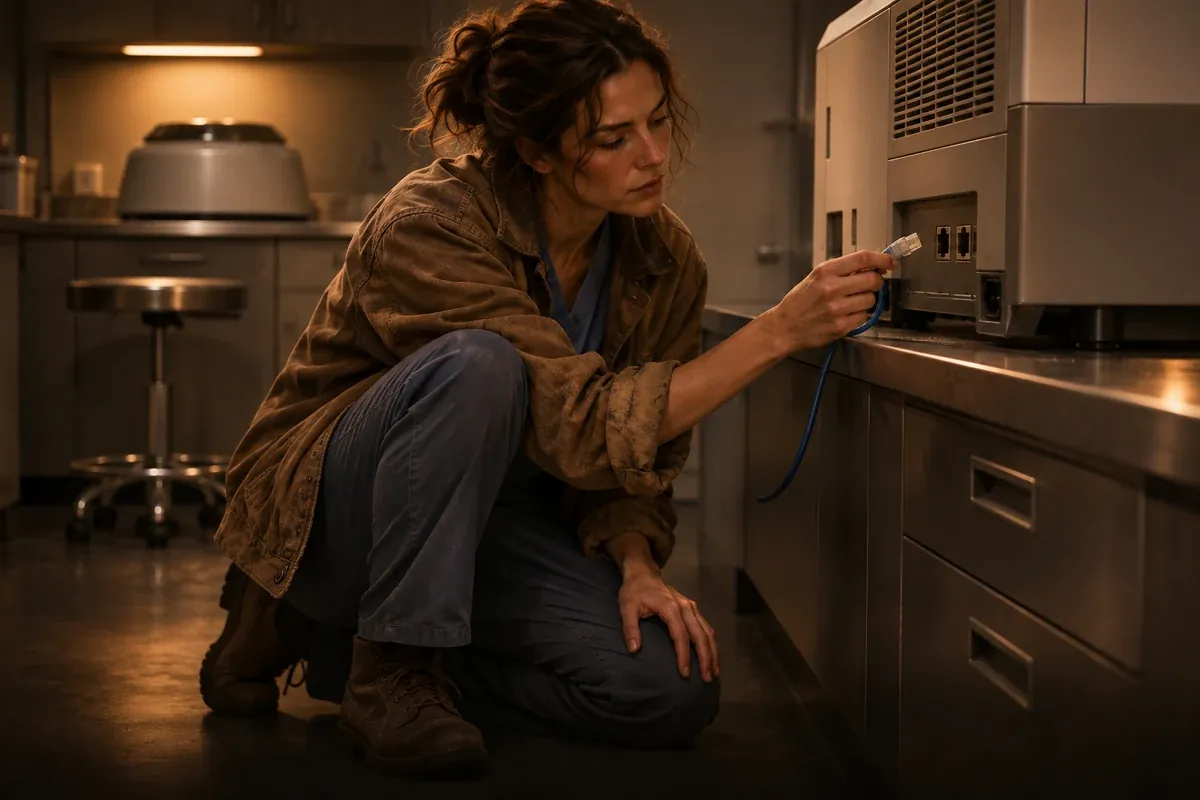
The lab at Marrow Animal Clinic is the size of a walk-in closet. There is a countertop, a stool, a centrifuge, and a chemistry analyzer that cost forty-one thousand dollars, which I am still paying for, and which talks to the manufacturer’s servers over an Ethernet cable every time it finishes a run.
I kneel and pull the plug out of the back.
It is a small thing. I did it, I think, because the old man told me to. Not in words. In the way he looked at the machine. Whatever you run here, Doctor, he said, somebody can read.
I take the gray-top tube from my coat and spin it. I load the sample. I stand there with my arms crossed over my chest while the little machine whirs and clicks and thinks.
When the panel prints, it is a strip of paper the width of a receipt.
I read it once. Then I read it again.
Most of it is fine. A thirteen-year-old heeler has a kidney that is a little tired and a blood sugar that is a little high, and I would not have blinked at either one.
But the liver numbers are wrong. Not wrong the way a sick dog’s are, a spike, a cliff, a thing you can point to. Wrong the way a wall is wrong when the house has settled. Everything a little too high, everything in the same direction, in a ratio I recognize from exactly nowhere in my training and from a single page of a toxicology lecture I almost slept through in my second year.
The analyzer has printed no flag. The machine was not built to flag this. It was built to tell me about a heeler who got into the rat poison. This is something else. Something small and patient, with a long memory.
A dog does not show a pattern like this unless something has been feeding it, in small steady amounts, for a very long time.
Okay. Okay. Okay.
Forty-one pounds. Heart rate eighty-four. Mine is a hundred and thirty. I count the seconds of my own breath against the second hand on the wall.
Then I go to the vaccine refrigerator.
It is a white under-counter unit with a magnetic door and a handwritten sign that says CANINE DISTEMPER, DO NOT OPEN BEFORE 8 A.M. I wrote the sign myself in a fit of whimsy, four years ago. Behind the third box, wrapped in a clean gauze square and a paper towel and a rubber band, are two tubes of blood.
One of them is labeled in my handwriting: PICKLE, 10/1.
The other is not. It says only G.B., in block capitals, and a date.
I have not run either of them. I have not looked at them. I have not so much as touched them in thirty-three days, except to move them, twice, because I was afraid someone would find them. That is the only thing I did right in the week after he died, and I did it because the old man made me swear.
He came to my door at eight minutes to midnight on the first of October, in a camel coat over pajama bottoms, with the dog at his heel. He was eighty-one. He looked, standing in the entry light, like a tall tree after a long dry spell.
He took a sterile needle out of my hand without asking, found his own vein, and filled a tube himself with a hand that did not shake, and he said, in his short, flat, mocking voice, “Doctor. Run the dog. Run me. Not tonight.”
“Mr. Brandt, it’s midnight. You should be in a hospital.”
“If I go to a hospital, they’ll write ‘heart.’” He pressed the tube into my palm. “Not on your machine. Not on anything that remembers.”
I spin the old tube now. I load it.
Pickle’s from a month ago, first. The machine thinks. The paper curls out, and I take it with fingers that I notice are not entirely mine.
The same wrong line. Slightly higher. A month ago, an old dog with a liver that was already being asked to do something it should not have to do.
Then I load the other.
It takes four minutes. They are among the longest of my life. I sit on the stool and listen to a centrifuge spin down in the dark and think of Gus Brandt’s hand on the door frame, big and spotted and absolutely steady.
The paper comes out.
I do not need to read it twice. I have read it once already, tonight, on a different sheet.
It is the same pattern. It is the same direction and the same ratio in the same organ. It is higher. It is so much higher that for a moment my brain simply refuses the numbers, the way you refuse a cold bath.
A man of eighty-one, and a dog of thirteen, and the same small patient thing in both of them.
I put the two strips side by side on the counter, with the one from tonight beside them, and I stand over them in the humming light of a lab I am about to lose. An old man’s printout. A dog’s from a month ago. A dog’s from tonight.
Three sheets of paper. One line.
Somewhere behind me, through the wall, the barn door bangs. Tori’s voice rings out, cheerful, talking to a horse. Out front, the retriever on the bag of kibble smiles into the dark.
I do not move.
I remember what he said last, in the doorway, with one hand on the frame and the other on the dog’s head. It was the only time in all the years I knew him that he did not sound like he was being funny.
“Tuesday,” he said. “He knows the way. If I miss Thursday, Doctor, it wasn’t my heart.”
He died at four on Thursday morning.
And it is Monday night, and the dog has been eating from the same bowls for a month, and I have just sat across a pot roast from three people who watched the bowl go down.