

At exactly 5:40 p.m., Pickle stands up off the kitchen floor, walks to the back door, and sits.
I know it is 5:40 because I am looking at the clock above the stove when it happens. I have been looking at that clock for most of the day. Ines is peeling potatoes at the sink. I am pretending to read a stack of lab invoices at the table, and what I am actually doing is watching the minute hand and waiting for something I could not name.
He does not scratch. He does not whine. He leans a little left, toward the eye he does not have, and puts his nose to the crack at the bottom of the door, and holds there like a statue of a dog.
The peeler stops.
“He does that,” Ines says. She does not turn around. “Every Tuesday. Since the funeral.”
“Every Tuesday at this time?”
“To the minute. Mr. Cole says let him be. He says it’s grief.” The peeler starts again, and then stops again. “I never let him out by himself. It’s dark by six. There are coyotes.”
“And before the funeral?”
“Before the funeral, Mr. Gus took him.” She puts down the potato. She dries her hands on her apron, one finger at a time. “Take a coat, Doctor.”
“Ines.”
“And a flashlight. The good one is in the drawer by the phone.”
I do not ask her what she knows. I have spent a day not asking, and I am getting better at it. I take the Carhartt off its hook and the flashlight out of the drawer, and I put my hand in my pocket, where the capsule lives, and I feel its small cold weight against my knuckles.
I have never opened it. I tried once, the morning after he died, at the clinic sink, and the cap would not give. It was stiff as a bottle top painted shut. Then I thought of the old man’s face in my doorway, and his voice saying Tuesday, and I put it back in my pocket and told myself to wait.
I open the door.
Pickle is through it before I have finished pulling.
He does not need me. That is the first thing I understand, about ten yards in. He has no leash and no collar tug and no command, and I could stand still and he would go on without me, down the back steps and across the frozen yard, tilting left the whole way, his one eye on a spot in the dark that is not on any map.
His nails tick on the gravel. His breath comes out in short clouds. The sun went behind the hills an hour ago and the sky has turned the color of a bruise gone green.
I follow with the flashlight. I count my steps, because I have to count something, and I get to two hundred and eleven before we reach the windbreak.
The cottonwoods stand along the north side of the property in a long ragged row, forty feet tall, bare except for a few brown leaves that clatter like paper. The wind comes through them with a dry sound, as though a hand is sorting through pages.
There is a path between the trunks. It is not a path anybody made. It is a track worn into the frost-stiff grass, a thin pale line about as wide as a dog’s four feet, and it runs ahead of me and curves toward the pond.
I think: a thousand walks.
Not a thousand. Fifty-two, if he went once a week for a year, and then a few more, on Tuesdays since, alone and refused at the kitchen door. The old man’s dog has been making this trip in his head for fourteen months. I do the arithmetic and stop doing it.
There is a plank across the irrigation ditch, wide enough for a dog. Pickle does not hesitate. He does not look at it. He walks across with the confidence of something that has done it blind.
I realize that, in a way, he has.
On the far side of the pond, past the big cottonwood that he loves, there is a hump in the land with a stone face. It is built into the hill the way old cellars are, with a roof of sod and a chimney that has not smoked in sixty years.
I know it from the window of my room and from one summer when I was twenty and Cole told me that nobody asked. The old creamery. A homestead cold room, from before there was electricity, when Gus Brandt’s grandfather kept milk and butter and cheese in a stone cave cooled by the spring.
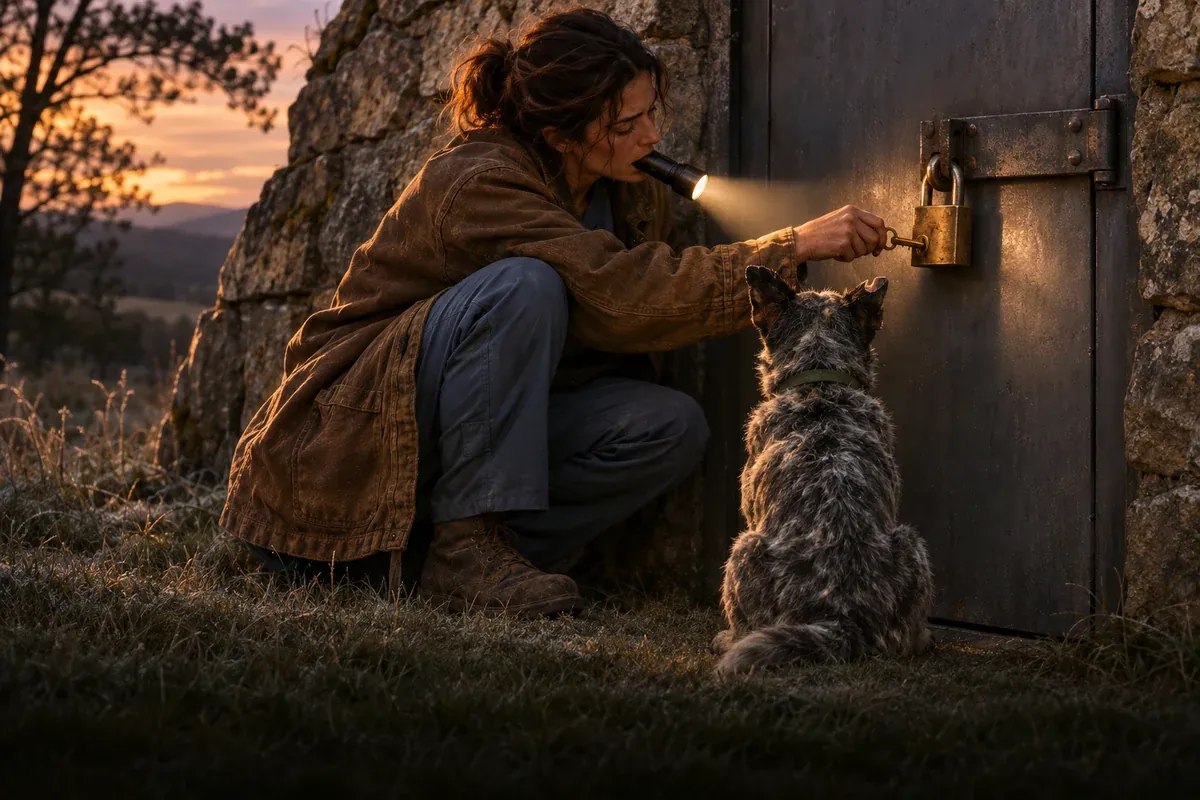
Pickle stops at a steel door.
It is not an old door. It is gray, flush-mounted, set into the stone with new bolts, and across the middle of it runs a hasp as thick as my wrist with a padlock the size of a fist. Above the lintel, almost invisible against the rock, a little black dome. A camera, I think, with a hard cable running into the stone beside it.
The dog sits down.
He sits the way he sat on my foot in the feed store lot. Square. Immovable. His back is to the wind. His nose is pointed at the lock. If I told him to get up, I think, he would look at me with the one good eye and decline.
“Okay, buddy,” I whisper. It is what I call everyone when I am at my softest, human or not. “Okay.”
I get the capsule out of my pocket.
It is just a tube. A little steel cylinder, no longer than my thumb, with a ring on one end for the collar and a screw cap on the other. I put the flashlight in my teeth. I take the cap in my left hand and the body in my right, and I turn.
It does not give. I turn harder.
Then I realize I have been turning it the way you turn a jar, and that Gus Brandt did not do things the way you do them with a jar. He did them the way a man does them who has spent sixty years opening refrigerated trailers with frozen hands. I push the cap in, hard, and turn.
It gives with a click.
Inside is a tight roll of paper, and a brass key.
I unroll the paper under the flashlight. It is the width of a fortune cookie slip and covered in a single line of block capitals, in a hand I have seen on prescription refill authorizations and vaccination waivers and the back of a check for the kitchen-table surgery on a dog with no eye.
TUESDAY. HE KNOWS THE WAY.
I put my hand over my mouth. Pickle looks up at me, once, and then back at the door.
The key is warm from my pocket. It fits the lock the way a thing fits that has been fitted to it. The shackle opens with a heavy, oiled clunk. The door swings out on a gasket and a breath of cold air hits my face, so crisp and clean it smells like a new refrigerator.
The hum comes next. A low, even drone, a compressor somewhere in the walls. Pickle gets to his feet and goes in ahead of me, and I follow, and the door sighs shut behind us on its own.
A light comes on. Motion sensor.
The room is about the size of a one-car garage. It has stone walls on three sides, whitewashed, and a poured concrete floor with a drain in the middle. There is a steel table and a wooden stool and a chart on the wall with a pencil on a string. The thermometer says thirty-four degrees. On the chart, in the same block capitals, are rows of temperature readings in a column, each initialed G.B., the last one dated October 1.
Along the back wall, floor to ceiling, runs a wooden rack.
It holds glass vials. They are small and clear, with rubber stoppers, each in its own slot like wine bottles in a cellar. Each has a white label. I walk to them without deciding to. I read the first label under the light.
PICKLE. 9/9.
The next one says PICKLE. 10/9. And the next. A month a vial, fourteen of them, in a straight row, going all the way to the one that says PICKLE. 10/1, in the same hand, the night he came to my door.
I am a veterinarian. I have a hundred and fifty thousand dollars’ worth of training in what it means to take a sample from an animal, to label it, to keep it cold, and to let the evidence speak. I know exactly what I am looking at.
It is a chain of custody.
He has been drawing his own dog’s blood every month for fourteen months, and sealing it, and keeping it at thirty-four degrees in a room that only a key and a dog could open.
Okay. Okay. Okay.
There is a fifteenth slot at the end of the row. It is empty. Taped to the wood beside it, there is a small white card.
MARROW. 10/1. (IN HER KEEPING.)
I stand there for a long moment with my hand against the wall. The wall is so cold it burns.
Then I see the second card.
It is taped at eye level on the stone, beside the thermometer, where a man looking at the temperature of the room would find it. It is a larger card, an index card, and it has been written with a felt-tip pen that bled a little into the paper. The letters are shaky in the way that handwriting gets when it is written in a hurry, in the dark, by somebody afraid.
DOCTOR. IF YOU ARE READING THIS, THEY HAVE MOVED ON TO THE DOG.
DO NOT TELL COLE. DO NOT TRUST COLE. DO NOT TRUST MARGIT.
DO NOT TRUST ANYONE WHO EATS BEFORE THE DOG.
WHOEVER IS DOING THIS WILL TRY TO PUT IT ON YOU. THEY HAVE ALREADY STARTED.
FEED THE DOG FIRST.
I read it three times.
I read the part about Cole a fourth time, and I wonder how a man who has been dead for thirty-three days can be so right and so cruel in the same breath. The Cole in the feed store lot, crouched in the gravel, his knuckles wet with a dog’s tongue, did not look like a man who would do this. But the ten-years-gone Cole, in the rental car, saying he would write, did not look like the man who would never write, either.
I have been wrong about that face before.
I take the card off the wall. The tape comes away with a small dry sound. I fold it in half, and in half again, and I put it in the front pocket of my scrubs, under my coat, where a person would have to put a hand on my chest to find it.
I do not take the vials. I want to. I have a hand on the first one, cold as a stone in a creek. But I did not bring a cooler. I did not bring gloves. I did not bring a plan, and the one thing the old man’s card has made clear is that I will need one.
Pickle has gone to the far corner and sat down in front of a steel freezer drawer under the table. He does not look at me. He just waits, the way he waits at any door.
That is when I see the camera.
It is mounted in the corner of the ceiling, a small white dome with a glass eye. It has a tiny steady light, blue, the color of a gas flame. It is looking at me. It has been looking at me since I walked in. It is, I realize, a hardwired camera, on a cable that goes through the stone, to a place I cannot see.
Somewhere, somebody is watching a woman with a flashlight in her teeth read a dead man’s mail.
And then, from outside, through a foot of stone and a steel door, there is the sound of an engine.
I know that engine. It is a big diesel, a truck the size of a small barn. It stops. A door slams. Boots come across the frozen grass, long strides, not hurrying, not hiding. The padlock, hanging open on the hasp, clinks against the steel.
Pickle does not so much as turn his head.
The door opens, and Cole Brandt stands in the frame with a flashlight in one hand and the dark behind him.
He is in shirtsleeves. It is twenty-six degrees out, and he has no coat on, and the cold has already put a flush in his cheeks and a white line around his mouth. He looks at me. Then he looks past me at the long wall of glass vials under the light, and the thing that comes into his face is not rage and not guilt. It is plainer than either.
He looks, I think, like a boy who has been told his entire life that there is one room in the house he may not enter, and has finally been allowed to see that it is only a room.
“Josie,” he says.
“Cole.”
“This door’s been locked since the funeral.” His voice is level. It is the voice of a man reading from a card. “I have a key. He gave it to me the day I turned twenty-one and told me never to use it. I never did.”
“It was open.”
“It wasn’t.”
“Pickle brought me.” I let it sit. It is the only thing I have said all week that is partly true. “He pulled me out of the kitchen at five-forty. I followed him. It was open when we got here.”
His eyes go to the dog. Pickle, in the corner, yawns.
Then Cole’s right hand moves, a small automatic motion, to his left wrist, where the cracked leather band of the watch is. He turns it up toward the light. He looks at it. It is, I notice, stopped. It says 2:17, and it has said 2:17 since the first time I saw it, in the feed store, and he is looking at the dial as if the time might have changed.
It is what he does when he is lying.
I have known it for ten years and I did not remember until this moment that I knew.
“Billings called me,” he says. “The security desk. They said someone had opened my father’s vault. They told me the feed was live.” He nods at the white dome. “My father had it hardwired when he built the room. It reports to the office downtown. Nobody ever told them to turn it off.” He looks at me, and for the first time there is something in his face I cannot name. “They said a woman had come in with a dog.”
“Billings called you.”
“Ten minutes ago.”
“Who at Billings?”
“The night desk.” He frowns. “Why?”
“No reason.”
I look at the camera. The little blue light looks back at me. Somewhere two hours east of here, in a security office in a building I have never entered, somebody is watching a woman with a flashlight in her teeth stand in front of fourteen vials.
I wonder how long ago the call was placed. I wonder who placed it before Cole’s phone rang.
“What is this?” Cole says.
He steps in. Not much. One step, then two, and the door sighs shut behind him as it did behind me. The light overhead hums. He stops at the rack with the flashlight hanging loose from his fingers and reads the first label, and the next, and the one beyond.
“Those are Pickle’s.”
“I know.”
“Fourteen.” He says it very quietly. “That’s a vial for every month. He kept the dog’s blood?” He turns. “Why would my father keep a rack of his dog’s blood in a locked refrigerator?”
“I don’t know.”
“You’re a veterinarian.”
“I’m a veterinarian who’s been here for six minutes.”
“You don’t look surprised.”
“I’m surprised,” I say. “I’m surprised and I’m cold and I would like to go back to the house.”
It is not a good lie. It has the shape of a lie, and I know it, and I see him know it. He stands with the flashlight in one hand and a hundred feet of dark behind him and the dead man’s cold room humming at his back. His eyes go over my face, and my collar, and the hand in my coat pocket. They stop on the pocket.
“What’s in there?”
“Gloves.”
“It’s a card.”
I do not breathe.
“There’s a corner of white showing,” he says gently. “At your collar. You might want to tuck it in.”
I tuck it in. Neither of us says anything. I have the very distinct impression of a man who is deciding not to ask, and of a woman who is grateful for it and hates being grateful, and of a dog who has had enough of both of us.
“Ten years,” Cole says.
“What about it?”
“I thought I would have something prepared.” His mouth does the thing, the half of a smile after a drought. “A speech. A first line.”
“You said ‘Josie.’”
“That was the first line.”
“It was fine.”
“It was inadequate.” He looks at the rack.
“I’ve been in my father’s house for five weeks. I have not been able to go through his desk. I have not been able to read his mail. And you walked into his vault on your first night and found a thing I never knew existed.” He pauses. “He chose you. I keep going over it. He had Margit, he had Dennis, he had me. He had the whole bench of the Brandt family to pick a guardian from. He picked the vet.”
“Maybe he liked my bedside manner.”
“Maybe,” Cole says, “he knew something I didn’t.”
His eyes meet mine, and I look away first.
My heart is going very hard. I check it against the second hand of the thermometer chart, the way I do. A hundred and ten. A healthy mammal reacting to a stressor. I am so tired of being a healthy mammal. I want, for one stupid second, to put the card in his hand and say read this, tell me you did not do this, tell me the old man was wrong about you.
But the old man wrote: DO NOT TELL COLE.
And the old man was right about the bowl, and I have three printouts in my coat that say he was right about the thing he died of.
“I’d like to lock up,” I say. “And go back. And not talk about this tonight.”
“Noted,” says Cole.
He holds the door. Pickle gets up, finally, and walks out between us with the unhurried air of a dog who has finished his shift. I turn the key in the padlock. It clunks. The camera is still watching, a blue point of light above the lintel, and I look up into it and think, very clearly, you saw me.
I do not know what I want to say to it, so I say nothing.
We start back along the path through the cottonwoods. Cole walks on my left with the big flashlight angled at the ground. The wind has risen. It rattles the last leaves, and one of them catches on his sleeve and he does not notice. I notice. I notice too much, always.
Neither of us speaks until we reach the plank over the ditch.
“Josie.”
“Don’t.”
“I only—”
My phone goes off in my pocket.
It is not a text. It is a call. The screen lights up my coat from the inside, and I get it out and read the name over the clatter of the wind.
SHERIFF D. PRUITT.
“Doc?” says Dale Pruitt, when I pick up. His voice is tired, and friendly, and awful. “You sitting down?”
“I’m on a footbridge.”
“Somebody broke into your clinic about an hour ago. Neighbor saw a light. The back door’s jimmied and your drug cabinet’s standing open.” A pause. I can hear him breathing, and a radio crackling behind him. “I’m sorry to do this to you tonight. I need you to bring your controlled-substance log down here. And Doc? I need you to bring it now.”