

Minus point four feet. That is where the tide table in Teo’s back pocket says low water will bottom out at Gannet Bar this afternoon, at 1:51 p.m., for about forty minutes, which in the language of the sea means we may come and look at the debt and we may not stay.
I do not know that yet. At 4:12 in the morning I know three things. I have not slept. I have a cup of tea in my hands that I did not make. And the little bronze bell hanging over the chart has just rung itself.
Let me back up nine hours, because the tea needs explaining.
The causeway floods at 7:18 and does not drain until after midnight, which means I spent my first night in Cinder Neck on a stool in a lighthouse, arguing with a dragon about a cup of diner coffee. By ten o’clock we had settled the legal question. By midnight we had settled nothing else.
“You cannot refuse a coffee,” I had said. “It is going cold. It is a waste of a resource.”
“I am not refusing it. I am declining to owe it.”
“Then pay for it.”
“With what?”
“I don’t know! Tea! You have a kettle.”
He went still. The fire in the cradle dipped a half inch, the way a face lifts when someone says an unexpected word.
“A trade,” said Ciaran.
“A swap. A coffee for a tea. Simultaneous. Nobody owes anybody.”
“That would be a matched exchange.” He said it slowly, as though he were reading it off the back of a very old contract. “Equal weight, same moment, both parties willing, one witness.”
“I’m a witness.”
“You are a party.” He considered. “The lamp will do for the witness.”
So at eleven at night, in a stone tower with a fire the size of a basketball and the Atlantic breathing against the glass, a dragon and a disgraced forensic accountant held out two paper cups at the same time and counted to three. I took his tea. He took my coffee. He sniffed it like a man identifying a bomb, and then he drank half of it, and then he sat down very suddenly on the stool and said, “That is extraordinary,” in the voice of someone who has just learned what a sunset is.
It had been cold for four hours. I did not tell him.
I kept the tea. I did not drink it. I held it all night, a small warm weight in both hands, while I sat at the table and read his ledger and he sat on the stairs with his back against the wall, and neither of us went to bed.
At some point before dawn I realized he was not looking at the ledger. He was looking at me, with a patience so complete it had a kind of pressure to it, and I decided to find the ledger very interesting.
Now it is 4:12. The bronze bell rings. One note, low and flat, like a spoon on a glass.
“Do not touch the chart,” Ciaran says from the stairs.
“I wasn’t going to.”
“You were. You have your hand out.”
I look. I do. I put it in my lap.
Under the glass, the harbor chart is coming apart. Not tearing. Dissolving, the black ink losing its edges and running inward toward the center of the sheet like a spill running backward. The soundings melt. The coastline blurs. The red number in the corner stays, 90, and then, as I watch, folds over into 89, and the whole sheet goes white as a bed.
Then it begins to draw itself.
It starts at the top, a line like a hair, and the line becomes the coast, and the coast becomes a harbor, and the harbor fills with soundings, tiny figures in a hand I now recognize, upright and careful, the steel pen of 1893. Piece by piece it recreates everything it has just erased. Every rock, every depth. And then, off the mouth of the harbor, a quarter mile out, a small crosshatch of ink appears where there was none before. A bar. A shoal. A shallow place where the sea thins out over stone.
A label crawls into place beside it, in letters so small I have to lean in.
Gannet Bar. Pellerin, H. One hour, borrowed 1989.
The red number in the corner ticks over. 88.
“It went down by two,” I say. “One for the night, and the other one?”
“For the shoal,” Ciaran says. His voice has changed. “Each shoal left unsettled takes a night off the clock. They are interest.”
“Who is H. Pellerin?”
He does not answer, and I realize with a small cold drop that he does not need to. I have a good memory for surnames. I watched a woman in a flannel shirt lie to me over a meatloaf, and I know exactly what her face did when I said the word lighthouse.
“Hank,” says Ciaran. “Henri Pellerin. Marguerite’s husband. He died in the winter of 1990.”
“What did he borrow?”
“The chart says an hour.”
“From whom?”
“From the sea,” he says, and there is something almost apologetic in it. “You will want to be careful with that word. It means what you think it means and a little more.”
I sit back. The tea has gone cold in my hands. I look at the label, one hour, borrowed 1989, and I think of the nine hundred and eighty-nine things I would want to ask, and I ask the only one an auditor can.
“How do you settle it?”
“An hour of equal weight. Given back, witnessed, on the shoal where it was borrowed.” He rubs his jaw. “It surfaces at low water. We have about forty minutes. I will not be allowed to say who has to give it.”
“But it’s someone in town.”
“Someone in Cinder Neck owes this. That is all the chart ever tells me.”
“And you’ve done this before.”
“Not in a hundred and thirty-one years,” says Ciaran Voss. “The chart has never redrawn like this before. Not once. It has been blank since 1895.”
He looks at me. And I understand, with a small clean click, like a lock turning, that something changed the night I walked up that causeway. That the thing in the corner of the ledger, one Halloran, to be received, is not a footnote. It is the reason the chart woke up.
I get up. I put the cold tea on the table. I take my good pencil out of my pocket.
“Then we have until one fifty-one,” I say, “and I have a dead man’s name and no clue who owes him. Where does a person start an audit in a town of three hundred and eleven?”
“With the one who is lying,” says Ciaran.
“That’s not accounting.”
“No,” he says. “But it is how the sea does it.”
Teo’s skiff is named the Reckoning, and it is not a boat so much as an argument between fiberglass and plywood that has lasted twenty years without a clear winner. It is fourteen feet long and painted the color of a school bus. Teo stands in the stern with one hand on the tiller and an official clipboard in the other.
“For the record,” he says, “I am not doing this for money.”
“I’m not paying you.”
“For the record, I know. Please don’t.”
The dock at one o’clock is cold and bright. Behind us, up the hill, the town goes about its business in the way of a town that has been told to keep its head down. A man in a pickup slows to look at me and speeds up again. Two women outside the hardware store stop talking. And at the end of the dock, with her arms folded and her braid over one shoulder, in an apron over a flannel shirt, stands Mags.
I have been dreading this. I had a short speech.
“Don’t go,” says Mags.
“Mags.”
“It’s a bar, dear heart. It’s a pile of rocks. There’s no cause to be out on it.” She is not looking at me. She is looking at the water. “The tide turns by two and it comes in fast. We lost a man to that bar in ‘71.”
“It’s Hank’s,” I say.
She does not move.
“It says Pellerin, H. One hour, borrowed 1989. I don’t know what that means. But you do.”
For three seconds nothing in her face changes. Then it all goes at once, like a building coming down in a film, from the top. She sits down on a bollard. She is sixty-eight years old and she sits down on a bollard and puts her hand over her mouth.
“Oh, honey,” she says. “Oh, Hank.”
“What did he borrow?”
“It was Bridget.” Her voice is rough. “My daughter. October of ‘89. She was early, and Hank was on the Margaret P., sixty miles out, and the radio was telling us it would be three days before they could get back in. I was in labor for nineteen hours. I screamed his name for fourteen of them.”
She laughs, without much in it. “And at two in the morning he walked into the delivery room with salt in his hair and his boots still wet. He’d been a day and a half from shore. The nurse said the tide must have been kind. I knew better. He told me, after. He said he’d asked the sea for an hour.”
“And the sea gave it.”
“The sea gave him an hour,” says Mags, “and a very long bill.”
“Did he know it would be a debt?”
“He knew,” she says. “He said it was worth it. He died the next winter, off Gannet Bar, in a gale. I thought that was the payment. I thought we were square.”
She looks up at me, finally, and her eyes are dry and furious. “And I have been paying on it every morning for thirty-seven years by not saying a word, because the one time I said it out loud, to a priest, he gave me a look I’ll never forget. And I thought: it is better to be a liar than a widow twice.”
I don’t know what to say. I am an accountant. I say the only useful thing I have.
“It’s not paid, Mags.”
“No.”
“I can settle it. It’s an hour for an hour. Given back, witnessed.”
“Don’t you dare,” says Mags, very quietly. “That’s Hank’s hour. It’s mine. You’ve known us a day.”
“It has a lien on your diner,” I say. “I’ve read the schedule. If it’s not settled by the next new moon, it doubles. By the solstice it’s your whole block.”
I did not know that until I said it. I have been in this town for eighteen hours and I am getting the shape of the thing, the way you get the shape of a fraud: not by reading the numbers but by feeling where they lean.
Mags stares at me. Teo has stopped writing on his clipboard.
“Then I’ll pay it,” she says. “It’s mine.”
“Which hour would you give?”
A pause.
“The one he walked in,” Mags says, barely a whisper. “The hour Bridget was born. It’s the only one I’d trade.”
“And then you’d forget it.”
She shuts her eyes.
“I’m not going to let you do that,” I say. “That hour isn’t what’s owed. That hour is what was bought. If I’m reading this right, you don’t repay a borrowed hour with the best one you own. You repay it with one of equal weight, the same price in a different place. An hour you chose to be somewhere you couldn’t stand to be.”
“Where did you read that?”
“I didn’t. I’m guessing.” I look at Teo. He has the face of a boy who has just realized his clipboard is being used as evidence. “Teo, can you get me to the bar?”
“For the record,” says Teo, “I think this is a terrible idea.”
“Noted.”
“For the record, get in the boat.”
The Reckoning noses out of the harbor on a flat gray sea with the engine coughing. The cold has teeth. I sit in the bow in a borrowed slicker with my tote bag on my knees and the good pencil behind my ear, and I try to decide which hour I’d give.
I know the hour. That is the problem. It has been waiting at the bottom of me for five months, like a coin at the bottom of a well.
It is the night before I testified. I drove to Larkspur House, where my mother lives in a room with a view of a parking lot and a woman who calls her Joanie, and I did not go in. I parked. I turned off the engine. I sat in the dark with my hands on the wheel for one hour, watching the window of her room, deciding. If I told the truth, the money would stop.
Not hers, not exactly. Garrett Sloane’s firm had been quietly paying a portion of her care for fourteen months. A friendly arrangement. A kindness. I knew, in the car, that when I walked into that courtroom the kindness would end, and I would have to find eleven thousand dollars a month that did not exist.
I sat there for an hour. And then I started the engine, and I drove home, and the next day I told the truth.
It is the most expensive hour I have ever spent, and I do not remember what I decided in it. I only remember that at the end there was a sentence in my head, one sentence, and it was not about justice.
I have never told anyone. I am not going to tell the sea.
“There,” Teo says.
Gannet Bar has surfaced.
It rises out of the water a quarter mile from shore, a long low back of black stone like the spine of a sleeping animal, wet and bright and ribbed with weed. The tide is peeling off it in sheets. Gulls stand along it like a row of judges. And in the middle, bolted to a flat rock with a brass plate under it, there is a clock.
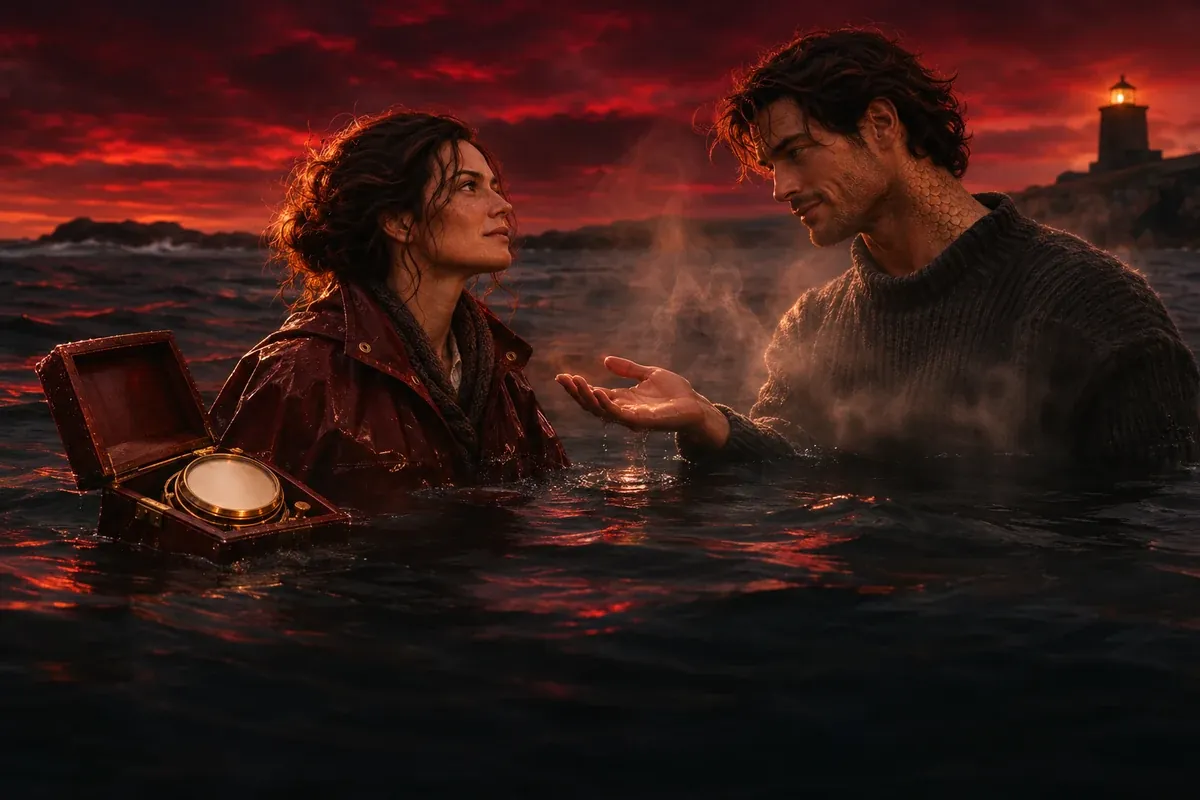
It is a ship’s chronometer, in a mahogany box with a glass lid, the size of a loaf of bread. The brass is green. The hands are moving. I can hear it from the boat, ticking, steady as a pulse.
Teo noses the skiff alongside and kills the engine. I climb out onto the wet rock in my ruined shoes. I do not look at the shoes. I walk to the clock.
The plate on the box is engraved. Pellerin, H. One hour. Borrowed October 1989. Balance due.
“How much time do we have?” I call.
“Thirty-one minutes,” says Teo. His voice is a little high. “For the record, it takes the tide nine minutes to cover this rock. So we have twenty-two.”
“Twenty-two is fine.”
“For the record, it is not fine!”
I kneel at the clock. The glass is warm. I put my palm on it, flat, and the ticking changes, speeds up, the way a heart speeds up when a hand touches the chest.
And I understand what to say, the way you understand the last digit of a long number. It is not a prayer. It is a transfer.
“I, Wren Halloran, of Cinder Neck, give one hour in settlement of the account of Henri Pellerin,” I say. My voice does not shake. “The hour of the twenty-ninth of April, from nine-ten at night, outside Larkspur House, in a gray sedan with the engine off. I give it freely and in full. I ask that it be taken at its weight and no more.”
The clock stops ticking.
Nothing happens for three seconds. The gulls go quiet. Teo says, “Oh no,” in a very small voice.
Then the ticking comes back, so loud it hurts, and the hands begin to spin backward, and I feel something leave me. It is not pain. It is the opposite of pain. It is the sensation of a tooth coming out, of a thing that was in me for so long that its absence has a shape.
I put my other hand out for balance and find nothing, because the water is at my knees.
“Wren!” Teo is yelling. “Wren, it’s early, the tide’s early—”
“I’m fine.”
“It’s at your thighs!”
It is. The sea has come in over the bar like someone throwing a sheet over a bed. It is cold enough to stop my breath. The clock is still spinning. The hands are going backward faster and faster, and the box is starting to lift off the rock, buoyant, and I realize that something is still missing. I gave the hour. But the settlement is not complete.
“It needs a witness,” I say. “It has to be seen. Teo, you can’t, you’re a party—”
“I’m not a party! I’m a boat!”
“It has to be the keeper.”
“He can’t leave the light!” Teo is standing in the skiff with the oar out like a pole. “He’s never left the light! It’s the only thing keeping—Wren, the water is at your waist—”
Behind him, across a quarter mile of gray and rising sea, there is a light.
It is not the lamp. The lamp is a small amber star at the top of a black tower on a distant point. This is something else. It is on the water, low, a warm line of gold under the surface, coming steadily toward us. It does not ripple. It does not hurry. A tall man is walking out of the harbor, up to his chest in the Atlantic, steam pouring off the water around him in white scarves, a gray sweater floating around his ribs like weed.
He does not look at the sea. He looks at me.
He reaches the bar in seven minutes. I have counted every one of them. By the time he arrives I am up to my ribs and my teeth are going like castanets and I have said the word idiot four times, once out loud.
He stops beside me. The water is at his chest and it is boiling gently around him. He puts out one hand, palm up, not touching, a hand’s width from mine.
“I witness,” says Ciaran Voss. His voice carries over the water like a bell. “One hour, given freely, in full, at its weight. I witness it and I take no part of it.”
The clock goes silent.
The hands settle. Midnight, twelve exact. The glass cracks across, a fine clean line, and a bubble of air leaves the box in a long silver breath, and the whole thing rises, floating, bumps against my arm.
I catch it. It is a dead weight, ordinary and cold. A stopped clock in a wet box.
And the sea goes slack. Just like that. The water drops around my ribs, and my waist, and my knees. The gulls go back to work. The tide, which was supposed to be forty minutes, turns out to have been only a threat.
Teo sits down in the skiff and says, in a voice with all the official gone out of it, “I want it on the record that I did not enjoy that.”
I laugh. It comes up out of me like something I had been holding down for a week. I am standing on a rock with a stopped clock and the water draining off my coat, and I am laughing, and Ciaran Voss is looking at me with an expression I cannot read.
“You left the light,” I say.
“Yes.”
“You never leave the light.”
“No.”
“Why?”
“Because it needed a witness,” says Ciaran, “and I am the only one in town who is not a party to anything.” He frowns slightly. “That was a lie, I think. A small one. I am not certain it counts as a lie if I did not know it was false.”
“You can’t lie.”
“No. So it was not a lie. It was an error.” The fire under the water has gone out. He is shivering, I notice, finely, all along his arms. “I will remember it.”
I hold out the clock. I do not know why. He takes it, and it is not a gift, it is a return, and nothing happens. He holds it carefully against his chest, and turns toward the shore.
That is when I see his hair.
It is dark and wet, pushed back off his forehead, and at the left temple, in a streak the width of two fingers, it has gone gray. Not silver. Gray, the flat dull color of ash. It was not there this morning. I would have noticed. I notice everything about him, which is a thing I have not had time to examine.
“Ciaran.”
“Yes?”
“Your hair.”
He puts a hand to it. His fingers find the gray and stop there.
“Ah,” he says.
“What is that?”
“That is the price.” He lowers his hand. He is not looking at me. He is looking at the water, as though he can read a number in it. “Every settlement is paid for. I carry it. You gave an hour. The sea wanted a witness at the cost of what a witness can spare. It is a fair exchange. I have no complaint.”
“How much?”
I do not want to know. I need to know. I have never in my life been able to leave a number unread.
He turns, finally, and looks at me with those slate-green eyes, and there is no bitterness in his face at all.
“Eleven days,” he says.
The sea laps at the bar. The gulls shift on the rocks. A cold wind brings the smell of woodsmoke from the town, and from very far away, up on the point, a small amber light at the top of a tower flickers once and steadies.
Eleven days. The margin. The exact margin, in my own handwriting, penciled on the inside cover of the ledger last night, a hundred and one days of fire against ninety nights.
He has spent all of it. He has no fire to spare. On the first morning, on the first shoal, for my sake, on a debt that was never his, he has spent every day of room he had.
He has never once told me a thing that was not true. And I know, standing in the cold with a stopped clock between us, that he is not exaggerating, not rounding, not sparing me. Eleven days is exactly what it cost.
“I’m sorry,” I say.
“I cannot accept an apology,” says Ciaran Voss gently. “It is not equal weight.”
I want to be furious about that, and I find that I cannot. The hour I gave is gone. There is a smooth, clean place in my memory where a sedan sat in the dark, and I know it was there only the way I know a tooth was there. I do not know what I decided. I only know that, whatever it was, it is not mine to weigh anymore.
And I know the other thing, the thing I will not say out loud for a very long time.
I am the one who put him in the water.