

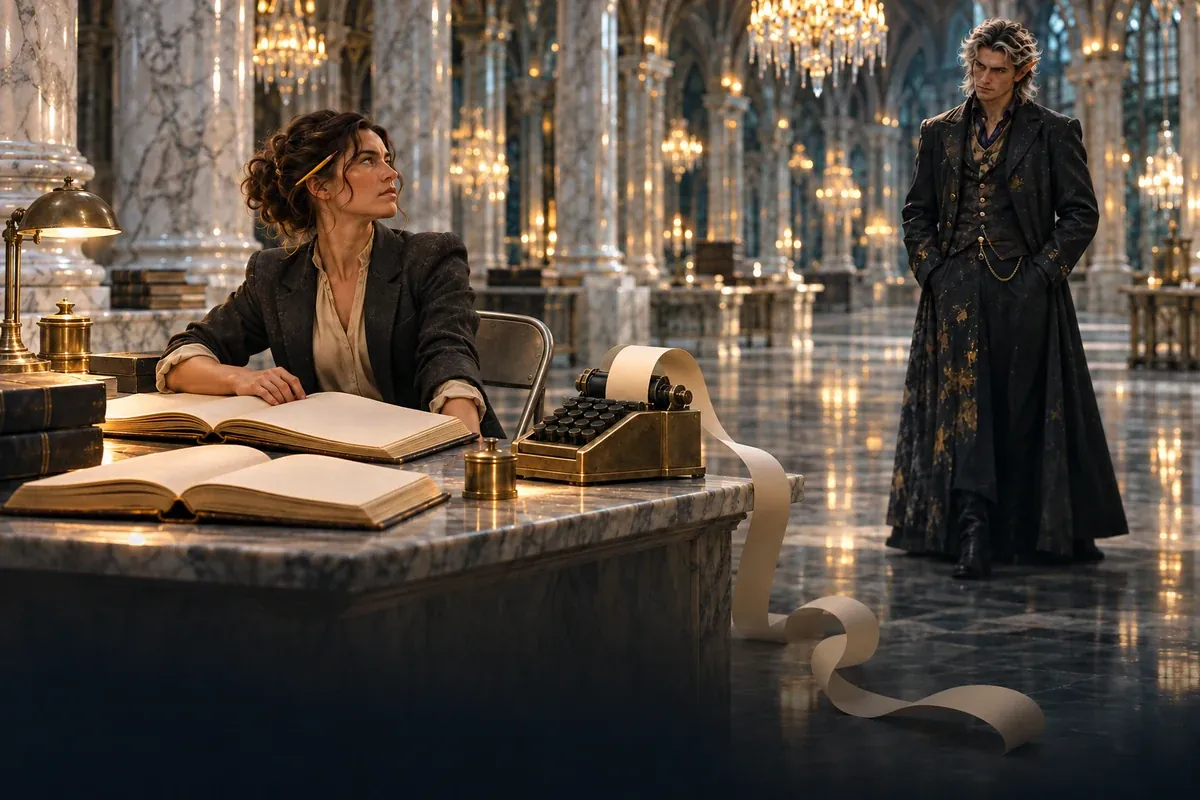
The Winter King’s books balance to the penny, which is how I know he is lying.
Real books never balance. Real books have a coffee ring on page nine, a clerk who typed a seven like a one in 1987, a petty cash drawer that comes up four dollars short while everyone looks at their shoes. Real books are embarrassed about themselves.
These books are not embarrassed. These books have been smiling at me for six hours.
I run the tape on my adding machine a third time anyway. Bureau training: distrust your own relief. The paper curls off the roller onto a marble floor that costs more than my building, and the total at the bottom matches the total on the Register’s last page. To the penny. Again.
Let me back up to the morning, when the only thing I owned in the world was a rule.
At nine a.m. on a Tuesday, my second chair and I stand in the dead-letter room of a decommissioned post office, six blocks from Lake Erie, and post a Notice of Examination through a brass slot marked UNDELIVERABLE. The room smells of floor wax and cold pennies. The slot swallows the envelope without a sound.
“Per section four-oh-two,” says Theo Banerjee, hugging the Bureau Manual like a hot water bottle, “we may not be offered, or accept, any hospitality, lodging, or—”
“Gift, favor, flattery, or seat,” I say. “Rule one: we take nothing. Rule two: we don’t say thank you. Rule three: if something is free, run.”
“What do we say instead of thank you?”
“Noted.”
He writes it down. Theo is twenty-six and has never once been late, and I like him more than I let on, which is a debt I intend to keep off the books. I check my kit. Thermos. Protein bars, counted. Six steel pencil sharpeners, because cold iron burns fae and steel only annoys them. My adding machine, the size of a toaster.
Two folding cots and two folding chairs, strapped to Theo like a tortoise shell, because a bed and a seat are gifts, and I intend to owe no one my posture.
The wall of pigeonholes unlatches with a click and swings inward. The cold that comes through smells of snuffed candles and warm ink.
Eleven days. If no Finding is on the record by midnight on the eleventh, the books are deemed accepted, and any auditor still inside becomes an unreconciled item on Schedule K. Everyone at the Bureau knows that sentence. Nobody has ever met someone who came back to explain it.
There is a reason I volunteered. A clean Finding here means the GS-13, and the GS-13 means Maple Court can keep charging my father eleven thousand eight hundred dollars a month to remember his own name for him. Dad hums the first four bars of a song and stops. The raise pays for the humming.
I do not mention the other thing in my bag. The forged transfer form. The reason I am here, instead of Cleveland’s second-best auditor.
The Counting Hall is the size of a train station and as quiet as a church. Columns of white marble stand stacked with ledgers. Chandeliers hang in rows, every candle flame frozen mid-flicker inside the glass, honey-gold, giving light and no heat. Goblin clerks sit at long desks and warm their ink over tiny braziers before each stroke. Cold ink won’t take.
A man waits at the foot of the hall with his hands empty. Dark hair, black coat, fingers stained to the wrist with ink the color of a bruise. He looks thirty-five and stands like someone told him to stand there before I was born.
“Senior Field Auditor Marlow, Bureau of Unlisted Obligations,” I say. “You have been served.”
“Ten days, fourteen hours and four minutes remain,” he says. “Yes.”
His voice is low and dry. I haven’t asked a question, but he answers it anyway, number first. I write that down.
“Are you the Treasurer?”
“Three hundred and one years. Emrys Wynhollow. Yes.”
“Do you intend to obstruct this examination?”
“Zero. No.”
“Have these books ever failed to balance?”
“Not once in one hundred and thirteen years. No.”
The ends of his hair have gone white, as if someone breathed on them. A little frost, fine as sugar. I write HAIR in my margin and underline it.
Behind me, a door opens that I did not see.
“Auditor!” The man who comes through it looks forty, which is how I know he’s a thousand. He wears a coat the color of nothing in particular and a crown that has clearly been talked out of being a crown. “King Teodric, at your service. What a sensible coat.”
“Declined,” I say.
“Declined?” He sounds thrilled. “Your shoes, then. Terribly honest shoes.”
“Declined.”
“And Mr. Banerjee has the sort of face one would trust with a savings account.”
Theo’s mouth opens. I watch the word thank rise up through his chest like a bubble.
“Mr. Banerjee is a federal officer,” I say, “and also declines.”
“Declined,” Theo croaks, a half second late, and goes pink to the ears.
The King sighs happily. “I had a speech.”
Here is what the Bureau won’t put in the Manual, because it sounds like a fairy tale. Fae cannot lie, so every compliment out of that mouth is true. That is what makes it expensive. A lie you can laugh off. A true thing said by a king about your shoes goes into your pocket and sits there, and at dawn it begins to cost.
He bows and leaves us the room, still smiling. Emrys Wynhollow has watched the whole thing without moving anything but his eyes.
Four goblin clerks wheel in a cart. Three volumes, bound in something I choose not to identify. The Register of Assets: seven thousand nine hundred and four line items, every treasure, favor, vintage and year the Winter Court owns.
I decline the chair they set out and work from my own.
Six hours. Theo calls out figures and I punch them in. Silver, sorrow, pledges, a cellar of third-hand apologies. Every page ties. Every subtotal agrees with every other subtotal in a way that no human institution has managed since the invention of the ledger.
At the sixth hour I say it out loud, to no one. “It balances.”
“Yes,” says the Treasurer, from nine feet away. “Seven thousand nine hundred and four items, no variance. Yes.”
“That’s not possible.”
“Ninety-eight percent of the time, no.”
“Then someone has fixed them.”
His hair frosts again, from the tips to an inch above. He looks at me for a long moment, and when he speaks, the dry voice has gone careful, like a man carrying a full cup across ice.
“Auditor. I am permitted one sentence in this audit that is not a number. I have been saving it.” A breath. “The Court has never miscounted. Ask it what it has counted on purpose.”
He closes his mouth. The frost recedes slowly, like a tide that has been told to go out.
I stare at the Register, at all that pale, smug arithmetic, and I start again at page one, looking for the thing that is counted on purpose. I turn to the second volume. Item 4417 reads, in a clerk’s tidy copperplate: Held. See Schedule K.
And in the margin beside it, in pencil, is a small check mark ending in a hook.
I have ticked every finished task of my life with that same hook. I learned it at my mother’s kitchen table. It is her hand, her pencil, her pressure on the downstroke, and I have not seen it in fourteen years.