

Form BUO-7, Demand for Production, has three boxes and a line for my signature. I fill it in with the pencil Nettle sold me.
Document requested: Schedule K, Assets Held Against Default, in full.
Basis: Section 4 of the Ledger Accord. Respondent: Winter Court.
It is day three. Dawn came as a bell, not a light, and the bell took Theo’s half of his debt in the most childish way possible: Sprat made him carry her crate of pencils up two hundred and twelve steps. Mine is still owed, a small cold stone in my pocket until I walk a goblin child home after dark.
Theo watches me sign. He has been writing a daily memo on Bureau letterhead and dropping it in the brass box, and I have decided not to notice that yet.
“Per section four-oh-two,” he says quietly, “a demand has to be witnessed.”
“Then witness it.”
“Boss. The Deputy Director said—”
“I know what the Deputy Director said.” I hold the form out to him. “Mr. Banerjee, I’m asking you to sign a piece of paper.”
He signs. His hand shakes very slightly, and the pencil tick he leaves beside his name is a perfect little square.
We serve it at the third bell, in the Counting Hall, in front of the King.
Teodric takes the form between two fingers, as if it might be warm. For the first time since I came down the stairs, he has no compliment ready. “Schedule K,” he says. “How very dry of you.”
“It’s my right.”
“It is,” he agrees. “Under the Accord the Court takes up to one bell to produce any document. Would you like to wait in the garden? It’s lovely at this time of—”
“Declined. I’ll wait here.”
“It’s a very small bell.”
“Then it will be a very small wait.”
The King smiles with his whole face. His eyes do not join in. I think of what the Bureau never put in my training: that a thousand-year-old thing can look at a stapled sheet of paper and be afraid of it.
Emrys Wynhollow does not move. When I turn to him, he stands with his ink-stained hands at his sides, and his hair is white to the roots.
“Is the document lost?” I ask.
“Zero. No.”
“Is it hidden?”
“Misplaced is a kind of placed,” he says, and the frost climbs another inch. “Fifty-nine minutes. Yes.”
“Yes what?”
“Yes, it will be produced in fifty-nine minutes. I cannot refuse a lawful demand.” His eyes meet mine, black and steady. “I would not, if I could.”
I do not know what to do with that sentence, so I put it in my pocket with the stone.
At the end of the bell, four clerks carry in a book no thicker than a prayer book, bound in black. I open it on the nearest desk. Theo reads over my shoulder, lips moving.
It is a short schedule. A vintage of storms. The name of a river, held. A violin that has played itself to silence. Each one has a number and a value and a reason it is owed.
Item 4417 is on the last page. It does not take a bell to read. It takes the span of one held breath, and I read it aloud, because I read footnotes aloud when I am afraid:
“Item 4417. One human, female, auditor. Age fifty-eight, apparent age forty-four. Acquired fourteen years ago. Held in stasis. Value: depreciating.”
My voice does not shake. I am very proud of that, in a distant way, like watching someone else carry a tray.
Theo says, “Boss?”
“Mr. Banerjee, I invoke Section 4, paragraph three of the Accord.” I look at the King. “The right to inspect any asset on any schedule, in person, in full, without notice.”
“Must you?” says Teodric, and there is no charm in it at all.
“I must.”
He looks at the Treasurer. It is a very long look, one bell wide, and a very human one: the look of a boss who has told a subordinate to lose the file and now watches him find it.
“Take her,” the King says. “Nine levels down. Don’t let her touch the glass.”
Nine levels is a long way to go in silence. Emrys leads, and Theo, white as paper, follows because I tell him to. Below the Cellars, the stairs stop being stone and become something colder. Level Three smells of vinegar and old coins. Level Five hums. Level Seven has no sound at all, not even our boots, as if the floor is listening.
I count steps. I count them the way Nettle does, out loud and then not out loud. If I stop counting I will make a noise, and I have not made a noise since I was seventeen.
On the eighth landing I say, without turning, “How long?”
He does not pretend not to understand. “Five thousand one hundred and thirty-one days,” says Emrys Wynhollow. His voice is flat and exact and entirely without defense. “I counted.”
“Every day?”
“Every one. Yes.”
I do the arithmetic because arithmetic is the only thing that will hold still. Fourteen years and seventeen days, with the leap days in. It is exactly right. He has not added a single hour of grace to it.
“Why?” I say.
“I may not answer that.” His hair is white to the scalp. “Not because I do not want to.”
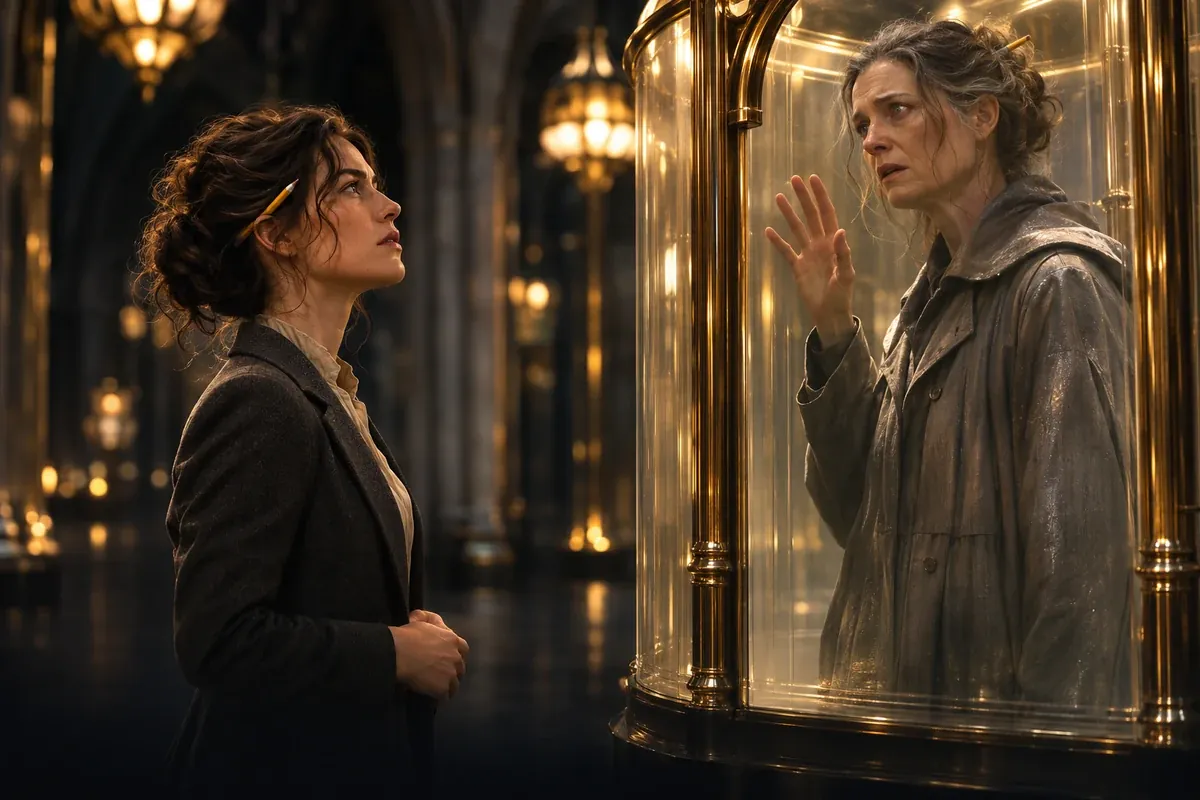
The ninth level opens into a long, cold gallery, and I understand at once why the King said glass. A row of tall cases stands against the wall, each one the size of a phone booth, each one lit from within by a pale light like moonlight on snow. Most of them are empty. Some are not. A man in a red coat stands in one with his eyes closed. A girl who might be nine holds a violin. They do not move.
The last case stands alone at the end of the gallery.
She is wearing the gray raincoat I last saw hanging on a hook in a kitchen in Parma Heights. Her hair is pinned up the way she wore it for work, with a pencil through the knot. She looks forty-four. She looks exactly forty-four, which is a number I am suddenly unable to say.
“Mom,” I say.
Every Thursday since his diagnosis my father has asked me where she is, and every Thursday I have told him she is at work. It was the kindest lie I owned. I am not sure it is a lie anymore.
She opens her eyes.
I think I am going to fall. Theo’s hand catches my elbow, and I let it, which is the second rule I have broken in three days. In the case, my mother turns her head slowly, as if through water, and finds my face, and does something I do not expect.
She is not glad.
She is terrified. Not of the room or the glass or the pale light. Of me. Of the badge on my belt and the folder under my arm and the Notice of Examination I carry like a lit match.
Her lips shape a word I cannot hear. She lifts one hand, slow as a tide, and breathes on the glass. Then she writes in the fog with one finger, backward, the way she taught me at her desk when I was nine, so that I can read it from my side.
Two words.
DON’T FILE.