

Mina Dryden had bought a school with one bench, and the bench was escaping.
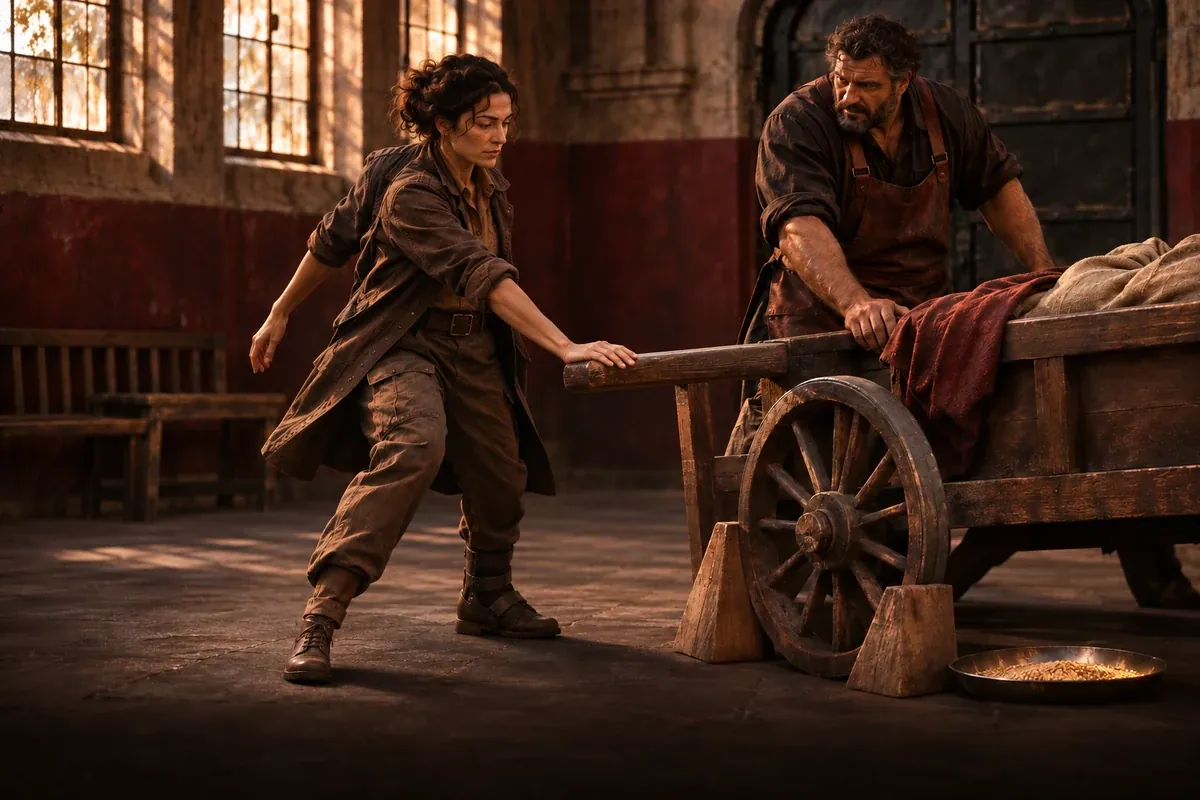
It came through the front doorway broadside, supported by a large man in a furnace apron and a smaller man who kept saying he had it. The smaller man did not have it. His end dropped. The bench hit the wooden cart beneath it, bounced once, and began descending the public steps on four iron-bound wheels.
Mina planted her staff across the doorway.
“Don’t catch it,” she said.
The smaller man immediately tried to catch it.
She caught his collar instead. His heel left the top step as the cart went past, then found stone again. One bench leg struck the wall. Plaster dust settled on her sleeve.
The large man had let go. He watched the cart rattle down the first two steps, stepped to the side, and turned it by pushing one end of the bench. The wheels left the stone. For a moment the cart stood diagonally across the stairs, one corner jammed against the rail.
Then it stopped.
Nobody was underneath it. Mina allowed herself to consider that a promising beginning.
“You said carry,” the large man told his companion.
“I said I could carry my end.”
“That’s where your end is.”
The smaller man looked down the steps. He was young enough to be offended by the position of a bench. Not a child, thankfully. Mina had made that clear on the notice she had painted herself. Adults. Practical settling. Beginners welcome. No guarantees about heroic potential.
The last sentence had taken most of the paint.
A man emerged from the hall behind them carrying a wooden practice bowl beneath one arm. He had a square face, gray eyebrows, and a right knee that stayed almost straight when he walked. Mina recognized the gatekeeper who had shown her the building yesterday.
“Jud,” she said. “Why is my bench outside?”
“It was going to the market.”
“I need a bench.”
“So does the man buying it.”
She looked past him. Morning light entered the Narrow Brim exercise hall through high windows that needed washing. Three pale rectangles marked places mirrors had once occupied. A rope hung from a beam. The floor was good stone, worn in the middle, with strips of black metal protecting the thresholds.
She had imagined people in that light. Not crowds. Six people would have pleased her. Six adults learning how to bring their own weight to rest without being told they had arrived too late to become anything.
She had forgotten to imagine where they would sit.
“We can discuss the bench after it’s off the stairs,” she said.
Jud glanced at the stranded cart. “That seems reasonable.”
The younger man reached for the rail. Mina put her staff between him and the drop.
“First, you tell me where you’re putting your feet.”
“On the steps.”
“All of them?”
He inspected the cart again. His ears reddened.
The large man smiled without appearing pleased. “I told him that before we started.”
Mina asked him to hold the bench steady while she examined its position. He did not try to lift it. That was encouraging too. Strong people were often made to believe strength was a duty they owed every badly arranged object.
One wheel rested on the edge of a step. The other had wedged against the upright rail. The cart’s rear axle hung free. They could not drag it upward without rotating the bench into the large man’s legs.
Mina’s right sole contained a small stored pressure, the familiar quiet of a movement she had ended before dawn. She could release it into a quick step. She could not make the bench lighter or turn a release into a weight-bearing hand she did not possess.
Her left ankle could bear her weight. It could not fold to meet the stair at the angle she wanted.
She had known that for four years. Wanting the angle remained tiresomely easy.
“Rope,” she told Jud.
“That’s still attached to the beam.”
“The loose one beside the door.”
He went back for it. The younger man bent as if to help and stopped himself halfway. Mina rewarded the decision by giving him something useful to do.
“Watch the lower wheel. If it moves, say so. Don’t improve the situation.”
“I can do that.”
“Most people think they can.”
The large man shifted his grip. His hands were broad, the nails clean except for dark lines that would survive ordinary washing. A burn had left a smooth oval on the leather of his apron. He had taken his gloves off to feel what the wood was doing.
“Len Corby,” he said. “Since we’re going to be here awhile.”
“Mina.”
“I know. The sign.”
Of course. She had painted her name beneath the failed promise about heroic potential. It had seemed sensible to make the proprietor identifiable.
Jud brought the rope. Mina passed it around the upper end of the bench and gave its free length to the younger man, who introduced himself as Rafe while she was explaining where he should stand.
“We aren’t hauling it back,” she said. “We are making somewhere for its weight to finish.”
“That sounds like hauling it back with an education,” Rafe said.
“Education costs more. Keep the rope slack until Len asks.”
Jud fetched a block from inside. Len slid it under the suspended axle while Mina and Rafe prevented the bench from turning. Nobody used a hold. Nobody needed to earn a warmer joint to move a piece of furniture five feet.
When the cart finally stood on four wheels, Mina’s shoulders hurt and her left boot had scraped a new pale mark into the step.
Jud examined the cart. He pressed the wheel bands with a finger, then touched the little iron pin holding one wheel to the axle.
“Was this one warm when you brought it?”
Len crouched. “Warm from the road, maybe.”
“You brought it across the square.”
“I didn’t say it was a good explanation.”
The pin was dark, newly forged. Mina could smell its oily finish. It was too small to have taken much of the cart’s friction. She held her palm near it without touching.
A little warmth rose from the iron.
“New wheel?” she asked.
“New pin,” Jud said. “The old one was worn. Fellow at the yard gave me that out of a tin.”
Rafe paid attention to the cart with the fierce concentration of someone who hoped a fault in equipment might become a defense of his performance.
Mina did not give him that defense. He had misjudged a lift. A warm pin was a different fact.
They returned the bench to the hall. Jud allowed this without conceding ownership, which Mina decided she could live with until lunch.
A woman stood inside the doorway holding a covered food pail. She had dark hair folded into a knot and the expression of someone whose errand had developed extra stages.
“Are the lessons happening?” she asked.
Mina looked at the empty floor, the bench, and the cart they had managed not to kill anyone with.
“One appears to have started.”
“Good. I’ve got forty minutes before the kitchen needs me. Pella Sorn. Do I put this anywhere?”
She lifted the pail.
Jud pointed to the bench. “Apparently we have furniture.”
Pella set the pail down and took off her coat. Her forearms were strong in a different way from Len’s, shaped by repeated work with something that moved within the vessel being carried. She looked at Mina’s staff, then at her shaped boot, without looking away hurriedly.
“You teach people who can’t run?”
“You don’t need to run.”
“That wasn’t the question.”
“Yes.”
Pella nodded. She had not requested an encouraging version of the answer.
Mina propped her staff against the wall. Her right palm had a second hold stored in it, smaller than the one in her sole. She let the pressure remain where it was. A demonstration would be useful. A demonstration performed because four people were looking at her would be less useful.
She went to the cupboard and brought out the used stillgrain puck.
Its holder was a shallow iron saucer with six pale bands along the rim. Each had a faint amber light caught beneath its cloudy surface. Jud watched her set it on the bench. His face changed just enough that she knew he had not expected her to own one.
“Six?” he said.
“For now.”
“That’s a short school.”
“It’s the first morning.”
Pella leaned closer. “How much does a morning use?”
“Depends what we ask it to carry.”
She disliked the answer as soon as it left her mouth. The question had concerned money and time, not a principle. Mina opened the little wooden case beneath the saucer and showed them the six divisions again.
“I won’t spend more than one band on the first lesson without asking. Nobody pays me to discover afterward that learning cost more than they agreed.”
Len had remained by the cart. He was turning its loose rope into a coil, not watching the grain.
“I don’t have a school fee today,” he said.
“Neither do I,” Rafe added quickly.
“I’m not paying until I know whether this is about jumping,” Pella said.
Mina had eighteen marks in her purse, a hall without certain ownership of its bench, and a stock of training reference that a larger school might use before breakfast. She could dismiss three people and wait for better customers. The ones with funds would already have rooms where somebody knew their names.
“We can begin with what you need,” she said. “Then decide whether I can teach it.”
Len wanted to set a heavy object down without being told he might as well take the next one, since he was there already. Pella wanted to carry a filled pot through a kitchen crowded with people who always believed the person with the hot thing would stop first. Rafe wanted to reach a roof edge without needing another roof beyond it.
Mina considered that last answer.
“How many times has the other roof been missing?”
“Not completely missing.”
“That will be an interesting distinction when we reach it.”
He smiled, relieved, and she made herself remember that relief did not mean he had answered.
They began without the grain. She asked each of them to move an empty bowl from the cupboard to the bench. Rafe arrived first and discovered she had not asked them to race. Pella held hers level. Len put his down so softly Mina barely heard it.
“You already know how to stop things,” she said.
“They’re empty,” Len said.
“Yes. That’s why I chose them.”
He looked at his own bowl. She could almost see him deciding whether she was making fun of him. She kept her hands away from it and let him decide what the quiet contact meant.
Jud sat on the disputed bench. It did not move under him.
“That one’s qualified,” he said.
Pella laughed. Len’s mouth moved a little. Rafe looked from his bowl to the floor, measuring the distance he had hurried for no reason.
Mina was opening the stillgrain case when the cart struck her shin.
It had moved perhaps four inches. Not far enough to hurt through the shaped boot. Far enough to touch something that had not been in its path when Len left it.
He turned at once.
“I put a block behind it.”
The block lay where he had put it, under the rear wheel. The front wheel had rotated around it. The warm pin gave a small sharp tick.
Jud stood. Pella moved her food pail off the bench. Nobody laughed now.
Mina put one hand on the cart handle. The iron shivered against her palm. She felt the beginning of a movement, a pressure that did not come from a person pushing.
“Leave the bowls,” she said.
She eased the cart onto a clear patch of stone. Len held its frame while Jud found two more blocks. Rafe moved the rope out of their feet. Mina checked the slight slope of the floor by rolling a plain wooden ball across it. The ball stopped against a seam. Nothing rolled toward the door.
The cart pin ticked again.
A used movement had remained somewhere inside that small piece of new iron. She did not know how. She did know what a held pressure felt like when it wanted a place to go.
She placed the stillgrain saucer on the floor beside the wheel. The first band brightened, almost white. Mina touched her right palm to the handle and released its stored effort against the cart’s beginning turn.
The contact went through her arm with a dull shove. She did not force it into her wrist. She let her body move, a short awkward step around the good foot, while the grain’s reference took the ending she could not safely supply with her left ankle.
The wheel struck a block and stayed there.
One band went dark.
Warmth spread across Mina’s palm. Not setting. Fatigue and a spent hold. She sat down before the warmth could persuade her to pretend she was still entirely ready.
Len looked at the dead band. “Was that the lesson?”
“No. That was an expense.”
He knelt beside the wheel. “Then look at this before it costs another one.”
With a scrap of charcoal he marked the pin and the wheel separately. They waited. Mina had begun to relax when the charcoal line on the pin moved past the line on the wheel.
The wheel had stayed still.
“It turned inside,” Len said. “The pin didn’t take the same stop.”
Jud brought the small tin the replacement pins had come in. Two remained. Mina asked him to leave them in the tin. Rafe fetched a clear practice bowl from the bench and lowered it over the tin without being told to touch anything inside.
“Good,” Mina said.
He looked pleased until she added, “Don’t take that as permission for the next thing you think of.”
Pella checked the clock above the cupboard. It had no hands.
“I have to go,” she said. “I want to come back. Those are separate statements.”
Mina nodded. “Tomorrow morning. No jumping.”
“I’ll bring something with a lid.”
She took her pail, left a folded cloth on the bench for Mina’s warm hand, and went to the door. Len stayed by the cart. Rafe sat on the floor a careful distance from the bowl. Jud looked at the five remaining bands and began bringing the loose blocks closer.
Mina let her palm cool on the cloth. One morning had cost more than she meant it to. Three people had found useful things to do without knowing what rank she thought they might reach. She would need to decide whether they wanted lessons, work, or a problem shared badly enough to count as a school.
Under the clear bowl, the tin clicked.
Nobody had touched it.