

By morning the little tin had moved the width of a thumbnail, and Mina had acquired a visitor who wanted to buy it.
The visitor was Jud. He had brought a breakfast roll and placed it on the far end of the bench, well away from the clear bowl covering the pins.
“You can’t sell me something you’re already trying to sell someone else,” Mina said.
“That’s the bench. I’m diversifying.”
He peered beneath the bowl. The tin sat inside a shallow wooden tray, surrounded by plain sand. Len had left the tray at dusk, after they discovered that the metal could rattle a cover without raising it. The new marks in the sand gave them a distance. They did not give them an explanation.
Mina ate half the roll before speaking again. She had slept in the little room above the entrance, where the previous proprietor had left one narrow bed and a chair with a missing rung. Her left ankle had been stiff when she went up and stiffer when she came down. That was an ordinary consequence of the stairs. She did not need a new theory for every inconvenience.
Her right palm felt normal. It held no stored effort. Sleeping had restored her willingness to use it, which was a different thing.
“We aren’t moving the pins out of the tray,” she said.
“I wasn’t planning to.”
“You were planning to buy them.”
“I own a cupboard.”
She looked at the tray. “A cupboard is a place. We need to know what happens when the place has to change.”
Jud considered this, broke the remaining roll in half, and took the larger piece.
They began with the cart. It had spent the night blocked on every side, its warm pin marked in charcoal. The mark had advanced twice before midnight. No further movement had appeared after that. Its metal was cool now.
Mina used an old wooden wedge to remove one block. She left the others in place. Jud held a length of rope tied to the frame, standing where a turn would not catch his legs.
The wheel stayed still.
She tapped the handle with her ordinary hand, just enough to move the cart against the remaining blocks. The loose wheel rotated a fraction. They watched the pin. It rotated with it.
“Fixed itself,” Jud said.
“Or spent whatever it had.”
“You sound happier with the second one.”
“The second one reminds us to look again.”
They waited while the morning bread cart rattled past outside. People on the steps talked about a delivery of new iron at the foundry. Mina heard the words new iron without finding them suddenly useful. Half the city had new iron. Most of it had not wandered across her floor.
The pin gave a faint tick.
Jud drew the rope toward him. The cart pressed its left block. Mina made a mark on the stone beside the wheel and waited until it stopped. She had not supplied a hold or grain. The movement had been smaller than yesterday’s. It was still a movement.
She put the block back.
“We can leave it there,” she said.
“For how long?”
“Until moving it is a better question than whether it moves.”
“I hate that sort of answer.”
“So do I.”
Len arrived carrying a wooden box with two handles. He had borrowed it from the furnace kitchen after promising it would come back without sand in it. Pella followed him with a covered jug. Rafe appeared last, eating something he had not bought from the bread cart.
Mina asked about it.
“Yesterday’s roll,” he said.
“Today?”
“It’s ambitious.”
Pella put the jug on a high shelf and asked them to leave it there. It contained her kitchen’s good vinegar. She had brought it to clean the bench, not to illustrate a lesson in carrying liquids. Mina had been about to suggest exactly that.
Instead she showed them the tray.
Rafe crouched close. Len pulled him back by the belt.
“I can see without touching,” Rafe said.
“Then see from there.”
The charcoal lines and sand marks meant more to Len than they had yesterday. He asked whether they had tried a pin in an old wooden wheel, so the little thing could turn freely without dragging a cart.
“Not yet,” Mina said. “That would mean taking one out.”
“We can make something around the tin.”
Jud fetched two pieces of scrap board, and Len considered how to set them in the tray. Mina left him to it. His proposal had limits she could see: if the pin jumped, it would strike wood rather than a hand. The proposed frame would let them move the tray without putting a finger beside the tin.
Rafe wanted to help. Len gave him the job of finding matching wooden pegs. He did not tell him to stand still and stop being a nuisance. Mina decided to remember that.
Pella had wiped the bench. She folded the cloth beneath her jug and sat down.
“I have forty minutes,” she said. “Again. If this is a school, I’d like some school.”
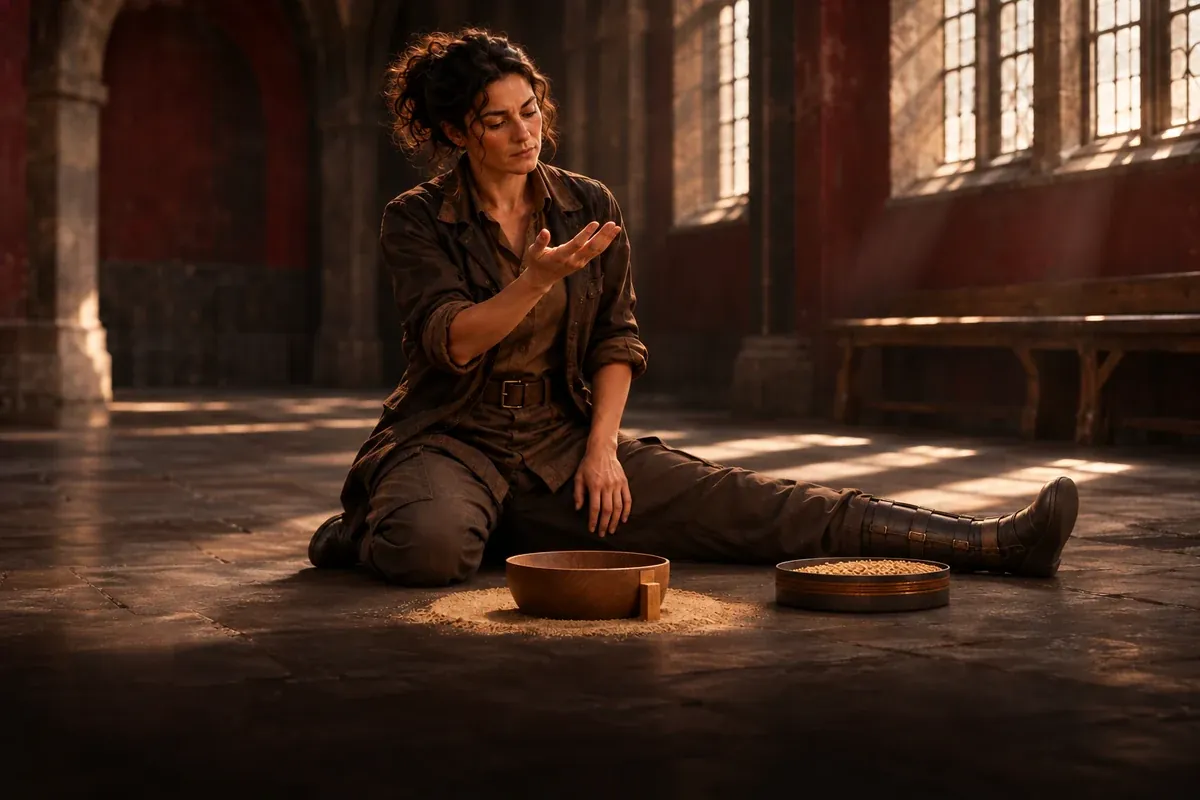
Mina brought the stillgrain puck to a clean patch of floor.
Five bands glimmered along its rim. They did not look like much. At North Ring, Elian had kept a full jar of training beads beside the warmup floor. Mina had learned to notice when a jar ran low because it meant somebody would have to make a trip to the storehouse. Now a single band meant a choice she would be making in front of three people who could spend their morning elsewhere.
She drew a small circle in the ordinary sand.
“No one steps into that until we decide what we’re doing,” she said.
“You’ve started well,” Jud said from the bench.
“That includes you.”
He lifted his nearly straight right leg in answer. He was staying where he was.
Mina set one empty bowl outside the circle. She knelt on her good side, not trying to hide the awkward arrangement of the other leg, and put her palm on the bowl’s edge.
“A hold isn’t being still,” she said. “If it were, this would be the most advanced bowl in the city.”
“It has been here a long time,” Jud said.
She smiled. “A hold is where a movement can wait without continuing through you. You make it with your own effort. The grain helps you find an ending that doesn’t have to be made out of a joint.”
Pella looked at Mina’s boot.
“Yes,” Mina said. “That’s one of the things that happens when you insist a joint can do it instead.”
“Did someone tell you not to?”
“Several people. I was unusually talented at hearing the part before not.”
She let the admission stay small. Her ankle did not need a speech every time someone noticed it. Pella had asked a fair question. Mina had answered it. They could do the next thing.
She moved the empty bowl gently along the sand and let it settle into the circle. No hold, no light from the grain. Plain friction had done the work.
Then she let the grain meet the beginning of the same movement, watching the first band until its amber edge sharpened. She used only her ordinary arm to move the bowl. At the ending, something familiar gathered beneath her right palm: the pressure of the small effort waiting instead of dispersing.
She lifted her hand.
The bowl did not move. Her palm retained the difference, no more impressive than a word recalled before someone supplied it.
“That’s yours now?” Len asked.
“Until I spend it. It’s small.”
“Could you make it bigger?”
“Not without moving more, and asking this to bear a different ending. We aren’t doing that.”
She touched a wooden peg and used the little hold to send it across the sand. It stopped against the bowl with a soft knock. The pressure left her palm. The band had dimmed but remained visible.
Rafe watched the peg.
“I thought it would go farther.”
“So did I when I started. That was an expensive expectation.”
Pella took the bowl next. She did not kneel. She stood at the bench with the grain on a low stool, where she could see it without having to lean. Her first attempt stopped because she gripped the bowl too hard. Her second made the grain brighten but left nothing she could distinguish from the effort of holding crockery.
Mina asked her to try again more slowly.
Pella put the bowl down.
“I move quickly when I’m working,” she said. “I don’t want to learn something that only works when everyone’s politely waiting.”
“We start slowly so you can tell what changed.”
“Then tell me that’s why. Don’t make slow the answer.”
Mina nodded. It was a distinction she had expected an explanation to make for her. She moved aside so Pella could see the saucer properly. They tried one more time, small enough that neither woman needed to pretend the result was clearer than it was.
Len used his whole hand on the bowl. He ended the motion quietly, as he had yesterday. The band sharpened once, then faded back.
“Anything?” Mina asked.
“A little. Maybe the rim pressed harder.”
“Keep maybe. We can use it.”
He left the bowl where it was. Rafe watched him, then took his turn before Mina asked.
His bowl went too fast.
Mina saw his shoulders attempt the correction. She reached toward the grain, ready to interrupt, but he had already let the bowl go. It crossed the sand circle, struck a shallow ridge, and stopped without overturning.
A little amber light remained along its underside.
Rafe held his hands above it.
“Did I do it?”
“Tell me what you felt.”
“Like I’d nearly missed a step, but the step stayed there.”
Mina knew that description. She also knew how badly she wanted it to be accurate. She asked him to keep his hands away while Len looked at the ridge beneath the bowl.
The first band went dark.
Four remained.
Pella glanced at the saucer, then at Mina. Nobody had needed to ask whether the lesson was finished. They had spent what Mina promised to spend.
Rafe’s smile faded. “I used the whole thing?”
“The four of us used it. Don’t turn that into your private fault.”
“But was it a hold?”
Mina examined the bowl. A reliable Held practitioner could repeat an ending, spend it on a chosen task, and say what was being held. Rafe had experienced something and let the result escape into an object. Calling him Held would make a promise to his next attempt she had no business making.
“It was an ending worth looking at,” she said. “You aren’t going to repeat it today.”
He opened his mouth, closed it, and sat back on his heels.
Len was looking at the floor.
“There’s black stuff in the sand.”
Mina leaned closer. Beneath the bowl, tiny dark points had gathered along a curved line. She had thought them shadows cast by the grain. Now the light was dimmer and the line remained.
Pella fetched the spare bowl. She let plain sand fall through her fingers well away from the first one. Nothing arranged itself. Len brushed a little of the marked sand onto a scrap of wood with a folded cloth. The dark points came with it.
“Not in the grain,” he said.
Jud got up. He came close enough to look without putting his knee on the floor.
“There was grinding work in here last month. Threshold repairs.”
“With new iron?” Mina asked.
“I didn’t buy the filings separately.”
Rafe looked ill. “So it wasn’t me.”
“You moved the bowl,” Mina said. “You felt something. The floor might have done something too. We can keep all three without voting yet.”
He looked at her for a moment. Then he nodded, a little more carefully than when he had agreed to watch the wheel.
Mina asked Jud for a clean scrap of wood. She wanted a surface that had not been repaired, polished or used beneath the cart. He brought a shelf from the little cupboard and complained that an experiment ought to have its own furniture.
Len turned it over. The underside was pale, with only a square shadow where a bracket had been. Pella wiped it using a damp corner of her cloth, then dried it. Ordinary sand fell from Mina’s hand in a loose scattering.
She placed the spare bowl on it.
Nothing moved. They had no grain active beside it, no new movement stored in a student’s uncertain hand. The comparison was limited. Mina said so before Rafe could announce that they had solved the problem.
Jud fetched a pinch of dust from the repaired threshold on the edge of a little shovel. Its dark grains looked ordinary until they lay against the pale shelf.
“Away from the bowl,” Mina said.
He lowered them at the far end. One point turned on its own side, then lay still. It might have settled into a hollow in the wood. Len bent until the shelf was level with his eyes.
“I’d like to see that twice before I call it anything.”
Mina liked the answer. She wanted him to keep it when the thing he hoped for was his own first hold.
They did not ask Rafe to repeat his attempt over the dust. Pella moved the shelf farther from the stillgrain saucer and made everyone leave a clear path around it. The room now contained three questions in three different places: a blocked cart, a covered tin, and a bowl nobody wanted to disturb.
“How many lessons can a school have before it starts?” Jud asked.
“Apparently the floor had several without us,” Len said.
Rafe laughed. The laugh helped him look at his own hands again. Mina had been about to tell him that a failed first attempt meant little. She let him have the better thing: an observation he could make without deciding what it said about him.
Pella checked the daylight through the high window. She went for her jug.
“I’ve got to leave. Tomorrow, clear floor before class?”
“Yes.”
“Good. I liked it until we discovered the floor was also taking lessons.”
She tucked the clean cloth beneath her arm and went back to the kitchen. Mina watched her go, uncertain whether she had just gained a student or lost one politely. Pella had said tomorrow. Mina decided to let the word mean what it meant until told otherwise.
Jud found a stiff brush. Len lifted the edge of the sand tray. Rafe stayed beside the bowl, keeping his hands on his knees while Mina marked the dark line with a piece of chalk.
She had taught for a morning and earned no fee. Four bands remained in the puck. She had one small restored hold already spent, a bruised expectation of what a lesson should look like, and three people who had begun asking better questions than whether they were talented.
It was not enough for a school.
It was enough to make the next patch of floor worth clearing.
Under Rafe’s unmoving bowl, the dark line shifted against the chalk.