

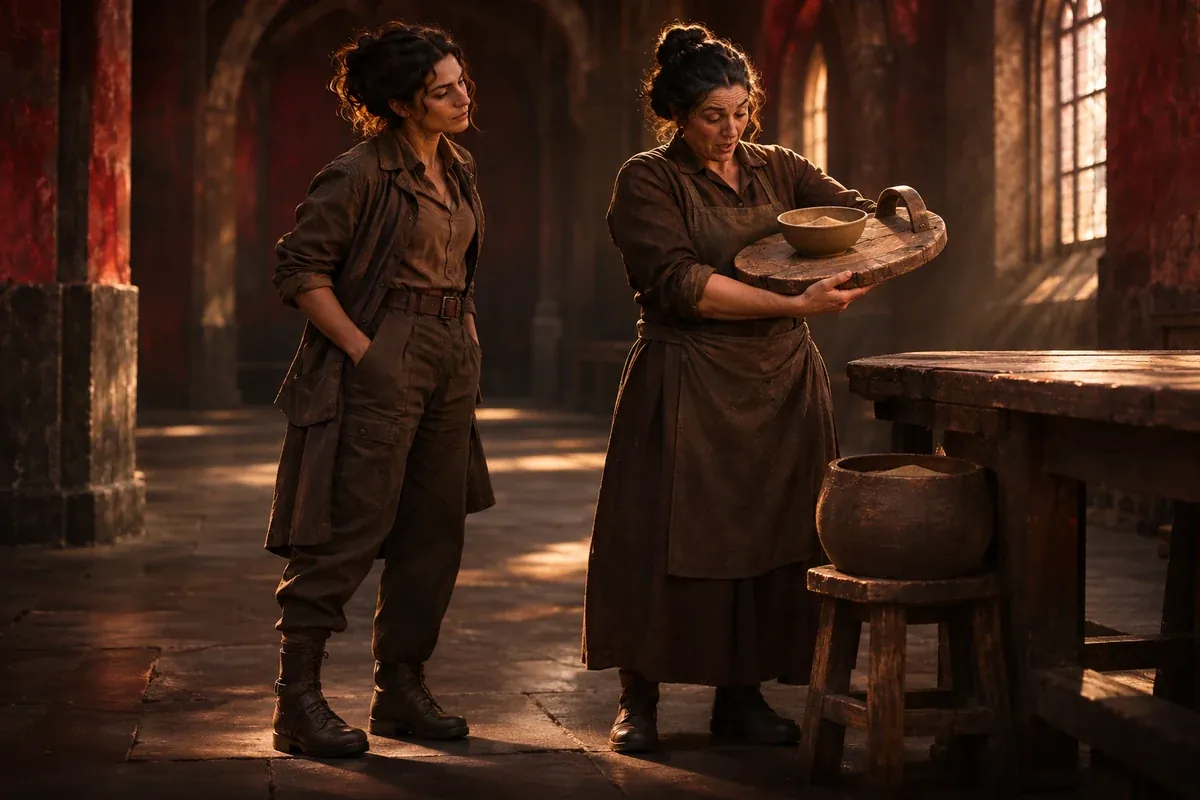
Pella arrived with a brush, a wooden lid, and the first money anyone had offered Mina for knowing anything.
She put one mark on the bench.
“For the lesson,” she said. “The brush is coming home.”
Mina looked at the coin. Its worn edge had polished itself smooth against other coins, the small honest work of spending. She had once received a winner’s purse so heavy somebody else had carried it. This mark pleased her more than she intended to show.
“You haven’t had the lesson yet.”
“I had one yesterday. Unless you’re going to tell me it didn’t count because I wasn’t brilliant.”
Jud made a small noise into his breakfast cup.
Mina put the mark in her purse. “It counted.”
Len paid the same amount when he came in. He had to be at the furnace yard by midday and said so before removing his coat. Rafe emptied three copper pieces into his palm, considered them, then put them back.
“I can clean,” he said.
“That’s useful,” Mina said. “It isn’t the same arrangement. We’ll decide how much work before you do it.”
He looked toward the dark dust on the floor. “What if I get good at this and you start charging more?”
“Then you’ll be allowed to find another teacher.”
“That sounds rude.”
“Only if the teacher thinks she owns you.”
She let the answer end there. The work mattered more. Two marks weekly for Jud had become due, and she paid him before they began moving equipment. He looked at the coins in surprise, then put them away without declining them to make a point.
Mina still had eighteen marks. The morning felt different anyway.
The bowl Rafe had moved stood within its chalk outline. The dark grit beneath it had shifted no farther overnight. A little iron dust lay on the clean shelf at the other end of the room; nothing there had grown a second face or a mouth or an interest in their affairs. Mina found herself grateful for plain inconveniences.
They cleared one rectangle of floor large enough for two people.
Jud wanted to take up the threshold strips. Mina refused. She did not yet know whether the strip or the dust was the problem. Turning a repair into a broken doorway would make the hall less useful without making them wiser.
Len lifted the bowls. Pella swept the larger sand into a pan, then used her brush around the edges where the dark points had collected. Rafe dampened a cloth and went after the narrow seams. He wanted to finish quickly. Pella made him hold the pan while she showed him how much he had pushed into the next seam instead.
“You can go fast after the room’s clean,” she said.
“What will be left to do fast?”
“Leaving. That’s usually safe.”
Mina carried the spent sand to the back yard in its pan. She had no intention of pouring it where someone would kneel beside a vegetable bed. An old lidded ash box stood under the covered drain. Jud said she could use it if she marked it as something other than ashes.
She wrote METAL DUST on its side in charcoal.
It was not a name for a new calamity. It was a reason not to spread the contents with a shovel.
When she returned, Len had placed a broad plank beside the cleaned floor. Its underside was unpainted wood. Pella’s brush stood beside it. Rafe was waiting, damp cloth held away from his clothes, without inventing another task.
Mina inspected the stone. She could see no dark grit. That did not prove none remained. It did give her a space whose condition she had watched them change.
“This is our floor for today,” she said.
Pella laid her wooden lid on the bench. It was round, scarred with heat at one edge, its handle offset where someone had repaired it badly or wisely.
“That handle’s wrong,” Rafe said.
“Not for my hand.”
“It isn’t in the middle.”
“My hand isn’t in the middle of me.”
Len laughed. Mina picked up the lid with permission and discovered it sat comfortably against her forearm. The edge rode above her wrist without pressing it. If she had made the lid herself, she would have put the handle exactly where Rafe expected it and called the result proper.
She set the stillgrain holder on a low stool. Four bands remained, each with a warm amber edge. They had agreed to use one. Pella had twenty-five minutes left. Len had a little longer. Rafe had the rest of the day and a habit of treating that as permission to use all of it.
“What do you want to carry?” Mina asked Pella.
“Pot. Filled. Hot, usually, but not for this.”
“Both hands?”
“Sometimes. Sometimes somebody opens a door and asks me a question while I’m doing it.”
“We’ll leave out the question first.”
“Thank you. I always want to leave out the question.”
They used a plain bowl holding a little sand. Pella carried it from the bench to the cleaned rectangle and back. Her feet knew the journey. Her shoulders kept the weight from telling the sand where she was turning.
Mina watched her right elbow.
At the end of each trip, Pella moved it backward to make room between her body and the bowl. The move was small. It finished before she put the vessel down, a tiny arrival nobody in a kitchen would have thought to praise.
“There,” Mina said.
Pella stopped with the bowl still in her hands.
“Where?”
Mina described the elbow movement. She did not grab Pella’s arm and put it in a better position. Pella repeated it herself, then looked at the lid.
“That’s why the handle’s there.”
“Yes. You already leave a place for what you’re carrying. We can work with that.”
She had taught beginners to settle through their feet for most of her career. At North Ring, students came to run, strike, jump. They wanted their next movement to begin where the last one ended. An elbow that made room for a bowl would have seemed a diversion.
Pella wanted a pot to arrive without the ending living inside her wrist.
Mina moved the grain stool. “Try the route you use. Just smaller.”
The first attempt made nothing happen. Pella took the bowl back herself rather than waiting for Mina to hand it over. The second brightened the band along one edge. On the third, Pella drew her elbow back and frowned.
“Feels as if I’m still carrying it.”
“Where?”
Pella pointed with her chin. “Here. Along the outside. But it isn’t pulling.”
“Don’t make it bigger. Put the bowl down.”
Pella did. The grain’s light held steady. She looked at her empty arm, then moved it slowly, testing her own surprise.
Mina could not feel the hold for her. She could only see that the ordinary recoil had not pulled Pella’s shoulder forward. They waited until she could describe the difference again without using Mina’s words.
Then they brought the lid.
Pella held it against her forearm, gave it the little settled movement she had found, and guided a new bowl off the bench. The bowl traveled onto the lid and stopped. No sand spilled. Her wrist did not twist to catch the last small arrival.
She stared at it.
“Again,” Rafe said.
“No,” Mina said.
Pella laughed before either of them could mistake the refusal for criticism.
“I’d like to know what I did before I charge it rent.”
She lifted the bowl away with her other hand. The feeling had gone. A held effort had done something useful and been spent. Mina had not assigned a rank. They had one result Pella could distinguish from holding her breath and hoping.
Len wanted to try the lid. Pella let him. He found its offset handle awkward.
“That,” she said, “is what I’ve been trying to tell people about handles.”
He returned it without fixing it.
The band still glowed, though weakly. Mina asked Len to put down the empty bowl he had used yesterday. He did it quietly again. Rafe knelt opposite him and watched his hands.
“You’re already doing the ending,” Rafe said.
“I’m putting it down.”
“You’re putting it down like you want to be invited back.”
Mina smiled. There was an observation inside the joke. Len let the bowl meet the floor and withdrew his fingers without keeping a private claim on its weight. His problem was not a lack of delicacy. It was expecting delicacy to be worth less than strength.
She moved the grain closer to his hand. “We can use that, if you want.”
Len looked at the two dark bands along the holder, then at the weak edge of the band they were using. Three untouched bands still glowed beside it.
“Not today,” he said.
Mina waited.
“I have a shift. If something takes more out of me than I expect, I can’t go in and tell them I’m promising.”
It was a good answer. She let it be good without asking him to take courage for her benefit.
They used the last of the band on Pella’s small ending once more. This time she knew which part she had not repeated correctly. She set the bowl down without forcing an answer from her arm. No hold arrived. Nothing set. The band went dark.
Three remained.
Pella looked disappointed, then irritated at being disappointed by something she had known about for less than half an hour.
“I want the other time to count,” she said.
“It does. So does this time. We know they aren’t the same.”
“That’s an infuriating arrangement.”
“Yes.”
They cleaned the bowl. Pella took her lid, brush and vinegar jug back to the kitchen. She left her coin where it was, in Mina’s purse. Len put his coat on and asked whether the early session would be at the same time tomorrow.
Rafe waited until the other two had reached the steps.
“Could I use what’s left if I’m careful?”
“There’s no band left from this lesson.”
“The other three.”
Mina sat on the bench. Her ankle had begun its dull complaint about standing too long, and she did not want refusal to be something she issued from a painless height.
“They belong to the next things we agree to do,” she said. “Careful doesn’t tell us which thing you’re doing.”
“I don’t want to be the one who only sweeps.”
“You aren’t. Yesterday you noticed a feeling. Today you helped us make a place where we could test it. Tomorrow you’ll do something else.”
He looked away. The reply was probably too reasonable to help much. Mina could make room for his impatience without feeding it a bead of grain.
She asked him to carry the clean shelf to the cupboard. He did, slowly enough she knew he was showing her he could. She did not turn that into a joke.
When he came back, he had brought Len’s two scrap boards. Their wooden pegs lay in a little pile beside the tin. Mina had almost forgotten the proposed frame. Rafe had not.
“We could finish this without grain,” he said.
“Show me where the fingers go.”
He arranged the boards around the sand tray, leaving the bowl untouched. The pegs could hold the boards apart. A loop of rope through the handles would let two people lift the surround without putting a hand close to the tin.
Mina found the flaw immediately. The tray could slide between the boards. Rafe stared at it, then moved one piece to form an end instead of a side.
“Now it won’t fit the bowl,” she said.
He muttered something about the bowl’s selfish shape.
Jud, passing with the ash box lid, watched without offering a solution. Mina could have made the surround herself. She knew three versions that would work. She also knew Rafe had asked for something he could accomplish without needing her to spend a resource.
She took the rope and used it to mark the size of the bowl. He laid his boards outside that circle. The gap became obvious. He fetched a short third piece from the pile by the door and asked Jud whether it was available before drilling into it.
“It is now,” Jud said. “You’re holding the rotten end.”
They replaced the rotten piece. Nothing moved while they worked. The little project remained work even when it failed to produce a sign from the tin.
At last Rafe had a frame with a wooden bar across one end. Mina helped him lower it around the tray. They lifted together, no cultivated effort, and moved the whole arrangement onto the bench.
The bowl stayed over the pins. No hand went beneath it.
“That’s somewhere we can change,” Mina said.
Rafe looked at the frame, then at the unused grain. He had not earned a new rank. The thing he had made would let the next person approach a question without supplying their own fingers as equipment. Mina saw him understand that part without needing to tell him how pleased she was.
Jud came back from the rear yard and put a small piece of iron on the bench. It was an old door hook from the ash box lid, the ordinary kind that had spent years doing one thing well enough.
“I tightened the lid,” he said. “Dust stays there. Your little tin stays here. How many things are we keeping?”
Mina looked at the cart.
“Two, if we can put the loose pins with the cart.”
“That sounds like the way people count expenses.”
Before she could answer, someone knocked on the open door. A man stood on the steps holding a length of broken coupling. He wore a work coat with shiny elbows and carried himself carefully, as if a heavy machine remained beside him even when it did not.
“Jud said you were a settling teacher,” he said.
Jud looked almost guilty. Mina had not expected to find that expression useful.
“I am.”
“I went to Copper Span. They sent me to North Ring. North Ring said go back to Copper Span.”
“Why?”
The man set the coupling down. It struck the bench with a flat little sound. Its inner ring continued turning after his hand left it.
Mina watched the delayed movement finish.
“My name’s Iven Marr,” he said. “I need someone to move an engine.”
“How large?”
“Smaller than the one they kept thinking I meant. Eighty-six pounds, without its carrying frame.”
That was not an enormous engine. It was an awkward one, perhaps. A warm one. A thing whose stored movement might continue inside a frame after the frame arrived. Mina looked at the charcoal marks on the cart pin and felt yesterday’s expense become a piece of work.
“Is it running?”
“No. Hasn’t been for six days.”
“Then why does that turn?”
Iven looked at the coupling, not at her.
“That’s the part they wanted me to stop asking.”