

There are six of us on the Marguerite Anne, and the captain has set seven plates.
I count them twice, because counting is how I make a room hold still. Seven white plates on a laminate table bolted to the galley floor. Seven spoons. Seven mugs hooked over the fiddle rail so they will not slide when the boat leans. Six chairs filled with people in orange bibs, and one chair at the end, nearest the stairs, with a man in it.
It is 0412 on the first night out of Dutch Harbor, and the man in the seventh chair is eating bisque in a grey beanie. He has a crooked front tooth. He is my brother, and my brother has been dead for eleven months.
Nobody else looks at him. I want that on the record before anything else goes on it. Five people sit within arm’s reach of a dead man, and not one of them lets their eyes land.
“Hands,” says Captain Brannigan.
He says it the way other captains say amen. Walt Brannigan is sixty-one, built like a mooring post that has been left out in weather, and he wears a wool cap with the brim turned up so he can see the gauges over the top of it. He stands at the head of the table with his own plate empty in front of him. His fingers are laced. They shake, a little, and he presses them together until the knuckles go white.
I put my spoon down. Everyone else already has. Luz Ballesteros, the deck boss, taps the edge of the table twice with two fingers, the same tap I watched her give the rail when we cast off, and bows her head.
“Lord,” Walt says, “we thank you for the soup and the soup’s cook, for the hull under us, and the six of us in it. Half a dozen and a spare, as ever. Amen.”
“And count your blessings out loud,” says Teofila Aguon from the stove, and she glares at me.
It takes me a second to understand that she means me. Teo is fifty-two, from Guam by way of Anchorage, with forearms like a bricklayer and a gold cross she tucks inside her shirt when she works. She stirs the bisque with a wooden paddle the length of my arm. She has been glaring at me since the dock.
“One,” says Odd Halvorsen, the engineer, and nobody laughs, because he is not joking. He is sixty-seven and has a voice like a hymnal falling down stairs. “Lord, a blessing. Two.”
“Respectfully,” says Sam Whitlock, who is nineteen and has been on the boat for exactly one day longer than I have, “this is the weirdest church I’ve ever been to.”
“Count,” Luz says, without looking up.
Sam sighs and counts. “Soup. Warm socks. Not being the guy who has to scrub the head. That’s three.”
They go around the table. Soup, socks, the heater in the bunkroom, a daughter’s grades. I am last, if you do not count the man in the beanie, and I notice that they skip his chair the way you step over a crack in a floor you have walked on for years.
“Dee,” says Teo.
I have a ledger in my coat pocket. Three-ring, black cover, columns I ruled myself. In my trade the ledger is the weapon. I do not wave a crucifix at a haunting. I find out what it is owed, and by whom, and I get the books to balance. Four hundred dollars a night, of which I collect about half, because ghosts do not pay and the living resent the receipt.
I am twenty-nine years old and I have never in my life been asked to count blessings at four in the morning in front of a stove.
“Coffee,” I say. “The coffee is hot, and the bunk is dry. That’s two.”
The words come out with the little tick at the end, the total, the way they always do. That’s two. I have done it since I was six years old. I got it from my mother, who counted stairs, and my brother got it from me, and for one second I look at the seventh chair because I cannot help it.
He is looking at me.
He does not smile. He lifts the spoon an inch, the way you tip a hat, and goes back to the soup.
“Eat,” Walt says. “String’s been down since nine. It’ll be a short haul and we’ll want the heat in us.”
Since nine. I do the subtraction, and I notice that he gave me the hour and not the number. A man who has hauled pots in this sea for forty years knows what seven hours of soak brings up. A handful of crab, if the current is kind. The pots that went down at nine last night should be full of nothing.
I pick up my spoon and I do not say that.
Eleven months ago, I was standing in a church basement in Anchorage, in the one black dress I own, listening to a man from the Coast Guard explain that a deckhand named Mackenzie Reyes had gone over the rail at the last haul of the season, in heavy seas, with no witnesses on the deck. There was no body. There is rarely a body. He said it with the practised softness of a man who has to say it a few times each winter.
I asked him whether anyone had seen it. He said the crew had been below, sorting.
I asked him whether the boat’s log had been filed, and he said yes, and that it was in order.
That was where I should have stopped. Instead I kept the log’s number, and the captain’s name, and the date. Ten months later I took a call on my cell from a man with a voice like wet gravel. He offered four hundred dollars a night plus a bonus I won’t write down, for a freelance specialist to come aboard his boat for one trip, as a greenhorn, and look at some things that were bothering the crew.
I said yes before he finished the sentence. I’d have said yes for nothing.
Teo hands out the rest of the bisque. It is salmon heads and cream and something smoked, and I eat all of it because my body does not care what my mind has seen. The seventh hand eats the way Mac used to eat, elbows in, as if somebody might still come and take the bowl.
It is the last thing I can stand to look at, so I look at the table instead.
On the dock, the morning we sailed, a man had stopped me.
To be fair to him, I was carrying a duffel bag and a sea bag and a thermos that did not close, and I was trying to find the Marguerite Anne among sixty boats on a wet, shining quay under a sky the color of dishwater. He leaned on a bollard with a vape in his teeth. Forty-four, thin, with the face of someone who has not slept right in a year.
“You’re the new greenhorn,” he said. “For the Anne.”
“Dee,” I said.
“Ronnie Pruitt. I was a deckhand there last year.” He took the vape out. “I don’t go out anymore. I just come down here sometimes and watch her.”
I should have asked him what happened. I knew what the Coast Guard report said. But he’d said last year, and Mac was last year, and so I looked at him.
“What happened to you?” I said.
His face did something.
“I voted no,” Ronnie said, as if I had asked a different question. “For what that’s worth. I voted no, and I got out the day we docked, and I haven’t been able to put my feet up on a chair since.” He looked at the boat, orange and white and ugly and beautiful, rust weeping from the scuppers. “I’m not going to tell you what it is. I’m not allowed. But I’ll tell you what I tell myself. Count the plates.”
“The plates?”
“At the first meal. Count them, and then count the crew, and see if you come out even.”
He put the vape back in his mouth and walked away, along the quay, hands in his pockets. I have not seen him since. I wrote his name in the ledger anyway, under a heading I had not yet found a word for.
So I am counting plates, at 0412, with my brother in the seventh chair and a spoon in my hand that I cannot make steady.
“Teo,” I say. It comes out quieter than I want. “Who’s that?”
She puts the paddle down. Odd stops humming. Luz, across from me, goes absolutely still, and then she taps the table twice with two fingers and says, “Greenhorn.”
“I’m only asking—”
“Eat your soup.”
“Respectfully,” says Sam, “I have been wondering the same thing. There’s a seventh plate. Is somebody on the way?”
“Somebody’s on the way,” says Walt. His voice has gone flat and tight and careful. “Somebody’s always on the way. Sam, finish and suit up. We’re hauling at half past. Dee, you’re with me on the block.”
That is all. That is the whole conversation. The seventh hand sits at the end of the table and does not look at anybody.
I look at the faces around me, one at a time. Luz is staring at the middle of the table. Odd is staring at his hands. Teo is looking at the seventh plate and at the man beside it, and what I see on her face is not fear. It is something closer to the look my mother used to give the empty chair at the end of the table after Mac’s father left.
Sam is the only one who is looking at the stairs. I’d call that curiosity, and it makes me like him a little.
Nobody looks at the man in the chair. I check the whole table, and I’m right. I am the only person aboard who will admit whose face he is wearing.
Or maybe I’m the only one who will say so.
I am on the deck in oilskins by 0430, and the cold hits like a hand.
The cold up here is a different substance from weather. In January north of St. Paul Island, the air is a solid. It takes the first breath out of your mouth and holds it, and it is so dry the inside of your nose cracks.
The wind is steady at twenty-five. The deck lights throw yellow cones into black water, and in the cones the sea smoke stands up off the swell in slow, crawling columns, the way steam stands off a cup. Ice has built on the rigging overnight. It is the color of old teeth.
Luz stands at the rail with her feet wide, one hand on the steel. She taps it twice, with two fingers, and says, “Block.”
That is my signal. I take the lever the way Walt showed me at the dock, with a sort of pained patience. The hydraulic block groans. The buoy line comes up out of the dark, wet and thick as my arm, and slaps across the sheave.
The first pot breaks the surface.
I have seen pots on video. A crab pot is a steel frame the size of a small car, wrapped in mesh, with a door in the side and a tunnel in the top. Seven hundred pounds empty. The crane takes it, and swings it, and sets it on the launcher with a boom I feel in my teeth.
It is not empty. It is full to the roof. The crabs are packed so tightly that their legs lace through the mesh, red-brown and dripping and furious, and as the door drops open they pour out onto the table in a living slide.
Luz hauls the door back. She looks at the pot for a long time.
“Since nine,” she says.
“I know,” says Walt, from the rail.
“Every one?”
“Every one,” he says.
Luz taps the rail twice. She does not say anything else. She does not need to.
We take the pots in order, one after another, and every pot is the same. A full pot, then another full pot, and the crew works in a silence so tight I can hear the buckle of Sam’s suspenders. The crab come across the sorting table in a river. I sort.
I know how, because Walt had me do it on the dock in a tank, for a day, and I have a trick of the eye that comes from reading handwriting for a living. Keepers on the left, shorts and females down the chute. My hands move. My mind counts.
Forty-one. Forty-two. That’s forty-two crab in the first minute, and I tick the number off in my head with its small total at the end, the old tic, and nobody notices because I keep my mouth shut.
The seventh hand works the rail.
He is a good deckhand. He is the best deckhand on the boat. He moves down the line of pots with an economy that Mac never had, hooking, shoving, steadying a swinging pot with the flat of one hand, and he does it in oilskins that are the wrong color, a faded blue that I realise nobody here owns. His beanie is dry. There is no ice on his shoulders.
Twice, he passes me. Twice, he does not look.
At the thirteenth pot, the line comes up with something on it that is not a pot.
It is a tag.
It is the size of a playing card, brass-colored metal, and it has been riveted to the bridle with four little rivets. The sea has not touched it. Even in the yellow light I can see that there is no salt on it, no ice, not a bead of water. It hangs on the line and turns a little in the wind and clinks against the steel.
Everyone stops.
Not at once. Luz stops first, and then Odd, whose hands are black with hydraulic fluid and who has not hummed for an hour, and then Sam, who looks round at them and says, “What?” and nobody answers him.
Walt comes down the deck. He does it slowly. He puts out one hand, and takes the tag, and I watch his face while he reads it, because I have been trained to read a face as it reads a contract.
He does not look afraid. He looks the way people look when the forecast on the radio is the one they expected, and that is worse.
“Clause three,” says Captain Brannigan. “The hands shall eat at one table, and a place shall be set for every hand the sea sends.”
He says it in the voice for tide tables. Then he puts the tag in his pocket and says, “Next pot, Luz.”
“Walt,” Luz says.
“Next pot.”
I look at Sam, because I have to see somebody’s face that is not made of rules. He is staring at the pocket where the tag went, and then he looks at me, and he mouths something that looks like what the hell.
I do not know. I do not know, and it is the worst feeling I have had in my professional life, because I always know what I’m looking at. I have stood in the doorway of a house in Wasilla where something had been moving the furniture and known, within a minute, that it was a woman who had been taken for a thousand dollars by her own brother. I know debts. I know the shape of a balance carried too long.
I am looking at a clause.
Only the one tag comes up. I am exact about that, since exactness is the only thing I brought aboard that works. One tag, on the thirteenth pot, and the other fifty-seven pots of the string come up clean.
I touch the ledger in my pocket anyway, the way other people touch a rosary, until the haul is done. Every time it is still there, and I do not feel better.
We finish at 0630.
Fifty-eight pots, and every one full. Walt has to stop us twice, to let the tanks catch up. We are fifty feet from the ice edge, and in the glare of the deck lights I can see something on the ice that I do not like.
I do not mention it. Not yet. I have the ledger, and I have a rule about speaking before I have a number.
“Galley,” Luz says. She taps the rail twice. “Everybody eats. We’re not done.”
“I just ate,” Sam says.
“You’ll eat again.”
There is something in the way she says it. The table is set again when we come in, by Teo, who has gone ahead. Seven plates, and the same soup, and the heat in the room is so strong after the deck that the glass of the portholes runs. I peel the oilskins off in the passage and my hands are shaking, not from cold.
The seventh hand is already at the table.
He has not been outside. I’d have seen. He has not been in the passage. I’d have seen. But he sits in his place, with his beanie in his lap, with a fresh bowl in front of him, and I understand that I have been watching him all night for the wrong thing.
I was watching him for the moment he would leave.
He does not leave. He is simply on the boat. He is a crew member. He is a fixture. He will be at the table for every meal, because there is a place set for him, and clause three says a place shall be set for every hand the sea sends.
The sea sent him.
“Sit,” says Walt. He has taken his cap off. In the harsh light, his scalp shows pale and spotted, and the skin of his face is the grey of old paper. “Dee. Sit. We say it again at every meal.”
I sit. My chair is the one directly across from the seventh. Of course it is.
Teo sets the bowls down. She does not look at me. She does not look at him. When she comes round the table with the pot, she fills six bowls, and then she fills the seventh, a little fuller than the others, and her hand does not shake, and she sets it down carefully, with the handle turned toward him.
And she says, very softly, “There you go, honey.”
I have been doing this a long time. I have spent six years in rooms where people talk to things that are not there, and I know the difference between a woman who says honey to a ghost and a woman who says it to a guest. Teo is not afraid. Teo has been doing this for years.
I wait until the grace is done. I wait until the others have started. Then I do the thing I do, which is to test.
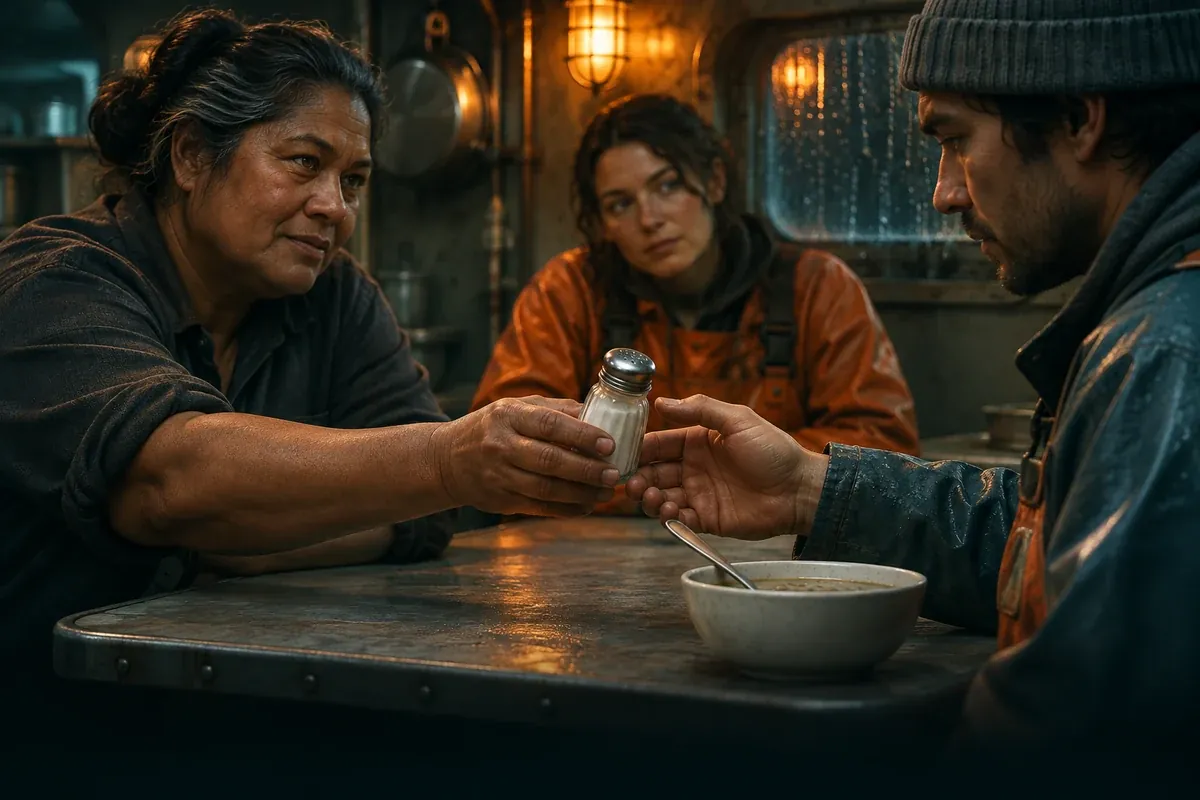
“Teo,” I say. “Would you pass the salt?”
“Sure.” She reaches for the shaker.
“To him,” I say. “To the empty chair.”
The table stops.
Not like before. This is a smaller stop. Sam looks at his bowl. Odd puts his spoon down very slowly. Luz does not move at all, not even her fingers.
Teo looks at me for a moment, and then, without asking a single question, she picks up the salt and holds it out, across the corner of the table, to the man in the grey beanie.
He takes it.
His fingers do not brush hers. He takes the shaker with the care of someone who has been taught not to touch, and he salts his soup, one pinch, two, and sets the shaker down exactly where it was.
It is the most ordinary thing I have ever watched, and a thing in my chest goes cold from the inside.
“Thank you,” I say to Teo.
“You’re welcome,” Teo says, and she turns back to the stove, and the table breathes. I hear it. The crew relax, all at once, the way a line goes slack. Walt picks up his spoon. Luz taps the table twice and lets her hand lie flat.
They are relieved.
That is what I take out of the room with me. Not fear. Relief. I have done something that might have gone badly, and it did not, and they are grateful for it. They have been waiting for a stranger to ask that question for fifty-two seasons. If I had been wrong, if I had been a woman who could see what they could not, they would have known what to do.
They would have had a vote.
I turn the thing over, the way I turn everything. Not a haunting. I have seen hauntings, and a haunting wants. It wants to be known, or forgiven, or fed, and it will scream until you give it the thing, and all of it is a kind of pleading.
This does not plead. It eats soup. It works a full shift. It takes the salt politely. It has a place at the table, and the place is set by a man who has set it, every night, for decades, without ever once asking why.
This is not a haunting. It is a billing cycle.
I put my spoon down. I find that I am looking at him again, and that I have been looking at him for a good while, and that he is looking back.
He has Mac’s brown eyes. He has the tooth. When he breathes in, there is a small sound in his nose that Mac made, a quick dry sniff, the kind you do when you are about to say something and have decided to be careful.
I have not heard that sound in eleven months. I could pick it out of a crowd.
The seventh hand puts down his spoon. He takes the beanie out of his lap and sets it on the table beside the plate, folded once, and his hair underneath is flat and dark and slightly damp, as if he has just come in from the cold. He puts one hand flat on the table. The wrist is thin. I know the scar on the back of it.
I know it because I gave it to him, when he was twelve and I was nine, with a kitchen knife and a bad idea.
He opens his mouth and says, in my brother’s voice, so quietly that no one at the table turns around:
“Eyes up, Dee. You weren’t due until the count.”