

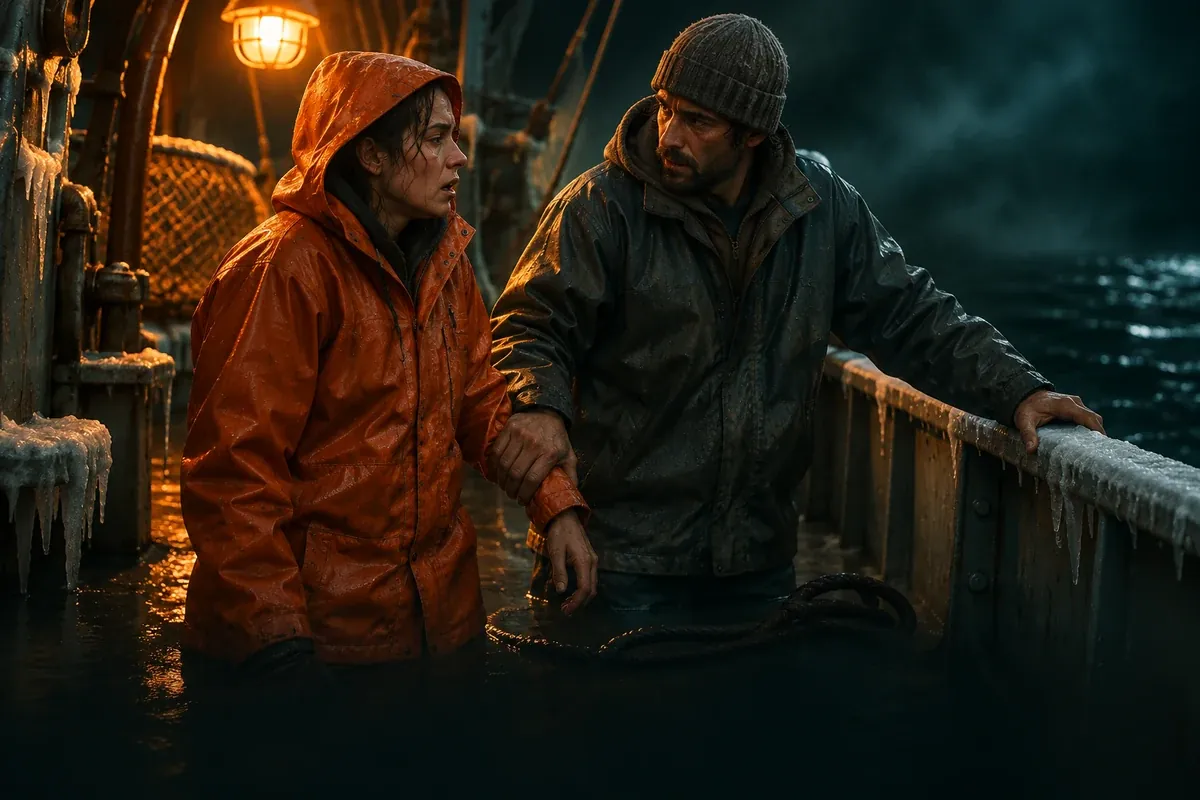
At 1015, on the stern deck, at the second string of the first full day, Odd Halvorsen reaches over and takes a whistle out of Sam Whitlock’s mouth with two black fingers.
He does not do it roughly. He does it the way you take a lit cigarette from a child. Sam was halfway through something tuneless and cheerful, rocking on his heels while the crane swung a pot over the rail, and there is no sound at all for a second but the hydraulics and the scrape of ice.
“Hey,” says Sam. “Respectfully, what is your problem?”
“Not on deck,” Odd says.
“It’s a song.”
“It’s a whistle. You whistle on this boat, you’re calling something. Hum if you have to.” Odd wipes his fingers on his bib and, to prove it, hums four bars of a hymn I almost know, low in his chest, and does not finish it. “That’s allowed. That’s not calling.”
“Calling what?”
Odd looks at him for a long time. He has a long, sad, weathered face, and when he looks at you it is like being weighed by a tired scale.
“Wind,” he says.
I am standing at the sorting table, with a gauge in my right hand and a keeper crab in my left, and I do not believe him. I do not think it is wind. But I write it down in my head anyway, under a heading I have started calling House Rules, because the first thing I learned in my trade is that the small rules are the ones that tell you the shape of the big one.
Rule one. No whistling. Rule two, which I got from Luz on the dock yesterday and did not understand: two taps of the rail with two fingers before any order, so that the boat knows it is being told.
Rule three is Sam, who has no rules, and who has told me his life story in the forty minutes since the last string: a mother in Zanesville, Ohio, a hospital bill of eighteen thousand dollars, a truck that does not run, a cousin who is not speaking to him.
“I’m only here for the money,” he said. “I don’t care about the weird stuff. They told me the weird stuff was part of the experience.”
“Who told you?”
“The captain. He said to me, ‘Son, we do a few things a little different on this boat.’ I said I’m from Ohio, we do things different there too. We put chili on spaghetti.” He grinned. He has a gap between his front teeth and a face like a half-finished sketch. “I think I’m gonna like it here.”
I am looking over his shoulder, at the rail, where the seventh hand is working.
He is wearing the faded blue oilskins and the grey beanie. He is not looking at me. He has not looked at me since the galley, three hours ago, when he said my name. He has not said a word to anyone. He works the pot door with the economy of someone who has done it all his life, hooking, tipping, and the crab pour out onto the table in a living red-brown slide.
I sort. I do it the way I do everything, which is under my breath, and without really meaning to. The crab slides toward me and my fingers sort them and my mouth counts.
“Twelve,” I murmur. “Thirteen. That’s thirteen keepers, and four shorts.”
The deck goes quiet.
This is nothing like the whistling. Every person stops at once, as if a hand had come down and pressed the mute button on the world. The hydraulics are still groaning. The wind is still pushing. But Luz Ballesteros has turned her head, and Odd has frozen with a pot hook half raised, and Sam, who does not know any better, is the only one still moving, shoveling shorts into the chute with a cheerful scrape.
“What?” I say.
“You were counting,” Luz says.
She is not a tall woman. She is thirty-eight and compact and strong, with a long black braid under her watch cap and a face that has been kind to a great many people and has decided not to be kind to me. She taps the rail twice with two fingers and walks across the deck, and I notice that she is walking carefully, as though the steel were thin ice.
“Habit,” I say. “It’s a tic. I do it without noticing.”
“Stop noticing.”
“Luz—”
“Under your breath is aloud, on my deck.” She is close enough that I can smell the cold on her. “You hear me? Not crab, not pots, not minutes. Nothing with a number. The only count we say out loud is blessings at the table, because that’s the one count that’s ours to give. Otherwise you count on paper, and you do it in the head, where no one can hear you, and you do not move your lips.”
“Okay,” I say. “Why?”
She does not answer. She looks, for a quick second, at the seventh hand, and he does not look at her, and then she walks away and lays two fingers on the rail and says, in a tight voice, “Block.”
I look at Odd. He has gone back to his hook.
“It’s in the Articles,” he says, without turning round. “You’ll hear the clause when it comes. Don’t make us hear it from you first.”
“The Articles?”
“Work,” says Odd, and hums four bars, and does not finish.
The pots come up. The deck lights hold their yellow cones against a morning that is already the color of an old bruise. The sea smoke has thinned, and I can see the ice edge to the north, a long white wall under the cloud, and all along it the dark water is flat and thick and slow, like a held breath.
I do not like that metaphor. It is the kind of thing a person writes in a diary. I am a bookkeeper. I will put it in a column.
At 1030, I see the marks.
I have been trying not to look at the water. I have a theory about the things I do not mention, which is that they gather. But Sam has just thrown a short over the side and the chute is running clear, and as it clears I can see, below the line of the hull, on the white slush where the sea meets the steel, something that was not there when we cast off.
Chalk.
That is the only word. Little white strokes, drawn on the ice, each one the length of my hand. They are in groups. Four strokes, and a fifth across them. A gate. Then two single strokes. They run along the waterline in a ring, spaced evenly, and they have no right to be there, because nobody can draw on ice that is moving, and the ice is moving.
A gate and two. That’s seven.
I put the number in my head and I do not move my lips.
“Don’t,” says a voice at my elbow.
It is Teo. She has come on deck with a thermos and a stack of paper cups, wrapped to the eyes in a scarf, and she is not looking at the water either. She has her chin up and her eyes on the sky. She pours me a cup of coffee and puts it in my hand.
“I wasn’t going to say anything.”
“Sure.”
“You’ve seen them.”
“I’ve seen them every year for three seasons,” says Teo. “I have seen them grow, and I have watched them be rubbed out when the boat comes in, and I want you to hear me, honey. They are not a thing you need to know about. Not yet.” She tucks her chin deeper into her scarf. “Drink. It’s hot, and it’s all the comfort you’re getting.”
I hold the cup and do not drink. I do not take gifts from people I am auditing. The cup warms my hands through the paper anyway, which I decide is not the same thing, and it smells of condensed milk and something faintly like cinnamon. I think it is the kindest thing anyone has done to me in eleven months, and I cannot tell whether I am grateful or insulted.
“Teo,” I say, and I keep my voice low, though there is nothing on the deck to hear me but weather. “The man at the table.”
“No.”
“You gave him the salt.”
“I give everyone the salt.” She looks at me then, finally, with her brown eyes huge in the gap of the scarf. “You listen to me. Whatever you saw this morning, it is not the thing to be afraid of. The thing to be afraid of is that you ask, and the boat hears you ask, and you get an answer.”
“From who?”
“From the table,” Teo says. She picks up her thermos. She goes back inside.
I stand there with my coffee.
“You done flirting with the cook?” says Sam, with a shovel. “Because the next pot’s up.”
The tag comes with the seventh pot of the second string.
I am watching for it. I think everyone is. We have been working the string in a silence so total that the clink of the hook sounds like a bell, and when the seventh pot breaks the surface and swings up, streaming, I see it before anyone else does, because I am the one standing at the block with my hand on the lever. It hangs on the bridle, a little brass card, riveted at four corners, turning slowly in the air.
Walt takes it. He is white around the mouth, and he has stopped saying anything for the last hour, and he holds the tag out at arm’s length, squinting, as if reading a menu without his glasses.
“A hand that is counted shall not count itself,” he reads. The number is stamped above the words, and he leaves it off, the way you step around a soft spot in a floor.
Nobody says a word.
I think about it. I do it quietly, in the way I was taught by a woman I once cleared a haunted laundromat with, who said that the first thing to do with a clause is read it twice and ask who it benefits.
A hand that is counted shall not count itself. A hand. A counted hand. In a crew of six, with a seventh at the table, it is a rule about me. Anybody who is part of a count may not be the one who counts. It is a rule that says: the arithmetic of this boat is not yours to do.
That is a hell of a thing to say to a bookkeeper.
“That’s why,” says Odd, very quietly. “That’s why it’s no counting aloud.”
“Was this one on the boat before?” I ask. “Is this in the Articles?”
“It’s always on the boat,” Walt says. “It just doesn’t always come up.” His voice is wrecked. He has a cough he keeps behind his teeth. “Everybody hears me. Nobody counts aloud. That’s the rule, and it has been the rule since before I could walk. Nothing with a number, not the pots, not the crab, not the men. You count on paper, if you have to. You count in your head.”
“Why?”
“Because the sea hears numbers,” Walt says. “That’s all. I don’t know more than that.”
It is a lie. I can hear it. It is not a large lie, and it is not a mean one, but I have spent six years listening to people who tell me the truth with their mouths and the opposite with the rest of their face, and Walt Brannigan is telling me he does not know a thing that he has known for half a century.
“Next pot,” he says.
I take my hand off the lever. I stand there for a minute. I watch the string go down the line, sixteen, seventeen pots, and I do not count them aloud, and I think about what I am.
I am an auditor. I do not take a rule on trust. I do not obey a clause I have not tested, because a clause that cannot be tested is not a clause, it is a superstition, and a superstition is just a contract nobody read. If a hand shall not count itself, I want to know what happens when it does.
I want to know what the penalty is, and what it costs, and who it is paid to.
It is the single worst idea I have ever had. I know that now. I did not know it then, and what I want to put on the record, in the cold plain light of a sorted deck, is that I did not know.
We take a break at 1200, before the third string.
It is five minutes, in the lee of the wheelhouse, and I take it alone. I stand with my back to the door and my hands in my armpits and I look at nothing. In the glass of the wheelhouse door I can see the reflection of the deck behind me, and in the reflection a man in blue oilskins comes around the corner of the winch house and stops three feet away.
I do not turn round.
“You can’t talk,” I say. “You never talk. You said one sentence, and then you went back to eating.”
“Eyes up,” he says.
It is Mac’s voice. It is Mac’s cadence exactly, the rise at the end of the order, the one that tells you the pitch is coming. I turn. He is leaning on the winch house, with his hands in his pockets and one boot crossed over the other. Grey beanie. Brown eyes. The crooked tooth.
“Are you my brother,” I say. I do not make it a question.
“No,” he says. “That’s one.”
I stare at him.
“I’m the seventh hand,” he says. He says it flatly, and then he adds, as if the sentence needs a number to be finished, “That’s seven.”
It is the tic. It is exactly the tic. He ends his sentences with a total, the way Mac did, the way I do, and I feel it go through me like a blade, because he is doing it right. He is doing it better than I do.
“Is he in there?”
“No. Two.”
“Then why does it look like him?”
“It’s the face on the account,” says the seventh hand.
I have a pen in my hand, and I realise I have been writing on the back of my glove with it, in block capitals, ACCOUNT. I look at him. He looks back, and for one second his face does something that is entirely Mac, a little twist of the mouth, something between apology and dare.
“You’re going to ask me a lot of questions,” he says. “I can answer some of them. I can’t lie, in a clause, but I can leave things out. Three.”
“What clause?”
“You haven’t had it yet.”
“Then—”
“Block,” says Luz, from the deck. Two taps on the rail. “String’s up. Greenhorn, you’re on the lever.”
The seventh hand pushes off the winch house and goes back to work, and I stand there, and the wind comes round the corner and takes the warmth out of my chest, and I put the glove in my pocket.
I am going to test the clause.
There are thirty pots on the third string. I know because I asked Luz, in the passage, at a quarter of one, in a voice I thought was casual, and she said, “Thirty. Short string. We’ll set the next one longer,” and looked at me with an expression I did not like.
I take the lever.
The block groans. The line comes up out of the sea, thick and black and streaming. The first pot breaks the surface, and the crane takes it, and swings it over, and sets it on the launcher with a boom that rattles my back teeth.
I open my mouth.
“One,” I say.
Nobody hears me, at first. Sam is humming to himself, a tuneless hum, and Odd is on the hydraulics with his back to me. But Luz hears. I see her head come round. I see her face, at the rail, with two fingers already on the steel.
“Two,” I say. “Three. Four.”
“Dee,” says Luz.
“Five.”
“Stop.”
“Six. Seven. Eight.” My voice is level. I sound, I think, like an accountant reading numbers off a ledger to a very patient client. “That’s eight. Nine, ten, eleven.”
The pots come up. The crab pour out. The crew is moving, but badly, in a sort of trance, and I see Sam turn and look at me with his mouth slightly open, and I see Odd’s hands go to his face, and I see the seventh hand, at the rail, turn his head and look straight at me.
He is not angry. He watches me the way a doctor watches a patient who has just taken the medicine she was told not to.
“Twenty-six. Twenty-seven. Twenty-eight.”
“Dee, stop it—”
“Twenty-nine,” I say, and the line goes slack.
It is the strangest feeling. The block is still turning. The hydraulics are still groaning. But the tension has gone out of the buoy line the way the tension goes out of a rope when a man lets go of the other end, and the thirtieth pot, which should be rising out of the black water with its door streaming, does not rise.
The bridle comes up alone.
It comes out of the sea in a long wet whip, a loop of thick braided line with a steel ring at the end and no pot on it. It comes up fast. It comes up like a thing that has been pulled, from below, by something much stronger than the block, and it flicks across the deck at the height of a man’s ankle, and I see the loop open like a mouth.
Sam is standing in it.
He does not understand. He has a shovel in his hand and his back to the rail, and he is looking at me, and the loop closes around his left boot with a sound like a shot.
“Oh,” he says, in an astonished voice. “Oh, that’s—”
The line takes him.
He goes down on his back, hard, and the line drags him across the deck toward the rail with a scream of wet nylon. He is sliding. The shovel clatters away. He is a nineteen-year-old kid from Zanesville, Ohio, in a thrift-store beanie, and the sea is pulling him toward the gap in the bulwark where the pots go over, and he is not even shouting yet, because he has not caught up.
I move.
I have no plan. I have a boot knife, which Luz made me buy at the Dutch Harbor hardware store the morning we sailed, and which I have been wearing in a sheath on my right calf with a feeling of faint embarrassment. I drop the lever.
I go across the deck on my knees on the wet steel. The bridle is hissing past me, with Sam on the other end of it, and I get one hand on his coat, and with the other I get the knife out and put it against the line, between his boot and the rail, and saw.
The nylon is thick as my wrist. It is under tension that I can feel through my arm, a vibration like a plucked wire, and the blade bites a quarter inch and stops.
“Dee,” Sam says, finally. His voice is high and thin. “Dee, Dee, it’s got my—”
“I know. Hold still.”
“Get it off—”
“Hold still!”
The rail is two yards away. I can see the gap in the bulwark and the black water through it. I saw. The line parts a strand at a time, and each strand that goes makes the rest pull harder, and I feel it begin to take me too, my sleeve caught in a loop of the stuff, my knees skidding on the steel.
The last strand goes with a crack.
The cut end whips back and takes me across the chest. I go over backward. My heels are over nothing, and my shoulder hits the bulwark where the gap is, and I feel the cold come up from the sea like a hand under my back, and I think, quite clearly, that is seven.
A hand closes around my wrist.
It is warm. That is what I will remember, afterward, longer than the fall or the cold or the faces. It is warm, a living warmth, dry and strong and exactly the temperature of someone who has been standing beside a stove, and it hauls me back over the lip of the steel like a bag of laundry and sets me on my feet.
I look up.
The seventh hand is holding my wrist. His other hand is on the rail. He is not out of breath. He looks at me with Mac’s eyes, steadily, for what must be two seconds, and then he opens his hand and lets go and steps back, and I see him look down at his own palm as if it has done something he did not expect.
“Four,” he says, to nobody. “That’s four.”
Behind me, someone is vomiting. Luz is on her knees with her arm around Sam. Odd has shut down the hydraulics and the deck is suddenly, tremendously quiet. The sea slaps at the hull. The cut line lies across the planks in loose black coils, and at the end of it there is a ring, steel, as big as a dinner plate, and on the ring a small brass tag, riveted at four corners, that was not there a minute ago.
Nobody picks it up.
“Is he okay?” I say. My voice is shaking. “Sam. Is he—”
“Foot,” says Luz. She has his boot off. “It’s bruised. It’s not broken. He’s okay, Greenhorn.” She looks up at me, and her face is naked, and I see for the first time what she looks like when she is not in charge. “You counted. I told you.”
“I know.”
“You counted all the way up.”
“I wanted to see,” I say.
“You saw.”
“Mac,” I say. It is out before I think. I am looking at the seventh hand, who has stepped back to the rail, and I say it in a flat, furious voice, because I have been touched and I did not ask to be. “Mac, you could have said.”
“Said what?” he says.
“That it would take him.”
“It would have taken you,” says the seventh hand. “Five.”
I open my mouth.
“Who the hell were you talking to?”
It is Sam. He has propped himself on one elbow on the deck. His face is the color of tallow and his beanie is gone, and he is wheezing, in short whooping breaths, with his mouth open, and he is looking at me with an expression of simple confusion.
“Dee,” he says. “Who’s Mac?”
I look at him.
He is looking past me. His eyes slide over the rail, and the winch, and the place where the seventh hand is standing, a foot from my left shoulder, in his blue oilskins and his grey beanie, six feet one inch tall. They slide over him. They stop. They go down, a long way down, to the height of a shorter man’s face, five foot eight at most, and they flinch, and they come away.
He has seen something. I can see that he has seen something.
It is not what I have seen.