

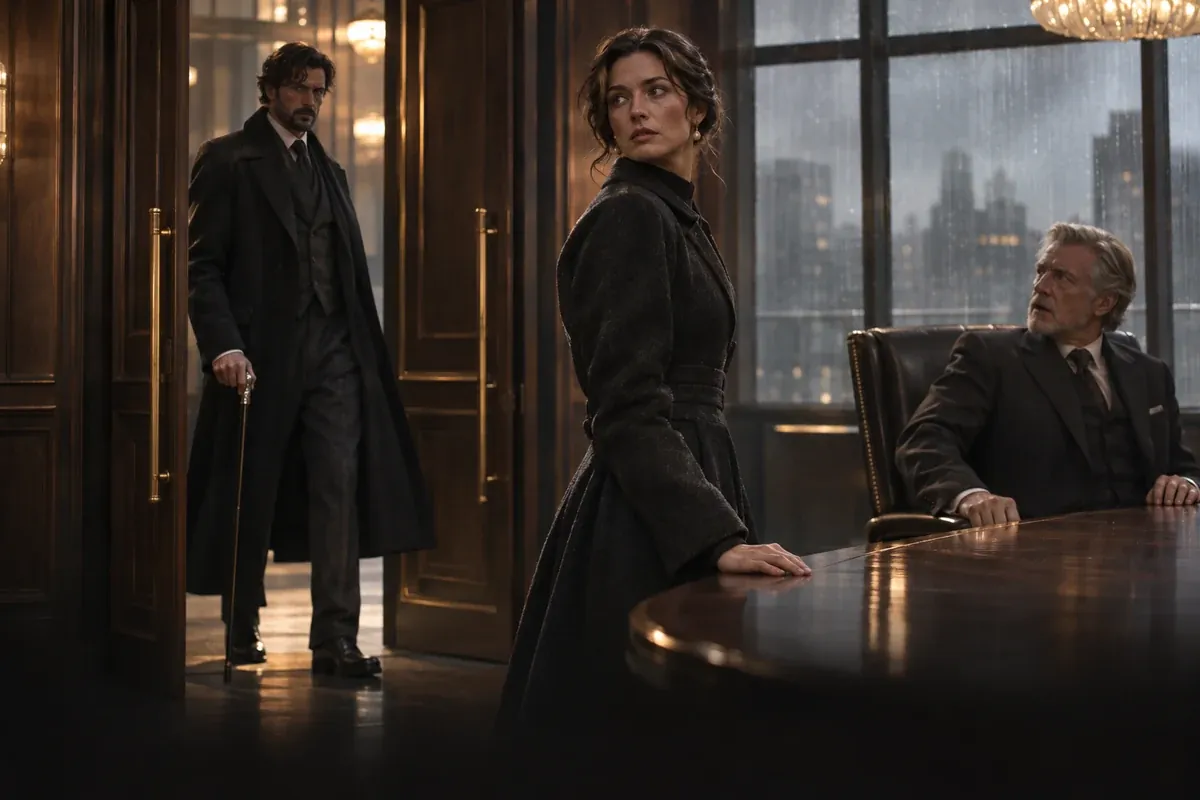
The boardroom of Voss Holdings occupies the thirty-first floor of a glass tower the family has never once called a tower, and it is the most expensive room Lena has ever stood in without being asked to price it.
Long walnut table, twelve chairs, a view of the river like a held breath. Fourteen people around the walnut: the board proper, six directors in the uniform of men who have approved a great many things, plus Grant at the head with Petrie at his elbow and the litigator at his left, plus Odette and Marsh Hale on one side and Beau, glowering, alone on the other, plus a court reporter and a stenographer’s machine that clicks, from time to time, like a very small clock. At the far end, in a seat that has been set apart for her, which is its own kind of insult, sits the widow in charcoal wool, with Ambrose Pruitt at her right, gray-faced, a man holding a briefcase like a life preserver.
It is ten o’clock on Thursday. Lena has slept two hours. She has her kit in her lap, and in her kit, the one thing she’s learned to count on in a room full of liars: documents.
Grant opens with a speech. It is a good speech, which is the worst thing about it. He speaks of stewardship and of fiduciary duty, of his late nephew’s private nature and of the heartbreaking opportunism that attends great fortunes. He speaks of a woman no one in the family had ever met. He holds up the certified page, the signature block, the altered notary seal. “A marriage,” says Grant Voss, “that the records place eleven days after the groom’s death. A marriage that cannot, in law or in nature, have existed. The estate is therefore intestate as to its residue, and falls to the family in the ordinary manner, and I ask this board to so declare.”
Eleven people nod. Lena watches them do it, and thinks: it’s already decided. He’s got the votes. And she has about nine minutes.
“Mrs. Voss,” says the chairman of the board, a silver-haired man named Alderidge who looks like he’d rather be anywhere else, “you’re entitled to respond.”
She stands. It’s a long way up. “Thank you. I’d like to introduce an exhibit.”
The exhibit is a magnifying lamp, a pair of embossed seals, and a very good light. She carries all three down the long table and sets them before Alderidge with the reverence she uses on anything that has outlived other people’s lies. “Every notarial seal in this state is pressed by an embossing tool registered to the notary,” she says. “The tool leaves a signature in the paper: ring width, relief depth, the tiny nick in the die that every tool acquires. Mr. Pruitt obtained the original page from the county clerk this morning. I’d ask the board to compare its seal impression with the one on the page Mr. Voss has submitted.”
She sets the county original on the walnut beside Grant’s copy and angles the lamp so the light rakes across both at a low slant. “In raking light, the original shows a ring of 1.9 millimeters and a nick at the four o’clock position. The submitted page shows a ring of 2.1 and no nick at all. Whoever altered this document did extraordinary work and made one error: they used a better tool than the original. It’s six months newer. The embossing company dates its dies.”
Grant’s litigator is already on his feet. “Objection. The witness is a party in interest, not a qualified examiner — “
“Then the board may retain one,” says Lena, “this afternoon, independent, and I’ll pay. I’d only ask them to look first with their own eyes.”
She hasn’t looked at Grant. She does now. His face has not moved at all, and under the stillness she sees something she can only call grief, bright and furious, the look of a man watching his son’s ghost be dragged into a courtroom.
“Where did the copy come from?” says Alderidge, quietly. “Mr. Voss, the page you submitted. Who made the alteration?”
“It was provided to us,” says Grant, very slowly, “by a family member.”
“Which?”
“Marsh did the legwork,” says Grant, and the room turns.
Marsh Hale has not moved. He’s sitting with his hands folded on the walnut, silver-haired, impeccable, wearing the faintest courteous smile of a man at a chess match where the opponent is playing well. But Odette, beside him, has gone white to the lips, and in the quiet she says, in a voice so low that only the stenographer’s machine hears it all, “Marsh. Look at me.”
He doesn’t.
“I counted the bonds,” says Odette. “For nine years. I’ve known what’s in the vault since before you married me. And last month I found a ledger in my sewing room, my father’s ledger, the one only two people ever read, and it had been moved. Two inches left. I keep it square.” She breathes. “You went to Lisbon in March. And in June. And August. You told me it was for the foundation.”
Marsh Hale unfolds his hands, one at a time, and sets them flat on the table. The courteous smile has not gone. It has simply thinned, as paint thins over a crack. “My dear,” he says, “this is not the venue.”
“It’s exactly the venue,” says Beau, from his end, and his voice shakes but doesn’t break. “I went through the mudroom key cabinet. Somebody took the box truck’s logbook, and somebody took the freight slip, and somebody — Cal’s friend Quill — found the slip anyway. ‘Attention R.F.’ You want to tell this room who R.F. is, Marsh? Because I’ve been wondering for two weeks, and I’m kind of a slow guy, but I got there.”
The boardroom has gone so quiet that Lena can hear the river through the glass.
Marsh Hale looks at Beau, and then at Odette, and then, with a long deliberate turn of the head, at the widow at the end of the table. And what crosses his face then is not fear, and not guilt. It is something older and stranger: a flicker of grudging respect, the look of a man at an auction who has been outbid by someone he had priced at a tenth of the lot.
“I’d hoped,” he says, “to keep the family out of it.”
“Whose family?” says Lena.
“Ask the man who pays me.” His voice is perfectly even. “I only ever did the legwork. Ask Royce.”
It is, she will think later, the only perfectly timed line of the entire morning, because he has barely finished saying it when the double doors at the far end of the boardroom open, and a tall man in a charcoal overcoat steps through, leaning on an antique blackthorn cane.
Every head turns. Nobody breathes.
He is wearing no cap, no drugstore glasses, no stranger’s face. The powder is gone from his temples, and with it a decade of false age. In the cold clear northern light off the river he looks exactly like his photographs, and nothing like them: mobile, ironic, alive, a man with a pulse. He crosses the long carpet at his own pace, and at the head of the table he stops and looks, one by one, at the faces of everyone who spent the last month burying him.
“Good morning,” says Calder Voss. “I understand there’s a motion to void my will.”
Someone’s chair goes over. Odette makes a sound that is not a word and is the most naked thing Lena has ever heard a human being say. Beau stands up, sits down, stands up again. Grant Voss, at the head of the table, with the forged page in his hand, goes the color of paper, and does not speak, and does not look away.
There is a rule in auction houses that when a lot is withdrawn at the last moment, the room does not gasp. It rustles, and then it goes silent, and then it begins, very quietly, to recalculate every bid it ever made. The board of Voss Holdings does exactly that. Six directors in dark suits sit very still, and Lena watches the arithmetic cross their faces one after another: the votes they pledged, the dead man they pledged them against, the living one now standing at the head of their table with a cane and an ironic eyebrow.
In the back row, on the glass side, a figure in architectural black has not moved at all. Simone Adler sits with a leather folio on her knee and her face arranged into an expression Lena has seen on exactly one other face, her own, in a museum elevator, on the last day of a job. The look of a woman revising a very large number. Then Simone’s eyes find Calder’s and something goes through them that has no business on a public relations professional’s face, and she lifts one hand, slowly, and presses the fingertips flat against her own mouth, and holds them there like a woman at a graveside who’s just been told the grave is empty.
“Uncle,” says Calder, gently. “I’m sorry. I’d have told you if I’d been sure.”
“Calder.” Grant’s voice is a thread. “You were — they — I buried — “
“A box of ballast and a wax prop. My apologies for the cost of the flowers.” Calder rests both hands on the cane. “I’d like to contest my own will, Alderidge. Not the clause. The petition. Every word of it. Mr. Pruitt, I believe the board would benefit from the original certificate.”
Pruitt rises on legs that have visibly decided not to. His hands, when he opens the briefcase, are not steady, and Lena sees, without understanding yet, the particular terror of a man with one more thing to say. He lays a document on the walnut, thick cream paper, embossed, gold-sealed. “The marriage certificate, recorded with the Haverleigh County Clerk. It is a true copy, certified this morning, and it bears two signatures and two witnesses.”
“Fourteen months old,” says Grant.
“No.” Pruitt’s voice cracks. “It’s dated five weeks ago.”
The room goes still.
Lena turns her head. Calder has turned his. They look at each other down the length of the table, the widow and the dead man, and what passes between them is not romance and not horror but pure unadorned bafflement, two people who have just heard a verdict nobody told them they were awaiting.
“Mr. Pruitt,” says Calder, very quietly, “what did you file?”
“What you signed.” The old lawyer is nearly in tears. “On the ninth of the month, eight days before the lake, you gave me a packet. A will, a contract, an authorization. Page nine of the authorization was a declaration of marriage before a licensed officiant, signed by you, with the bride’s name left blank, the bride to be named on her signature. I am a licensed officiant in this state, as you know. I’d been one for thirty years.” He swallows.
“When Mrs. Voss signed her contract in my office five weeks ago, in the presence of Mrs. Okonkwo and Mr. Okaro as witnesses, she signed that page also. Page nine. She believed it was an acknowledgment of the cover. I completed the declaration and filed it with the clerk the same afternoon. I did it because I thought the fiction would be torn apart in court. I thought it would be safer if it were true.” He looks at Calder, and his eyes are wet. “I never told you. I assumed you’d read page nine.”
“I read every page,” says Calder, very faintly. “But nine was stapled behind the exhibit list.”
“Yes.”
“You — “ The dead man stops. Starts again. “Ambrose. You married us.”
“I believe I did.”
In the long gold silence that follows, someone, it’s Beau, makes a sound that is half a laugh and half a sob. Alderidge takes off his glasses and rubs the bridge of his nose. The stenographer’s machine, unaccountably, clicks once, and is still.
Lena finds she is standing. She doesn’t remember rising. She is looking at the certificate on the walnut, at her own signature in careful, small, honest ink, and at Calder’s beside it in fast slant. Two names on cream paper. Whatever else is true, whoever Royce Fenn is, whatever the vault and the Lisbon number and the burning garage still have to say, in the plain bureaucratic language of the county of Haverleigh the record is clear.
“Mrs. Voss,” says Calder Voss, and his voice, for once, is not dry at all. “It appears you are my wife.”
“It appears,” says Lena, “I’m going to need a very good lawyer.”
From the head of the table, hoarse, almost inaudible, Grant Voss says what the whole boardroom is thinking, in the exact words of the old cathedral. “The widow is dead.”
“Long live the wife,” says Calder, and offers her his arm.
She takes it. She doesn’t know yet what she’s doing. But on the far side of the glass, in the long light off the river, the sky is the color of a held breath finally let go, and under the walnut, where nobody can see, in the pocket of her charcoal coat, her fingers close around a small folded card with a Lisbon number on it, and she thinks, in the clear cold voice that has never once lied to her: this isn’t the end of the case.
It’s the first page of the inventory.