

The thing about bait, Lena has learned from twelve years of estate sales, is that it only works if you believe in it yourself.
She rehearsed it with Pruitt that morning, in his office with the blinds drawn, the old lawyer pacing between his bookcases like a man at a very small and very dangerous wedding. “A partial liquidation,” he said. “It’s a perfectly sound fiduciary act. No judge alive could object.” He’d stopped.
“Mrs. Voss. It is also, if I may say, a lie.” “It’s bait.” “Bait is a lie with a purpose.” “Then it’s an honest one,” Lena had said, and he had looked at her over his half-moons with something that, in a less careful man, might have been affection, and said, “I shall prepare the auction house letterhead. Haddon & Pryce are old friends. They will not mind lending us their name for a week, so long as nobody actually buys anything.”
So on Tuesday she believes. She calls the family to the long gallery at five o’clock, under the forged Corot, which she has had rehung where everyone can see it, and she stands at the head of the table with a stack of cream-colored auction prospectuses in front of her, and she says, in the voice of a woman who has learned to sell grief at retail, “I’ve decided to proceed with a partial liquidation of the estate.”
The room does something she can only describe as an intake of breath, collective and nearly silent.
“Not the house,” she goes on, steady. “Not the family collection. Mr. Pruitt and I have discussed what Calder would have wanted, and what he’d have wanted is not to leave his estate frozen while the lawyers feed on it. So as residuary legatee I’ve asked Haddon & Pryce, the auction house, to conduct a private sale of the securities and bearer instruments held in the vault beneath the main stair. The 1998 series Voss Holdings bonds. All seven hundred. They go on the block this Friday, with a pre-sale authentication by their specialists on Thursday at noon.”
She hands out the prospectuses like a croupier dealing cards, and lets the next ten seconds do her work.
Lena has spent a month learning to read this family as other people read faces, and what she reads, in that small ceremonial hush, is what she came for.
Grant takes his prospectus in two fingers and does not open it. His eyes go, for the barest instant, to the left, toward Petrie, and then he arranges them back on Lena with a smile as flat and clean as a coin. “Friday,” he says. “That’s very quick.”
Beau picks his up, grins, reads the cover sheet with his lips moving, and says, “Whoa, I’ve never seen the bonds. Can we go look at them?” — an answer so open, so entirely unguarded, that she files it under honest wear before he’s finished the sentence.
Marsh Hale doesn’t look at the document at all. He looks at his wife. A flick of the gray eyes, there and gone, and in that beat Lena sees Odette’s whole face go very, very still.
“Of course,” Odette says, in a voice that has been scrubbed of all its warmth. “Whatever you think is best.”
Then she turns the prospectus face down on the table, squares its corners, and puts a hand flat on top of it as if to keep it from blowing away.
The family disperses in the usual order of fury and civility, and Lena stands in the emptying gallery with the sense of having thrown a stone into a pond and watched the rings go out. She doesn’t have to tell Calder. He’s heard every word through her earpiece, a ghost in the carriage house with a telescope and a stopwatch, and when the last footsteps die in the corridor, his voice comes low and fierce in her ear. “Odette.”
“Odette,” she says. “And Grant checked Petrie. And Hale checked her.”
“The wife’s the one with the vault key.”
“Is she?”
A pause. “I gave a key to Pruitt,” says Calder, slowly. “And my father left a second set with his daughter. Not with me. I’d forgotten. It was a family thing, a joke: the safe-deposit key was a christening gift to my sister.” He exhales. “Stay near the stairs tonight, Lena. And keep your phone on the table.”
She stays near the stairs.
Before that, there is the long, strange afternoon. She walks the house with Mrs. Okonkwo, who has decided, without a word spoken, to be on her side, and who produces from her apron pocket a ring of keys Lena has never seen and says, “Madam may require the east stair after dark. The third step does not creak.” Lena stares at her. “Mr. Calder showed me when he was nine,” says Mrs. Okonkwo, with a face of stone and eyes of water, and goes on to polish the banister.
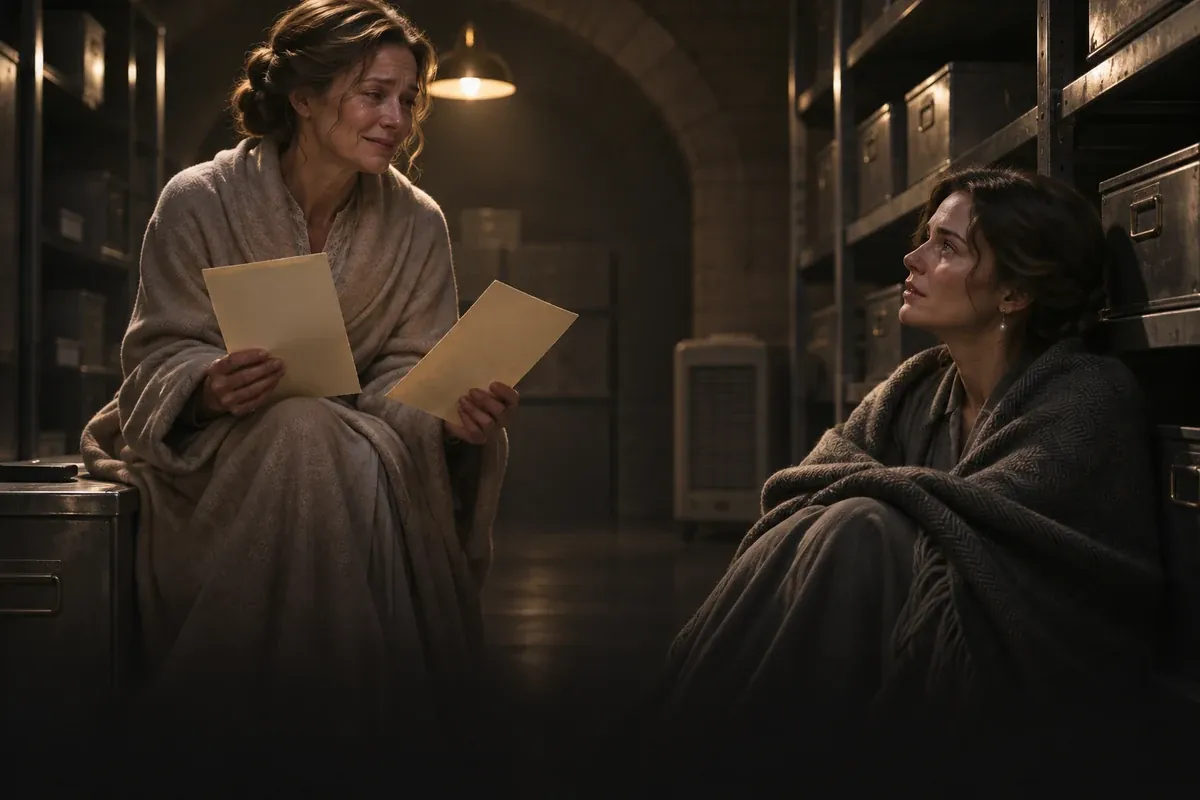
Three a.m. in a great house is a particular and well-defined silence. Lena has spent two nights now learning its register: the tick of a cooling radiator, the long exhale of the north wind in the chimney flues, the distant electric hum of the vault’s dehumidifier like a refrigerator in a house on the edge of the sea. At 2:51 the east door opens. She’s sitting on the third step of the main stair in the dark with a wool blanket around her shoulders and her phone face down on her knee, and she hears it clearly, the door and the careful footfalls, a person who knows the house well enough to walk it without a light.
A small flashlight comes on at the stair’s foot. It illuminates, briefly, a pair of slim bare ankles and a cashmere robe, the hem trailing, and a face turned up toward the vault’s steel door as if toward an altar.
Odette Voss-Hale kneels at the vault’s dial like a woman at confession, and she is crying.
She isn’t doing it quietly, which is what makes Lena stay still. She’s doing it the way you cry when you’ve been practicing not to for a very long time, in great ugly bone-deep gulps, and her fingers, spinning the dial, are shaking so badly she has to start over twice. The door opens with a soft pneumatic sigh. She goes in. A light comes on. And Lena rises, and crosses the dark hall, and stands in the vault door with the blanket around her shoulders, and says, very gently, “Odette.”
The woman at the shelves doesn’t scream. She turns, with a bond in each hand, and the expression on her face is not guilt. It is relief, that same enormous relief Lena saw on Beau’s face in the archive, but older, and worse.
“I thought it would be Grant,” says Odette. “I’ve been so frightened it would be Grant.”
“It’s me.”
“Yes.” She laughs, one wet cracked sound. “Yes, of course it is. You’d be the one to look.”
She doesn’t run. She sits down on a document box, in her good robe, under the dehumidifier’s hum, and holds up the two bonds in the light, and Lena sees, as clearly as she’s ever seen anything, that Odette knows exactly what they are.
“They’re fakes,” Odette says. “You’ve known for days. I could see it on your face at the gala when Grant asked about the Corot, you’ve got a terrible, wonderful face for it, you look at a lie like a dentist looks at a tooth.” She turns the bond so the engraving catches. “I had them made. Nine years ago. I’d like to tell you why, if you’ll sit, and if you’ll let me finish.”
Lena sits. On the vault floor, on the cold steel, with her back against a shelf of forgeries, listening to the woman she has spent a month cataloguing as a possible killer.
“When Father died,” says Odette, “Calder was twenty-nine and drowning in the chairmanship. I was thirty-six and I’d been the one in the family who looked after the paperwork, because I was a girl and Father thought it was a hobby. Three weeks after the funeral I came down here to find the will’s original, and I opened the 1998 box, and the bonds were gone.” She says the last word like a name.
“Not stolen. Sold. Years before. There was a ledger, in Father’s hand. He’d been selling them for a decade, at a discount, to cover — to cover what he did on weekends in Atlantic City. A great deal. A gentleman’s habit, he called it. The vault was empty, Lena. My father, the great Edmund Voss, whom my brother revered, had hollowed out the family’s reserve with a card habit, and Calder would have found it in the first audit.”
“So you had the shelves refilled.”
“With very good paper, from a man in Antwerp, for a great deal of my own money.” The tears have stopped; her voice has gone level, almost clinical, and Lena hears how much it costs. “My brother was twenty-nine and had just buried the only father he’d ever idolized. I decided he could have the idol a little longer. I told myself it was temporary. Nine years.” A smile, brittle. “I come down here once a month and count them. It’s absurd. It’s the only place in this house where nobody asks me to be kind.”
The dehumidifier hums. Somewhere over their heads, in a bedroom, a very dead man’s wife is listening to a half-sister confess to a fraud that was a gift. And somewhere in the earpiece, a hand over a mouth, a breath held, a man hearing for the first time what his sister did for him in a vault under his own stairs.
“The bond Wendell Pike was paid with,” Lena says, carefully. “From the garage. Was that yours?”
Odette’s face loses its color all at once. “What garage?”
“A man upstate was paid with a Voss bearer bond for a job on Calder’s car. Brake work. It came from this vault. You’re the only one with a key who isn’t Pruitt.” She watches the answer. “I don’t think it was you. But somebody knew these were fakes. Somebody took one, knowing it was worthless, and used it to pay for a killing. A joke. A contemptuous little joke. Who else knew what was down here, Odette? Who else did you ever tell?”
The silence stretches until it creaks.
“Father’s ledger,” says Odette finally, very low. “It’s in my sewing room. I never destroyed it. Only one other person ever read it, because there was only one other person in the world my father trusted with his shame.” She looks up. “His oldest friend. The man who kept his books.”
“Royce Fenn.”
Odette’s lips part. She nods. She does not say a word, and in her eyes Lena reads the whole exhausting arithmetic of nine years: the Christmas cards, the Lisbon postmarks, the great kind avuncular voice on the phone. And then Odette begins, softly, helplessly, to cry again, because grief, when it finally has a shape, is the cruelest object in any collection.
Dawn comes on in the high windows like water in a bath. They sit on the vault floor, two women in robes and blankets, and Odette tells her everything she knows: the Lisbon trips Marsh made, three of them since spring, and her own ignorance of what he did there. “I never asked. Isn’t that the sin? I was so grateful not to be asked about my own secret that I never asked about anyone else’s.” Lena doesn’t tell her about the carriage house. It’s the hardest silence of her life, and she keeps it, because there are twelve hours left of her usefulness and she is not yet sure the half-sister is safe.
At seven, the phone on her knee rings.
“Mrs. Voss.” Pruitt, and he’s shaking. “I’ve just received a motion. Hand-delivered to my office at six this morning by a process server. A petition to void the residuary clause of the will on grounds of fraud upon the court, signed by Grant Voss as chairman of the transition committee, with a supporting exhibit.” A breath. “It’s a certified copy of the marriage certificate’s signature page. With the notary seal altered. Whoever made the alteration was very good. It shows a date eleven days after Calder’s death.”
Lena closes her eyes. The vault walls hum around her. A page that makes the marriage a posthumous forgery; a petition built from the exact document Tam Okaro was paid five thousand dollars to copy; and a board meeting, Pruitt adds, hollowly, called for Thursday at ten, with the family’s full votes pledged in advance.
Forty-eight hours.
Across the vault, Odette has risen and gone to the shelves and is quietly, tenderly, with the care of a woman putting flowers on a grave, setting every counterfeit bond back where it belongs.
“The vote,” she says, without turning. “Grant told Marsh last night he had the votes. I thought it was bravado.” She looks back, and in her wrecked, lovely, tired face Lena sees the real condition report at last, the one that had been under all the varnish. “Whatever he planned,” says Odette Voss-Hale, “whatever you are to him, I’d like to be in the room when it’s finished. Put me down for the front row.”