

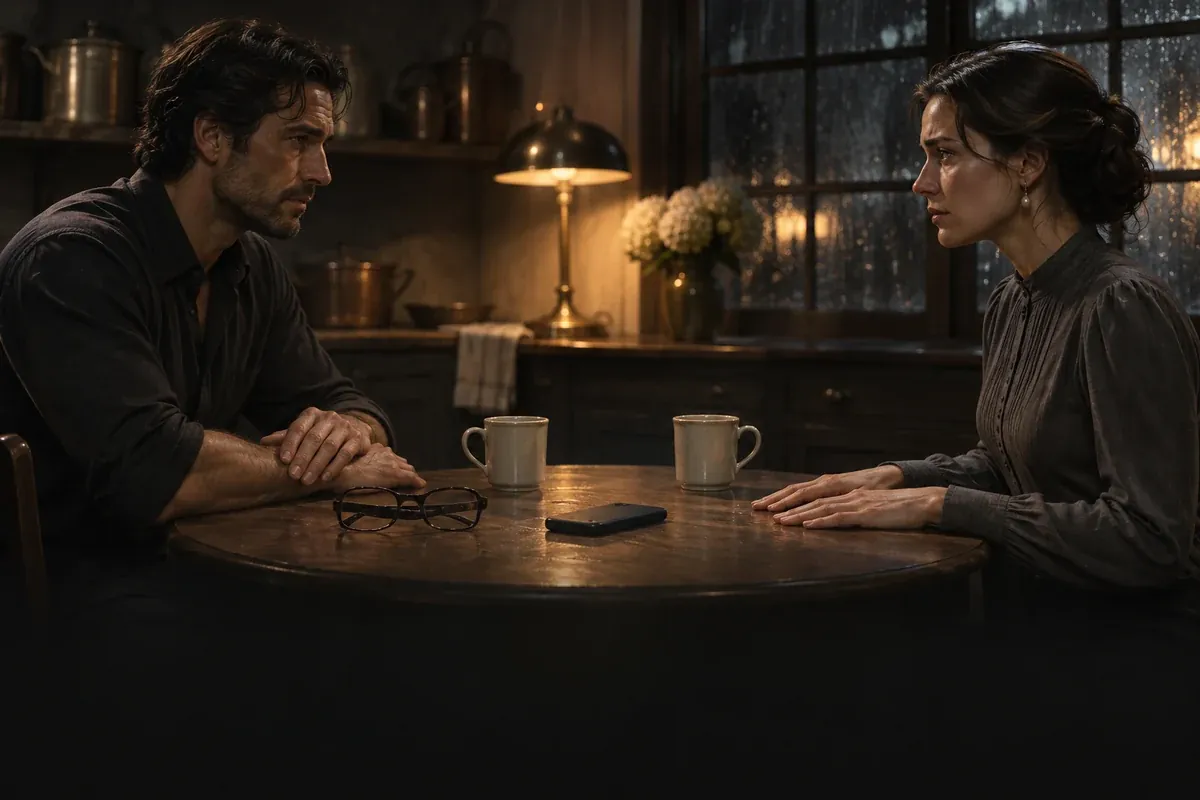
They fight on Sunday, at widow hours, which is somehow worse than a fight at noon. Fights at noon are weather. Fights at nine in the evening in a kitchen that smells of solder and black tea have the intimacy of a thing happening in a locked room.
It begins with the phone. The new one, a clean burner Beau bought for cash at a gas station and delivered in a gym bag, together with two cheeseburgers and an apology for the diner’s coffee, which he hasn’t tasted and is sure was terrible. Lena sets it on the table, switched on, and says, “We need to talk about Meridian.”
“I’ve talked to Pruitt. The beneficial ownership request goes out tomorrow.”
“I mean the call from Denny on Friday.” She has rehearsed this, and the rehearsal evaporates the moment she starts. “A woman came to his shop and offered to buy his franchise rights at thirty percent above what he paid. Cash. She gave him a card. The card said Meridian.”
The silence is the kind that has edges. “On Friday,” says Calder.
“On Friday. Before the loafers. I didn’t tell you.”
“You didn’t tell me.” He says it without volume, as an observation, an item entered on a ledger. “A woman from the firm that bought your brother’s debt visited his shop with a cash offer you suspected was a way to flush the standstill, and you decided I didn’t need to know.”
“It was my brother. I thought I could handle it.”
“We had a rule.”
“We had no rule.” The word comes out hotter than she meant. “We had a verbal contract amendment and a lot of tea. You gave me a clipboard and a grudge and told me to walk through your family. You didn’t give me a rule book, Calder, you gave me a hostage situation with a nice kitchen, and you’ve had my brother’s debt in your pocket the whole time as an incentive, whether you meant to or not.”
He goes still. “I never intended — “
“I know you didn’t. That’s the horror. It doesn’t matter what you intended.” She presses her palms flat to the table to keep them from shaking. “Three weeks ago I was an appraiser. Now every person in your family thinks I’m bought. Grant thinks I’m a gold-digger, Odette thinks I’m a fire alarm, Simone thinks I’m a sleeper agent, and the one person who knows exactly why I’m here is a man who watched me lose my job over a forged Rothko and decided I was a good investment.”
It lands. She watches it land, and sees, a second too late, that it was the exact true thing to say and the exact wrong time to say it.
“I owe you,” says Calder, “a different conversation than the one we’re having.”
“Then have it.”
He’s quiet so long she thinks he won’t. Then he sits, slowly, in the chair across from her, and he takes off the heavy-framed glasses and sets them on the table, a gesture so small and so naked that she feels it in her teeth.
“Three years ago,” he says, “the Driscoll Museum didn’t circulate your memo to its board. It circulated it to me.”
The kitchen goes very far away.
“The Rothko was a gift from a donor foundation whose largest contributor, in a manner I would prefer to describe as complicated, was Voss Holdings. My company’s name was on the wall plaque. When your memo landed, the museum’s director called Pruitt, Pruitt called me, and I did what I’d done for fifteen years when a problem arrived with a rich man’s name on it. I made it quiet.” He doesn’t look away.
“I paid for the Driscoll’s new conservation wing. In exchange the loan was withdrawn, the memo was filed, and the whole affair was handled with the greatest discretion. The restructuring of the registrar’s office was the director’s idea. I was told, in the most civilized terms, that a certain junior employee was a risk. I did not ask her name.”
She can hear the dehumidifier somewhere under the floor, and her own pulse, and the small precise tick of the kitchen clock.
“I didn’t ask your name,” Calder says again, “for almost eighteen months. And then one night I was reading the old memo for the third time, because I’d begun to suspect the Voss collection had its own problems, and I found the signature at the bottom of page four. L. Marsh. Careful, small, no flourish. You’d signed your own death warrant in a font nobody could object to.” A sound that isn’t a laugh. “I thought: that is the only honest person who ever sent me anything. And I’d paid for her silence with a building.”
“You hired me,” she says. Her voice is very thin. “Out of guilt.”
“I hired you because you were the best appraiser I could think of and the only one I knew I couldn’t buy. The guilt was how I could stand to ask.” He folds his hands, left over right, the posture Odette had noticed, and she realizes he’s holding himself still, the way you hold a bone you’re afraid will move. “The five hundred thousand was never a fee, Lena. It was an invoice. Overdue. Three years and change. I’ve been trying to pay it since the day Pruitt called you.”
For a long time neither of them speaks. When she finally does, it isn’t what she’d planned.
“That’s the most expensive thing anyone’s ever told me,” she says. “And the first one I believe.”
“I’m sorry.”
“I know. It’ll be worth more than I can say, and you’re right, I’m not going to take it tonight.” She breathes. “But new rule. You asked for a stress test of your family. I’m calling a stress test on us. Everything, from now, in the open. No omissions, no plans I find out about by being inside them. If I’m going to be your widow in public, I’m going to be your partner in private, or I’m walking out of this carriage house with the best forged Corot in the county.”
For the first time since she’s known him, Calder Voss looks young. Not the polished age of the photographs. Young, and astonished, and visibly braced for a worse sentence than the one he got.
“Agreed,” he says. “Full disclosure.” A beat. “You’d really leave with the Corot?”
“It’s hanging in my bedroom. I’ve grown attached.”
The smile, when it arrives, is brief and shaky and the best thing she’s seen all week.
The carriage house is very quiet when the argument is over. He walks her to the door, which is thirty feet, and stops at the pegboard. “Lift, then pull,” he says. “It sticks.” “I know. I’ve been through it fifty times.” “I know you have.” Neither of them moves to lift it. Behind the pegboard the night waits with all its machinery of little sounds. “Go to bed, Lena,” says Calder, not unkindly, and she does, because she is a woman who finishes what she’s started, and what she started tonight, she suspects, has no end she can price.
She doesn’t sleep. At one in the morning she stands in the bedroom of the main house, under the forged Corot, in an old museum T-shirt, with her notebook open on the bureau and a pen that has gone cold in her hand. She is trying to write a condition report. It’s what she does when a thing is too large to hold: she lists it.
Subject: Calder A. Voss, 38. Provenance: documented, thoroughly; some gaps. Attribution: genuine. Condition: structurally sound, surface wear consistent with age. Previous restoration: extensive, concealed, visible at the left hand. Flaws: counts everything, thanks no one, pays his debts in buildings. Not a flaw, noted for completeness: held the carriage house door open for her tonight and pretended he hadn’t.
She looks at the last line a long time. Then she tears the page out, folds it small, and puts it in the pocket of her kit with the anonymous note and the yellow slip, with the evidence, because that is where she keeps the things she cannot yet explain. In the morning she will not mention it, and neither, she suspects, will the house.
Pruitt calls Monday morning. He sounds like a man who hasn’t slept and has been relieved of the privilege of lying. Tam Okaro is in a unit at Haverleigh Self-Storage, aisle D, number 41, rented under his mother’s name; a neighbor of his mother’s saw him loading boxes at dawn and mentioned it to the woman at the pharmacy, who happens to be a client of Pruitt’s old secretary. “It’s an absurd chain of custody,” Pruitt says. “Mrs. Voss, I cannot go. If I’m seen, the box goes into a fire. I would be grateful if you and Mr. — if you and Mr. Quill would handle it with discretion.”
“Pruitt.”
“Yes?”
“The burner phones. The first ones. Did you buy them yourself?”
A long silence. “No,” Pruitt says, finally, in a smaller voice. “Tam did. I asked him to pick up two prepaid devices for you. I never touched them.” A breath. “I understand now why you’re asking.”
They find Tam Okaro in a self-storage unit the size of a closet, sitting on an overturned crate between a stack of banker’s boxes and a camp lantern, eating cold lo mein from a carton with the hollow concentration of a man who has been awake for three days. He is twenty-four, narrow, spectacled, with the particular pallor of a clerk who has been crying for three days in a manner he hopes nobody noticed. When the door rolls up he does not run. He does not even stand. He looks at Lena and Calder, the widow and the man in the cap, and says, very calmly, “You can have the box. I’d like to say I’m sorry before anyone calls anybody.”
“Say it,” Calder says.
“I copied the signature page.” Tam sets the carton down, with enormous care, as if it were evidence. “Mr. Hale asked me to. He came by the office in March, on some pretext, a trust matter, and said Mr. Pruitt had a hold on a certain document, and that if it were ever to be challenged in court the family would want a reference copy. He said it was protective. He said Mr. Voss would’ve wanted it.” His glasses have fogged; he doesn’t wipe them. “He gave me five thousand dollars. I told myself it was a retainer for outside work. I used it to pay my mother’s hospital bills.”
“March,” says Lena. “That’s before the will. Before Calder wrote the clause. Before there was a widow.”
Tam looks up, bewildered. “No — no, it was last week. Last Tuesday. After the funeral.”
“You said March.”
“I said — “ Tam stops. His face goes slowly, thoroughly white. “He asked me twice. In March, about the trust file. And last Tuesday about the certificate. I didn’t think — I thought they were the same thing.” He looks at her with the plain wretchedness of a young man who has just understood the shape of his own mistake. “He asked me in March to put two prepaid phones into Mr. Pruitt’s supply drawer. Ahead of time. For when they’d be needed. I thought it was a surprise gift for someone.”
Lena looks at Calder. Calder is looking at the boxes, his face unreadable, hands very still.
“Hale knew in March,” he says, quietly, “that I’d need a pair of untraceable phones.”
“Which means Hale knew in March that you’d be dead by autumn,” says Lena. “That’s not a man who copied a signature page. That’s a man who was setting up the board.”
“One more thing.” Tam fumbles in his jacket pocket with shaking fingers and pulls out a folded card, the cheap kind used by call shops. “He told me, if it ever went wrong, if I was caught, I was supposed to call this number. A man called R. He said R would take care of my family.” His voice breaks. “I don’t — I don’t know what that means. It’s a Lisbon number. The country code’s three-five-one.”
Lena takes the card. It’s printed with a phone number and nothing else, no name, no logo, the kind of anonymity that costs money. In her other hand, in her coat pocket, the yellow transfer slip from the Greywater box truck, ATTN: R.F., rides against her fingers like a small hot coal.
She holds the two pieces of paper up together in the light of the camp lantern, the yellow slip and the white card, and they say the same thing in two different alphabets.
Behind her, very softly, Calder says: “Royce.”
“Who’s Royce?” Tam whispers.
“Royce Fenn,” says the dead man, in a voice she’s never heard from him, nine years of old trust turning in it like a key in a bad lock. “Voss Holdings’ first chief financial officer. My father’s best friend. He retired to Lisbon the year my father died, with a plaque and a pension and a speech in which he said the company would always be a family. I was his godson. I sent him a card every Christmas.”
He turns the Lisbon number over in his fingers, and his hand, she sees, is shaking, very slightly, for the first time.
“He taught me to count,” says Calder Voss. “I used to think it was the kindest thing anyone ever did for me.”